


On Monday afternoon, more than a hundred people, including many of San Francisco’s top officials, lined the steps of Lincoln High School behind Alan Wong. They were there to see Mayor Daniel Lurie swear in Wong as his handpicked, appointed supervisor representing District Four in the Sunset.
Wong may not have been Lurie’s first choice for the role, but that’s under-the-table payroll and dead animals in the freezer by now. The event, captured by television news cameras and local reporters, was crafted to give an imprimatur of credibility, and erase the weeks of scandals that hung over D4.
One person who Wong had asked to be there but didn’t show up was Barry Hermanson. A 35-year resident of the Sunset, Hermanson is a political activist and leader in San Francisco’s Green Party.
Hermanson first met Wong when the newly anointed supervisor worked as a legislative aide to former D4 Supervisor Gordon Mar starting in 2019. Working for Mar meant an alignment with labor unions fighting for better wages and working conditions for working people, Hermanson told me. Standing in support of Wong at the ceremony, Hermanson felt, would represent a betrayal of his hard-fought principles.
Hermanson said he’s been disappointed to see Wong abandon progressive causes as his political aspirations have grown, especially after left-leaning activists helped him win a seat on the City College Board of Trustees in 2020. To Hermanson, Wong’s latest, and most alarming, shift was his willingness to vote in favor of Lurie’s so-called family zoning plan to allow for taller, denser residential construction. Despite deep opposition to the plan from some of the district’s loudest political voices, about 24 hours after Wong was sworn in Monday, he voted in favor of it, helping to deliver a big legislative victory for Lurie.
To Hermanson, Wong voted himself out of office on his very first day.
“I said, ‘Come on, if you aren’t going to stand up for the community, I’m certainly not going to stand behind you again,’” Hermanson told me he said to Wong. “I told him that his political career is going to be over in six months.”
“I’ve always been able to work with everybody, and some people don’t get that, it baffles them,” Wong told me in his new City Hall office the next day when I relayed the criticism. “I’m not a litmus-test person, where if you disagree with me on one thing, you’re forever on the other side.”
At the swearing-in ceremony, Lurie touted Wong’s commitment to the mayor’s tough-on-crime agenda, pointing to his role as a board member at Stop Crime SF from 2019 to 2020. Sandra Lee Fewer, a former District 1 supervisor and public school board member, said Wong’s work at Stop Crime SF, a group that received funding from some of the same wealthy donors who drove the recall of Chesa Boudin, is “inconsistent” with his work for Mar, a stalwart progressive.
Fewer pointed to the group’s practice of putting “watchers” in courtrooms to call out judges it views as too lenient being squarely at odds with Mar’s view of criminal justice. Wong’s involvement in the group highlights his tangled alliances in another way: At the time Wong served on Stop Crime SF’s board, its executive director was Joel Engardio, who in 2022 defeated Mar, his onetime mentor, for supervisor, and whose recall in September created an opening in the job Wong now holds.
Fewer, who is Chinese-American, said that Wong’s easy support for Lurie’s zoning plan, without having first heard the objections of his Chinese-American constituents, could prove costly. The community was active in Engardio’s recall, which was partly based on his unbending support for transforming the Great Highway into Sunset Dunes park. For that group in particular, Fewer said, the rezoning fight is “a really big issue for them.”
Chinese-American voters in the Sunset want an “independent minded” representative, Fewer said. “They want someone who is going to fight for their district, even if it means fighting City Hall.”
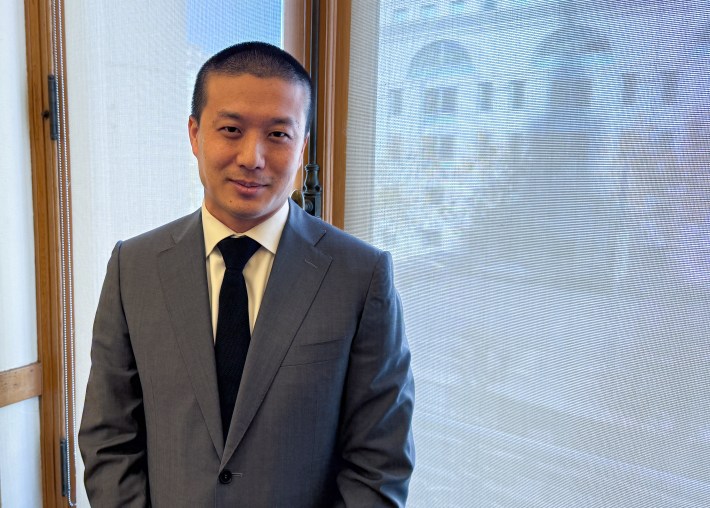
I called Wong’s office late Tuesday to get his response to the criticism. I received a text message at 2:45 a.m. Wednesday morning asking if I could meet with the Supervisor in person later that day. When I met with Wong at City Hall, the day after he voted for Lurie’s rezoning plan, the supervisor’s name was already stenciled on the glass door of his new office. Wong hasn’t moved in yet; the walls and desks are still bare. Slim, and younger-looking than his 38 years, Wong was relaxed and listened carefully as he held his hands together in his lap.
My first question was whether the new job, and the attention, felt overwhelming or unreal? Instead of answering that softball — the journalistic equivalent of asking someone about the traffic on the way to a lunch — Wong launched into a politician’s biographical recitation, much of which I’d already heard at his swearing-in ceremony. His parents immigrated from Hong Kong, Wong was born and raised in the Sunset. He made a point of saying that his dad supported his family as a unionized hotel cook at the Grand Hyatt on Stockton Street.
Wong graduated from UC San Diego, earned a master’s degree in public affairs from the University of San Francisco, and has served in the Army National Guard for 16 years. He told me that he can pass as fluent in spoken Cantonese, but is missing some advanced vocabulary. He can’t read or write the language, though he grew up speaking Chinese and watching Chinese television.
Wong takes pride in his role as a legislative aide to Mar, including the effort to extend free tuition at City College of San Francisco, where Wong went on to serve as board president. Wong’s critics point to his support for California Assembly member Catherine Stefani, who in 2018 cast the lone vote against putting free tuition on the ballot. The move contributed to Wong reportedly losing the support of AFT Local 2121, the union representing teachers at CCSF.
When I asked Wong about the loss of support, he grew defensive.
“They’ve never said they don’t support me,” Wong told me. “I haven’t run in an election where they’ve not endorsed me so far, so I cannot predict the future. Whether they endorse me or not, I don’t know what they’ll do. I’ll be seeking everybody’s support, as I always do.” (The union didn’t respond to a request for comment.)
Rezoning is the one issue on which Wong’s “work with everyone” approach may not work. As the plan advances, there will be clear winners and losers, and Wong will not be able to stand with both sides.
The fear among some Sunset families who have spent decades there is that their homes will be demolished for taller, higher-priced housing. They’re worried about being able to remain in the city in the long term. Renters are worried about the destruction of rent-controlled units. Many residents are likely to seek recourse through lawsuits.
Wong told me he’s lived in in-law units all his life, “living in little spaces behind garages.” Like many of his constituents, he laments the multi-million price tag on homes in the Sunset that he can’t afford. He said he’s committed to making sure working families are heard.
Hours before he cast his vote Tuesday, representatives from the Planning Department met with him at the same table we were sitting at, and told him that once Lurie’s plan was passed, the city could “subtract things, some from some places, so long as you add it elsewhere, so that we don’t alter the 36,000 number.” He was referring to the number of new units the plan requires.
“I’m here for that,” he said.
The rezoning, Wong explained, is the city’s chance to decide its fate “rather than Sacramento coming in and dictating to us.” Here, he was clearly parroting a line Lurie has used.
According to Hermanson, the plan that Wong voted for envisions too much market-rate housing designed for wealthy residents. Hermanson thinks that Wong is blindly supporting the mayor without considering other ways forward, including an amendment offered by Supervisor Connie Chan to exempt all rent-controlled units from demolition. (That proposal failed; a more modest amendment to exempt buildings with three or more rent-controlled units passed).
“I understand the argument,” Wong said when I shared the criticism. “That’s not something I’m going to try to respond to or counter.”
He added that his previous views on representing his constituents “speak for themselves.”
As Wong’s term as supervisor begins, his votes will also speak for themselves.