

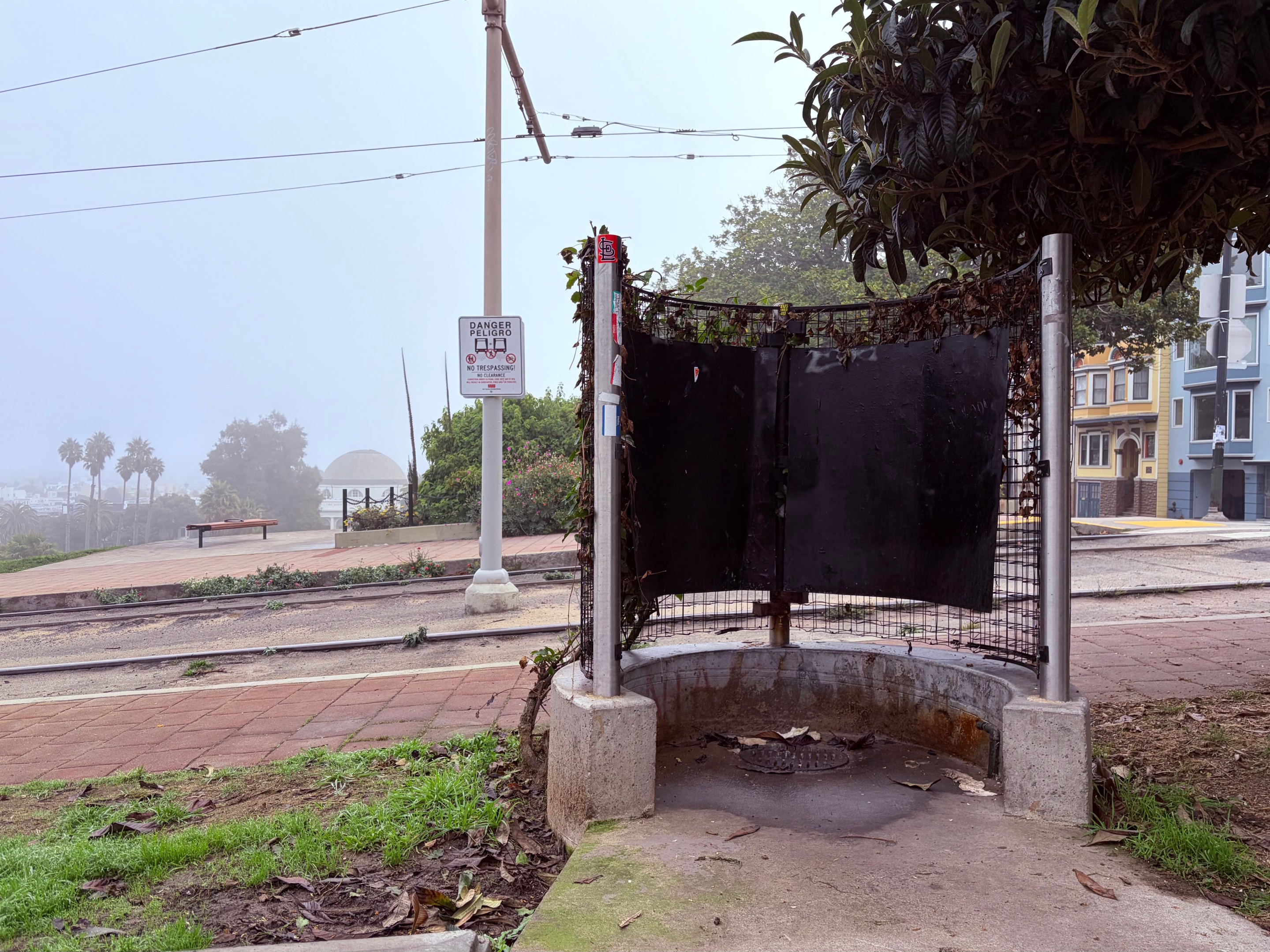

It stands at the top of the hill at Dolores Park, an austere hunk of concrete and black steel that resembles a vestige of Brutalist architecture. The structure, which looks like a cylinder wide enough for one person, is unadorned save for a string of ivy and dead leaves from the loquat tree that shades it. More leaves and detritus collect in the large drain on the ground, pooling rainwater around it.
There is no sign explaining what this structure is. It does not invite the uninitiated, but to those seeking relief, it is an ideal place to urinate. Why would anyone think they could pee along a busy sidewalk, right along the Muni tracks, visible from the waist-up to everyone in the park?
For those in the know, however, the pissoir is a practical — and, daresay, ingenious — bit of urbanism, a small yet heroic bulwark in the city’s fight against piss and poop. Christened in 2016, it’s still going strong. The controversy of its birth may have washed away with time, but the piss flows on.
This unmarked monument to fast relief is also a tribute to Representative-elect Scott Wiener’s political savvy.
Wiener floated the idea for a pissoir in 2012 while considering the problems of the old, overcrowded bathroom in Dolores Park, which featured just three toilets and lengthy lines amid growing numbers of visitors. Wiener’s plan explicitly acknowledged that the pissoir would be especially helpful for the disproportionately male crowd at “Gay Beach” at the top of Dolores Park. The open-air urinal would be in the style of a “Parisian-style pissoir,” as the Bay Guardian described it in 2014. (Paris’ pissoirs, sadly, are now defunct.)
Meanwhile, residents’ concerns about pee running rampant on SF sidewalks continued to grow. In 2015, under Mayor Ed Lee, the city launched a pilot program that covered about 30 walls in the Mission, SoMa, and Tenderloin with a “pee-proof” paint layer designed to discourage public urination by splashing the stream back at the perpetrator. It is unclear how many shoes and shins were speckled with piss due to this preventative measure, nor how many people simply moved to another unpainted wall to relieve themselves.
The following year, Wiener’s pissoir came to fruition near Church and 20th streets. Its approval took “at least 50 community meetings,” according to Wiener, which seems like a lot of time for a supervisor to spend debating a piss hole. It was the cherry on top of a $20 million renovation of the park, which wrapped in January 2016 and added two new restrooms with a total of 27 toilets. Ironically, the toilet expansion meant the pissoir was needed less than ever; nonetheless, the novel urinal had finally arrived.
(Wiener, who is traveling to and from DC as he gears up for Congress, was not able to comment by press time.)
Not everyone was thrilled about the notion of the city encouraging peeing in an open-air nook. The San Francisco Chinese Christian Union and the conservative law firm Pacific Justice Institute came together to sue the city in April 2016, claiming that the pissoir violated the civil rights of women, people with disabilities, and anyone else who could suffer the “shame and degradation” of urinating in public.
Ultimately, the lawsuit fell apart when a judge ruled against the plaintiffs, and the pissoir stayed. Rec and Parks continues to clean and maintain it, department spokesperson Tamara Aparton told Gazetteer SF, and observed that the public urinal gets “plenty of use.”
“On a nice weekend, there’s often a line!” Aparton said. (I can confirm this.)
Despite the controversies, ten years after it was installed, the pissoir has blended into the park. Rec and Parks crews check it daily to remove debris and address graffiti, Aparton said. In addition, the pissoir has an automatic flushing system that operates hourly when the park is open.
“When it first opened, there were some privacy concerns because people getting off the J Church [Muni line] had a pretty clear view. We installed more robust privacy screening, which addressed the issue, and we rarely receive complaints these days,” Aparton said.
On a recent sunny weekend afternoon, I spoke with two people passing by the pissoir, curious what they made of it. Melanie Han, a visitor from Burlingame, was unaware of the urinal and reflexively scrunched her face when I pointed it out. Han, 24, said that the pissoir’s utility makes sense, even if it’s “hilarious” to stroll past someone “with their dick out on the sidewalk.”
“I think it’s fine that it exists, but I do think it’s obviously so boy-coded,” Han continued. “Like, a woman is never going to be able to use that. We can just go to the bathrooms in the actual park, but I think it says something about who gets to urinate publicly and who doesn’t.”
(In 2012, the Bay Guardian asked Wiener about that and the then-Supervisor told the paper that women could possibly use the pissoir “but I don’t really I know… I’m not an expert on female urination.”)
Later, I chatted up Matthew Gonzalez, a 32-year-old resident of the Mission. Gonzalez described the pissoir as “so San Francisco” and called it a cult icon — a true “if-you-know-you-know” part of the city’s landscape.
“I think I’ve used it once in the middle of night after a lot of drinks. It’s like, a major improvement over what a lot of guys would do, which is just piss on the side of an apartment building or in an alley somewhere without a second thought. But we gotta admit that the pissoir or whatever kinda looks like shit. I imagine that it’s super confusing for a tourist,” Gonzalez said with a laugh.
As Wiener heads to DC in 2027, the fact his pissoir remains in use should stand as a reminder of his ability to get shit — okay, piss — done in San Francisco. While it shouldn’t be at the top of his resume, the pissoir is the perfect embodiment of SF in the 21st century: functional and a little ridiculous, melding grimy vibes with a common-sense urbanism. It is a distillation of the Castro and Mission’s anything-goes history, and a counterpunch to their rapidly gentrifying present. As the city gets more expensive and challenging to live in, the pissoir is a rare and generous fixture in the landscape.
“The more options we can give [people] to relieve themselves, the better for the parkgoers,” Wiener told the Associated Press in 2016. “The better it is for neighbors.”
As it turns out, that kind of pragmatism can take a person far.