

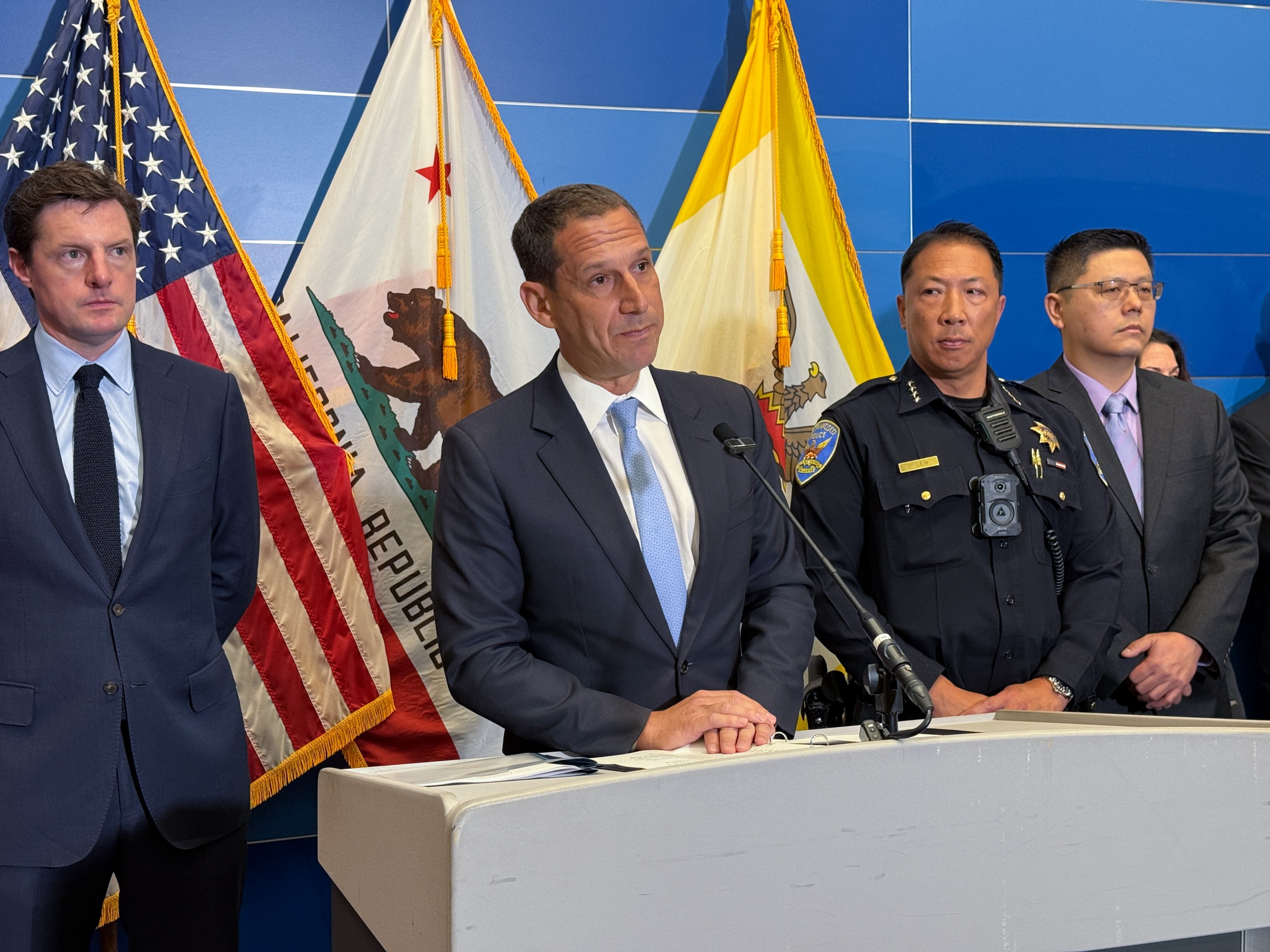
At about 1 p.m. Monday, Sept. 14, San Francisco Mayor Daniel Lurie took to the podium at San Francisco police headquarters in Mission Bay for a press conference about what the invited media had been told was a “public health and safety” announcement.
Lurie began by telling reporters about Dante Lacourte, a 16-year-old from Lower Nob Hill who died of an overdose in April. The city’s medical examiner detected a drug called cychlorphine in the teenager’s blood, Lurie said, describing the narcotic as “a new synthetic opioid, even more powerful than fentanyl.”
Every reporter in the room likely already knew about Lacourte, having probably read about it in an article by Heather Knight that ran in the New York Times eleven hours earlier. If the assembled reporters hadn’t read the story, which featured intimate, painful scenes of Lacourte’s mother Christina finding her son “turning blue” as black fluid “oozed out of his nose and mouth,” the mayor made sure to plug it: “I want to take a moment, and just acknowledge the article in this morning’s New York Times that Heather Knight wrote,” Lurie told the crowd.
During the press conference, Lurie alluded to arrests and a criminal case stemming from Lacourte’s death. He thanked Police Chief Derrick Lew, and District Attorney Brooke Jenkins, both of whom filled in details of the investigation, and the prosecution, after the mayor spoke.
Lurie’s recognition of the Times and Knight was notable, and not just because the mayor has previously singled out the reporter’s coverage at other press conferences. The timing of the press conference following so closely behind the Times story hardly seemed coincidental. It gave the impression that the mayor’s office had coordinated with the Times, and perhaps planned its announcement around the paper’s scoop.
Cementing that impression was the fact that the four arrests described by Chief Lew were publicly described in detail for the first time in the Times story, long before anyone else had access to the information. The rest of the press dutifully published the details of the arrests; the San Francisco Chronicle linked to the Times story for readers who wanted to learn the grim, and tragic, details of Lacourte’s death.
Asked if she worked in coordination with the city to produce her story, Knight declined to comment. In an email, she referred Gazetteer SF to Charlie Stadtlander, a spokesperson for the Times who sent a statement that reads: “The New York Times produced our article independently through months of dogged reporting, writing and publishing it on our own editorial timeline.”
Leah McLean, the court-appointed lawyer representing Leander Pitts, one of the four people arrested in the criminal case who was named in the Times story and by Police Chief Lew at the press conference, said the timing of Knight’s story in the Times and the press conference appeared to be “highly coordinated.” McLean was surprised by the flood of attention from various media sources suddenly focused on cychlorphine and the criminal case against her client.
McLean also said that the media frenzy tying Lacourte’s death to Pitts and the other defendants has potentially jeopardized her client’s right to a fair trial, as it risks compromising the impartiality of potential jurors.
A parent of four kids, two of them teenagers, McLean said she, too, felt the “devastating” loss of Lacourte’s life. She said she appreciates the mayor’s eagerness to be seen as getting out in front of the threat posed by cychlorphine, but questioned blasting the public health alarm, perhaps prematurely.
“We have to make sure we’re not conflating our feelings about a devastating loss with preserving constitutional rights for the accused,” McLean said. “So when you release names like that, you really can, in many ways, poison the jury pool.”
Asked about Lurie’s nod to the Times reporter, and whether his office may have coordinated with the newspaper, the mayor’s spokesman, Charles Lutvak, said the mayor’s comments at the press conference reflect his appreciation of journalism.
“I’m surprised, actually, that you wouldn’t appreciate someone who’s acknowledging a reporter doing work that raises issues to the attention of officials who are responsible for making decisions about public policy,” Lutvak said. “I think he read the story, and he thought it was powerful, and so he acknowledged the person who did the reporting.”
The mayor’s respect for journalism, however laudable, didn’t answer the question of whether the city coordinated with the Times or planned the mayor’s announcement to amplify Knight’s work.
“Well, you would need to ask the police department,” Lutvak told me. “That was their announcement.” I pressed him again, arguing that if Lurie spoke publicly, the mayor, or Lutvak himself, must know if the Times story was a factor in deciding whether and when to discuss the arrests.
“I’m just telling you, that if you want to ask the people who are making the announcement, then you would need to ask the police department,” Lutvak repeated.
Evan Sernoffsky, a spokesman for the SFPD, emailed a response to detailed questions by Gazetteer: “We scheduled our press conference shortly after seizing over 20,000 counterfeit pills to warn the public about a new and dangerous drug in our community.”
Sernoffsky didn’t respond to follow-up questions about coordination with any news outlet and McLean’s concerns.
District Attorney Brooke Jenkins’ office said it doesn’t announce charges, or determine their timing, based on news coverage, her office said in an email. “In this case, our office had no communication or coordination with The New York Times prior to the announcement,” the office said in an unsigned statement.
Jenkins’ office said McLean’s “speculation” that her client’s right to a fair trial might have been jeopardized is “not supported by what was actually said at the press conference.”
Asked in a follow-up email about McLean’s concerns, Lutvak, Lurie’s spokesman, said the mayor’s goal is to alert the city to a “dangerous new drug on the street, so we can save lives and continue driving down the number of people who die from overdoses every year.”
Editor’s note: The story has been updated to add a response from Charles Lutvak, a spokesperson for Mayor Daniel Lurie.