
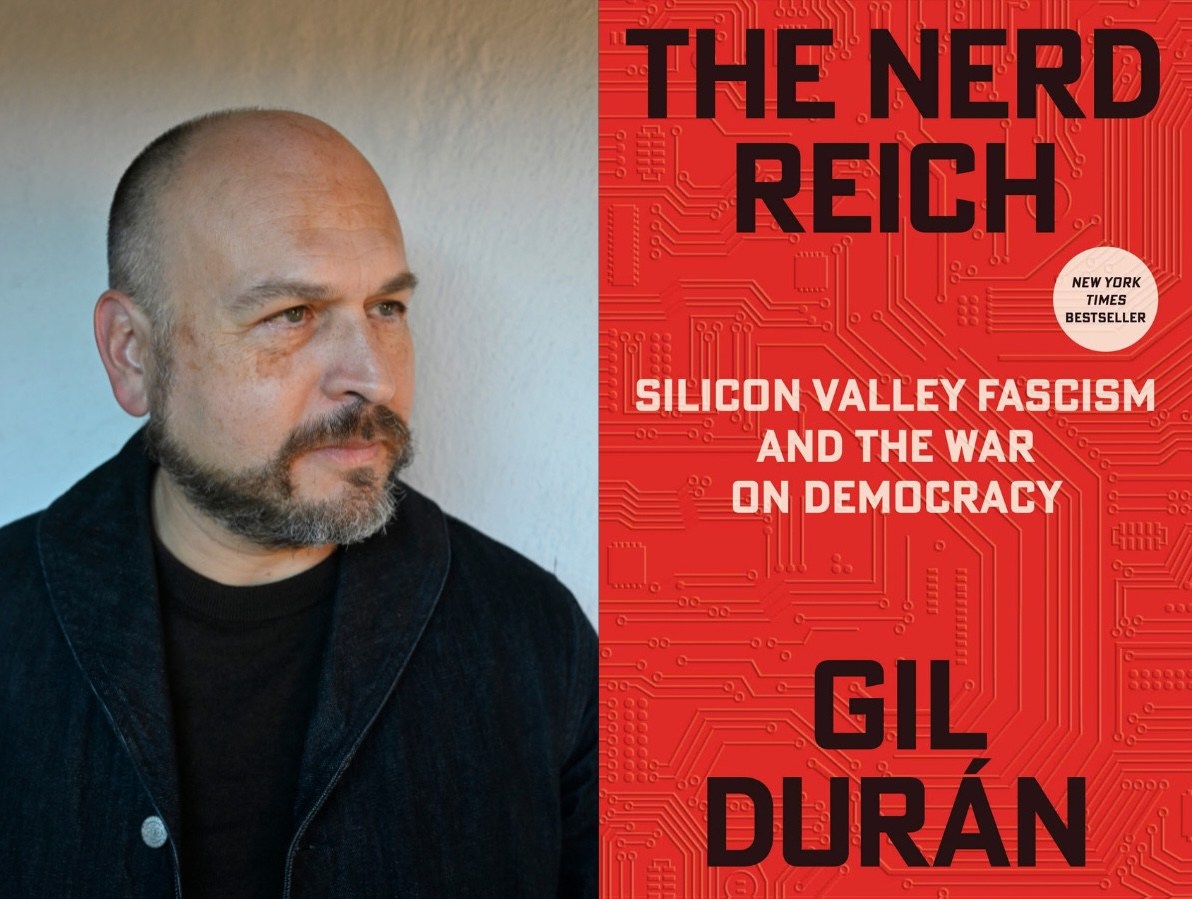
The last time I talked to journalist Gil Durán, he had just been banned from X for posting just two words — “TLDR: Fascism” — in response to a rambling, moralistic manifesto published by Palantir, Peter Thiel’s widely-deplored defense and surveillance tech company.
That was in April. Five months later, Durán remains undeterred, continuing to call Silicon Valley’s staggering rightward turn for what it is: a systematic dismantlement of American democracy.
This summer, the California-based writer and former Democratic Party operative published The Nerd Reich (Simon & Schuster), a thorough investigation into the antidemocratic ambitions of the most powerful men in tech. The highly-anticipated book debuted at #3 on the New York Times Best Seller list, launching Durán on a global book tour and his message into the wider debates around technology and democracy.
Tonight, more than 300 people will see him speak at Club Fugazi in North Beach. (Tickets are still available. Doors open at 6 p.m.) Ahead of the event, Durán squeezed in some time to call Gazetteer SF from Oakland, where he was about to hit his favorite boxing gym, to tell us about the book’s reception, the question he’s asked most frequently, and his possible next project.
This conversation has been lightly edited for brevity and clarity.
It’s been a little over a month since The Nerd Reich came out. Tell me about the reception so far.
The reception has been amazing. My book debuted #3 on the New York Times Best Seller list, which was nothing that I expected, and it’s still on the list. In fact, last week it went back up to #5. Usually books fall down the list, you know? So, it’s been amazing. I think people have been looking for an explanation of what’s gone wrong with the Silicon Valley billionaires, why they seem so extreme and radical, and I think my book is breaking through because it provides that explanation. There are translations coming all over the world just in the past few weeks: Finland, France, South Korea, Vietnam, Japan, Italy, Poland. So, it’s been pretty amazing to see the reception. It’s been far beyond my expectations.
In addition, all my events have been selling out. I have a sort of phobia of public events, because, you know, I thought I was going to be in a bookstore with five people, half of them my friends. Instead, there were like 200 people in New York, and [my talk at] the Commonwealth Club had over 200 people.
It’s amazing. People are showing up to listen, to ask questions, and I’ve got them booked out through early next year, with appearances all over the country and the world — Berlin, Lisbon, all kinds of places. It’s… It’s pretty shocking.
You’ve been covering topics like network states and Silicon Valley fascism in The New Republic and on your blog since 2024. Back then, those ideas might have sounded far-fetched to most people, but now they’ve become part of much more mainstream political conversations. Do you think your work has helped drive that?
I was just a little ahead of the curve, but people were going to have to reckon with these things anyway. Even if I hadn’t written my stories in The New Republic, they were going to do DOGE, and JD Vance was going to be on the ticket. This radical, extreme Silicon Valley ideology was coming to Washington no matter what. At the time people looked at me like I was crazy, or like I’d fallen down a strange rabbit hole. There are a lot of people in journalism who are just too dumb about politics and still can’t quite figure out how to engage with this material. But increasingly they’re not going to have a choice. I was just paying close attention to what these guys were saying and doing, and I ended up in the right place at the right time. And now my book is published at a moment when people understand this stuff is real, understand the billionaires have gone insane and become radical, and my book provides an explanation for that.
Some people have already heard to some degree because of the New Republic stories. At the time, most of my Republic stories were viral in a way that's unusual for me, and unusual for the general Bay Area California journalism community. I was getting like 15,000 retweets on a story. It was like the biggest thing happening in California journalism, except that it was a conversation largely ignored or censored by most of the establishment journalism community. They couldn’t quite find a way to acknowledge it or to cover it themselves. Even today, you’re not going to hear a word about this stuff in the San Francisco Chronicle. You had one of the biggest, most extreme political movements in the history of our country come out of the San Francisco venture capital milieu, and it was completely completely missed by almost everybody who covers politics in California journalism.
My feeling is that a lot of people in establishment journalism are still attached to this ridiculous notion of objectivity. But you can’t be objective in the face of something like this. You have to be pro-democracy, you have to be pro-truth. If you’re not, then what are we even doing here? But I think between my book and Naomi Klein and Astra Taylor’s book [End Times Fascism], we’re making it hard to ignore this reality.
After covering this for so long, was there anything that was still able to surprise you while you were writing the book?
One thing that became quite obvious and made me feel silly was the degree to which Peter Thiel was connected to almost everybody involved in this. This is a movement that has been incubated, funded, and created by Thiel, who now is roaming the Earth giving long lectures about the Antichrist. Early on [reporting] in San Francisco, I knew he was involved to some degree, but I didn’t understand the full structure of the thing or how it had emerged over time and been built in layers. That was surprising to me, in a way, because it’s one thing when you’re writing stories, but when you write a book you have to go back and start at the beginning, listen to all the podcasts, look at all the evidence. I had to go back and read essays that Thiel was writing in the early 2000s, listen to a speech he gave in 1999, and I realized the degree to which he had been very openly talking about this stuff.
One of the things that readers tell me is most shocking about my book is the degree to which it’s told in the words of these guys. When you see it all put together, what they’ve been saying they want to do and what’s now happening, it’s pretty scary because they’re doing what they’ve been talking about doing. They’re carrying out these ideas. Now, I don’t necessarily think they’ll win or that they have it all figured out, but this should not have gotten this far.
And so I think one thing that became even more surprising to me was the degree to which they have been openly discussing these ideas in a consistent fashion — the idea of technology and the people behind it becoming so wealthy and powerful that they are able to take over the government and become the government. That’s the basic idea. I mean, if you strip away all the gobbledygook about the network state or the “dark enlightenment,” Curtis Yarvin's gobbledygook, it’s about an argument for tech oligarchy. That they should have the power. That democracy is stupid and they should have the power in this system to do it whether anybody likes it or not. And that goes back to the quote from Peter Thiel in 2010 [which opens the book], that “technology is this incredible alternative to politics.” This is what that means. Instead of having to win elections, you use technology and the wealth it generates to just win the argument, regardless of what the majority of people think.
You’ve described your book as being about a “cult of apocalyptic billionaires,” and since it was published, we’ve seen several of the most powerful people in AI say that what they’re building is possibly going to bring about the end of the world. How do you read that situation?
I don’t believe anything any AI executive says, for the most part. I always assume there’s something unsaid that we should pay attention to. I think that the situation’s going to shake out over time. They are obsessed with [the] apocalypse for multiple reasons, one being that their entire business model is apocalyptic. They need, you know, trillions of dollars in investment for a technology that is not generating the revenue needed to justify that. So the way they justify that investment is by saying, “Oh this is going to change everything! We’re creating God!” and, “Oh it’s so dangerous! Maybe the government should be involved.”
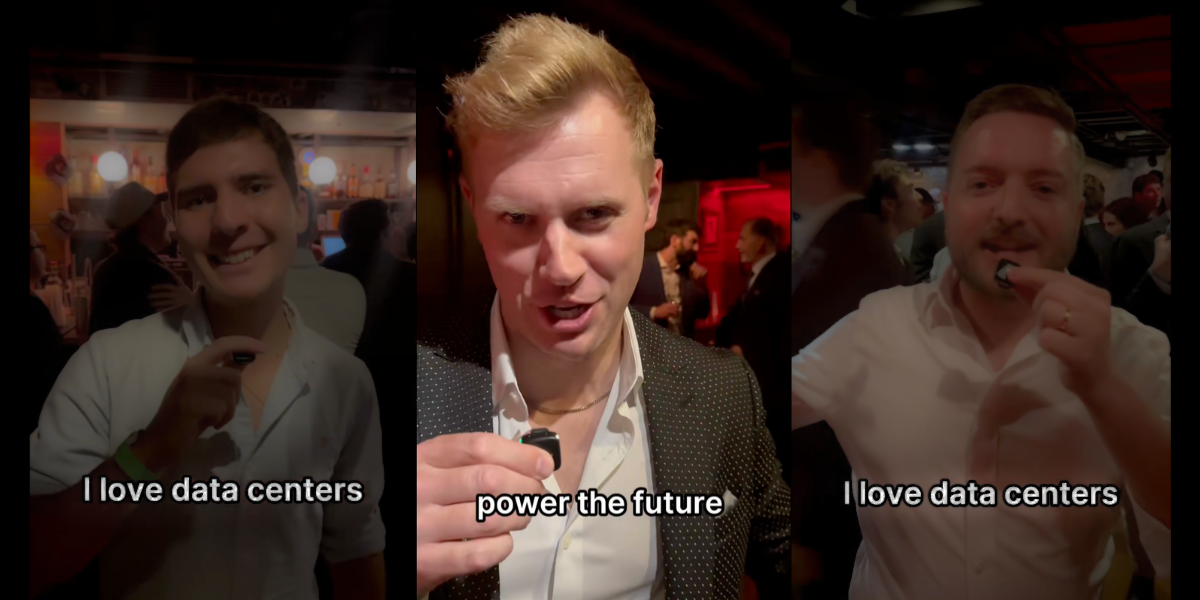
The problem with this marketing is that they’re scaring the hell out of people. They’re promising, at the very least, to kill all the jobs, and possibly, in their mystical fantasy, they’ll create a technology that might make humanity extinct. And this has resulted in a lot of fear, a lot of rejection of AI, and a populist movement against data centers which has been very effective, and it’s clearly organic. It’s been so effective that there’s a conspiracy theory that China must be behind it. But you know who’s behind it? All the tech and AI CEOs telling everybody this is the job-killing, humanity-extincting machine. That's the most logical explanation.
The last time we spoke back in April, we talked about the Palantir manifesto, and you mentioned how it suggested a pervasive sense of anxiety running through the tech industry. What do you think about that now?
It’s amazing the degree to which the polls have really shifted. First, against the Trump regime, which wasn’t very popular to start with, but Trump is now historically unpopular. Then also against billionaires — Americans now believe billionaires have too much power — and against AI all at once. So, these guys should be a little nervous about what they have created, right? All putting their manifestos out there.
You know, when this first started, I was worried that maybe they have some kind of amazing unprecedented propaganda plan to somehow make this all very popular. Because that’s what I would do if I was plotting to kill democracy and take over the world. Instead, we’ve got all these wars, and we’ve got prices going up: gas prices, food prices. And meanwhile we have this flamboyant Epstein class of billionaires who are writing kooky apocalyptic manifestos and fueling the shockingly flagrant corruption of the Trump regime. Every time you turn around the Trump family has got some new major business deal that is clearly a conflict of interest and they’re just raking in the cash. So, in a way, they’re recreating the conditions of the French Revolution: Prices are going up, people are hungry, people are angry.
It does seem like if we have a free and fair election, there’s going to be a massive rejection of the Republican party of Trump. And we already see some of these tech oligarchs trying to realign behind Democrats, and it’s not a coincidence in my view that this call for a slowdown of AI comes as the political winds shift. I think we have to wait and see the whole story here shake out of what’s really going on, but one of the theories is that they’re calling for all these regulations so that the Democrats will put them in charge of the regulations, which is a perfectly sensible assumption, given how things work. But prior to this, they were hitting pedal-to-the-metal acceleration under a Trump regime that is fully invested, personally as well as politically, in maximal AI. So, yeah, it’s falling apart more quickly than I think they expected it too.
When you speak to readers at your book tour events, what is one question that comes up again and again?
People want to know what can be done about this, what the solution is. You know, my job as a journalist was to tell the story, to make sure that people have these facts. And it took a lot to be able to do that in 10 months, basically, because I had to write the book in 10 months.
I think we have to reckon with the fact that we already had an oligarchy before this started. We have a system where money buys influence and power. The difference is, these guys don’t have the common sense to say, “Wait, let’s not be so open about it. Let’s not try to buy all the power. Let’s buy it in little dribs and drabs and preserve at least the appearance of democracy.” These guys have no concern about the appearance. They want the power. And I think one good thing about this is that it’s waking people up to the threat.
You know, Peter Thiel’s preaching about the Antichrist. That’s pretty damn weird at a moment when his protege, JD Vance, is a heartbeat away from the presidency, at a moment when Trump is raking in billions in corrupt crypto profits while his family invests in AI and all of the same businesses he’s supposed to be regulating. They’ve made it very obvious how broken the system is and that their plan is to capitalize on that.
So just as these billionaires have become radicalized against democracy, I think we’re starting to see an awareness that we have to become radicalized against billionaires and billionaire power in our political system. No one voted for this. I think we still have time to reject it and to imagine a future where we are not subject to the tyranny of billionaires.
There aren’t going to be any easy solutions, especially when Democrats like Gavin Newsom are campaigning against the billionaire tax. But I think people need to understand that we can’t just go back to sleep for four years if the Democrats start winning again. Because the only people who love billionaire money more than Republicans are Democrats.
You’re in the thick of your book tour now, but I have to ask: Have you thought about your next project yet?
I’m putting a lot of thought into the failures of the Democratic party, and how the moral rot and decrepitude of the Democratic party is a symbol for how our political system is failing. I don’t know, maybe some kind of Gavin Newsom users’ manual might be an interesting project to take on, who knows. Maybe it’ll just be a series of tweets. But it seems like 2028 might be a good year for a book telling people who Gavin Newsom really is.