


In mid-September, the cafe management team at Corgi, the $5 billion AI insurance startup infamous online for its “hot girl” marketing and 24-hour cafes, sent out an email to its San Francisco-based barista staff.
“As you are all aware, Corgi has been making a lot of changes lately,” wrote Cameron Kong, then-general manager at the Corgi Cafe at 9 Claude Ln. downtown. The insurance side of Corgi’s business operates in the same building, one floor upstairs.
“The main objective is to make the cafes profitable so we can continue to run as a business. Currently, we are far from this goal and labor is a main contributing factor to this,” Kong wrote in the email, obtained by Gazetteer SF. Labor costs, he noted, were outweighing “100%” of cafe sales.
“Due to this, we are enacting a company wide wage cut.”
Hourly wages for shift leads would be slashed from $26 to $22, one former barista told Gazetteer. Regular baristas, most of whom had previously made $22 an hour, tumbled down to $20. (Minimum wage in San Francisco is $19.61.)
The wage cut signaled a new low for Corgi Cafe staff, two former baristas told Gazetteer. One day earlier, the newly-opened Dogpatch location had been ordered to shut down by the Department of Public Health for operating without the proper health permits, but things had been rocky since the earliest days.
Since the first Corgi Cafe opened downtown in April, its staff had already been frantically trying to navigate a workplace that ran, it seemed, almost entirely without systems: Scheduling was a mess; pay was inconsistent. The cafes lacked the proper commercial equipment, the baristas said, and inventory was ordered ad-hoc from Instacart and Amazon. Drink recipes were also vague and often required ingredients the cafes did not stock.
The two former baristas also said they barely received training and were managed by a revolving door of Corgi employees who were at times dismissive, hostile, and “incompetent.”
“In general, Corgi is a really messy place to work. [The managers] don’t really know what they’re doing,” said one former barista, who asked to remain anonymous to avoid reputational damage. This person’s former colleague also asked to be quoted anonymously.
“Corgi Cafe is committed to maintaining a safe, professional, and supportive workplace while continuously improving our operations,” Corgi spokesperson Erika Lee said in a statement to Gazetteer. “As part of these efforts, we standardized our compensation structure, strengthened relationships with wholesale suppliers, and refined our scheduling practices.”
Do you work at Corgi? Message me securely on Signal at cyd.01.
Corgi was founded in 2024 by two Stanford dropouts, Nico Laqua and Emily Yuan, with the financial support and guidance of startup accelerator Y Combinator. The co-founders made headlines early on, touting their trillion-dollar-valuation ambitions and seven-day workweek, which resonated with investors; in two years, Corgi raised at least $442 million in venture capital funding, pushing the company’s valuation up to $5 billion, as Forbes reported in May. Laqua is now 26. Yuan is 24.
In early 2026, Corgi got into the corporate cafe business for the same reason Capital One did: Marketing. (In April, Laqua also told Gazetteer that the landlord at 9 Claude Ln. required him to lease the ground floor retail space when he rented the office above, so he decided to turn it into an all-night hub “for the startup community.”)
Corgi had previously announced an aggressive cafe expansion plan to open 100 cafes in six months, but has since faced a number of setbacks: After the Health Department shuttered the Dogpatch location, Corgi dismissed its cafe expansion team, all of whom were hired just a few months before. The company also slammed the brakes on at least 16 new local cafe leases that were about to be signed, the San Francisco Business Times reported in September.
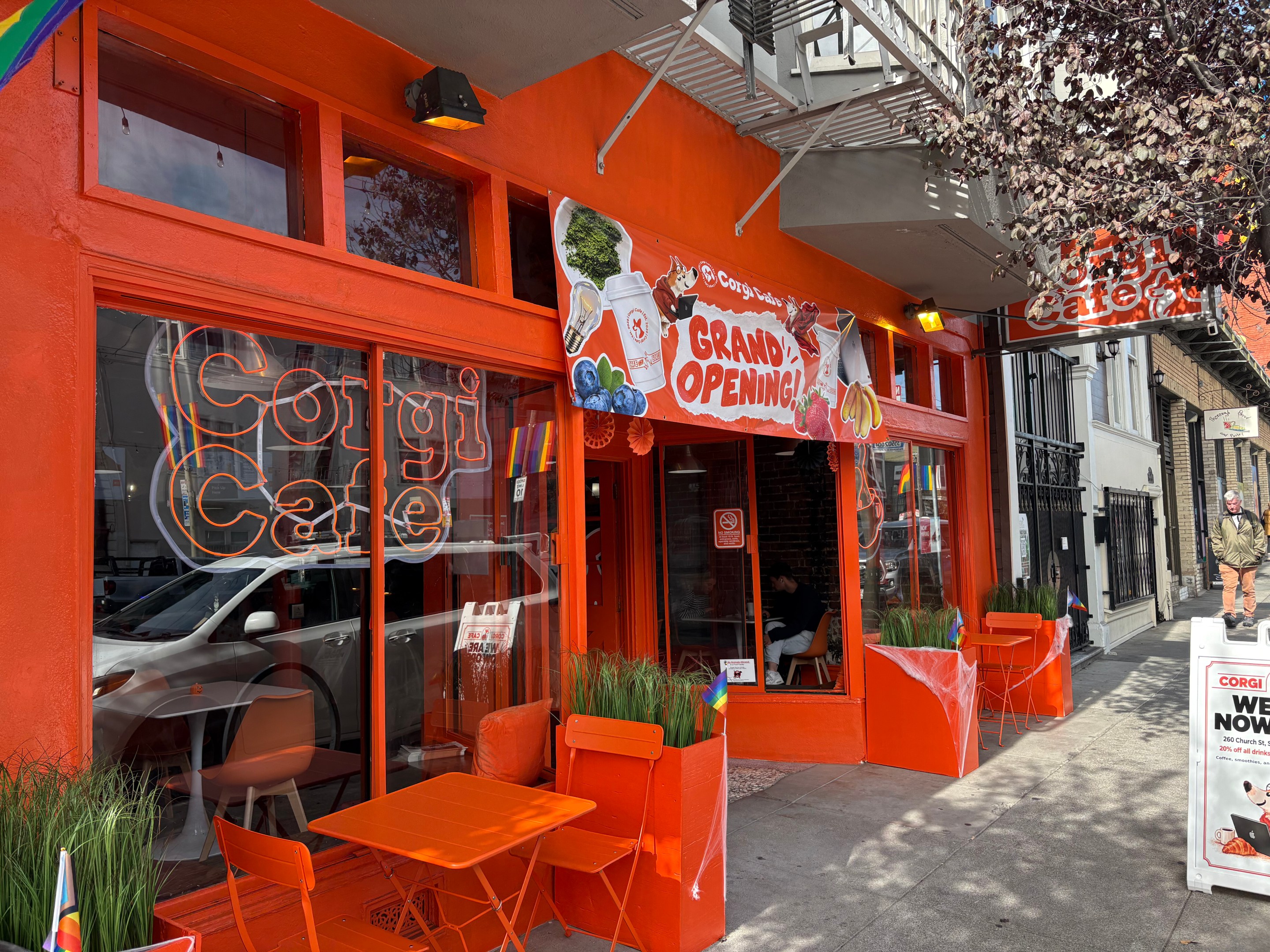
Nevertheless, a new Corgi Cafe opened last week at 15th and Church streets in the Castro. The space, which used to house the beloved lunch spot Church Street Cafe until it was priced out of the area by skyrocketing rents, has been repainted in Corgi’s eye-searing shade of orange. During a recent visit, flyers advertising open barista positions are posted in the windows.
Both of the former employees who spoke to Gazetteer had worked as baristas in the Bay Area before they joined the Corgi Cafe staff. Separately, they both said the signs that Corgi Cafe was not a normal place to work were there from the first day.
One former barista said their interview lasted five minutes, did not require a resume, and that their interviewer, a Corgi employee from the insurance side of the business, “looked super exhausted and tired. That was probably the first red flag I should’ve seen.”
A few days later they arrived for their first training shift. “There had been no communication to the baristas on shift” that a new hire would be joining them, the former barista said. The area behind the bar was overcrowded with workers: There were “four or five other trainees that were shadowing that day,” plus two regular baristas, plus the shift lead, who “looked super stressed and tense.”
One source of that stress might have been the cafe equipment Corgi had provided, namely the espresso machine.
“It’s not an industrial one. It’s like a home appliance. It can’t make drinks consistently,” the former barista said. If they tried to make drinks in quick succession — a necessity at any cafe — the milk steamer “wouldn’t work properly,” they said.
“Home espresso machines cost like $2K. Corgi doesn’t want to invest $30K” into a restaurant-grade espresso machine, the other barista speculated. (Nor would they have to: Basic mid-range commercial espresso machines, the kind used by many independent coffee shops, can go for around $10,000.)
“We exclusively use equipment that meets applicable ANSI/NSF and ETL standards,” Lee said, referring to public health and safety benchmarks put forth by the National Sanitation Foundation (NSF) and American National Standards Institute (ANSI), as well as the electrical testing laboratory (ETL) certification given to certain commercial products by inspection companies.
Storage space was also an issue. The Claude Lane location has a small store room that is supposed to be used for coffee supplies, but one former barista said it was often cluttered with backpacks, clothes, Amazon packages, and other items belonging to the Corgi insurance employees who work upstairs.
“I’d come into work and I couldn’t focus on making drinks. I’d just be cleaning up this mess, every day,” the former barista said.
When asked about the random clothes and packages cluttering the store room, Lee simply said, “our cafes use different storage areas depending on the needs of the supplies.”
The shift leads were responsible for stocking inventory. At first, they ordered supplies from bulk food supplier Sysco, but after a few months the cafe staff got locked out of Corgi’s Sysco account. As a solution, they began ordering whatever was needed from same-day delivery apps like Instacart and Amazon.
There was also no storage fridge at the downtown location, so whatever perishables the shift leads ordered had to fit in the small fridge that can hold about 10 gallons of milk, one former barista estimated.
In some cases, that meant several Instacart orders per day; in others, it meant waste. Entire cases of fresh fruit — “pineapples, mangoes, and mixed berries" — used for smoothies were thrown out “because we didn’t have the overflow fridges that we needed,” the other barista said.
“There’s no system, no organization,” the first barista said. As a result, “We lose a lot of money.”
Beyond that, the drink recipes were bizarre. Coffee beans were frequently ordered on short notice from Amazon, regardless of freshness. Ingredients like milk and vanilla were measured in un-standarized units like “squeezes” and “scoops” on the internal Corgi Cafe app, viewed by Gazetteer.
“The coffee is really bad,” one former barista said, adding that they felt “sad” to serve it to the customers.
One negative review online called the coffee “some of the worst I’ve ever had.” Another said their coffee was so weak, it was as if it had “a dead battery.”
“Imagine if Lacroix made coffee,” the reviewer wrote on Google.
Corgi Cafe also offers a menu of specialty drinks sponsored by other tech startups, the recipes of which often included ingredients that the cafe did not regularly stock. (The recipes were supposedly created by Corgi’s marketers, but baristas suspected they were generated by AI.) As always, the solution was same-day delivery from Instacart.
“We collaborate with sponsors to develop creative, customized beverages. Some call for ingredients outside our regular menu,” Lee said. “As part of that process, we sometimes use AI for assistance to brainstorm new drink ideas, alongside the expertise and creativity of our team.”
Pay was also inconsistent. “There were several times tips were missing from paychecks,” one former barista said, noting they had heard one barista’s check was missing $1,000. (That barista confirmed this, and said they received their full paycheck a few days later.) At times, when dedicated cafe administrators were fired or left Corgi, marketers from the insurance side of the business handled payroll.
“I started doing [my own payroll] calculations myself, because I couldn’t trust them,” the former barista said.
Lee, in a statement to Gazetteer, said only “authorized supervisors have ever had access to manage payroll and reported discrepancies are reviewed and corrected as promptly as possible.” She did not directly address whether any marketers were considered authorized supervisors in this context.
Naturally, chaos in the cafe often made its way upstairs, where employees for Corgi’s insurance business work in a sprawling office. When news of, say, a milk or yogurt shortage reached the executives, interns or lower-level employees “would come running” to hound the baristas for answers, the former barista said.
This was understandable: Laqua especially “would be really mad, like really, really mad,” if the cafe was out of his favorite milk brand (the glass-bottled kind from Alexandre Family Farms) or the right ingredients for a smoothie he was craving. Soon, the barista’s work group chat on Telegram would be blowing up with messages. “They’d be like, ‘Why is Claude cafe out of milk?’ But we were suffering from more issues than just being out of milk,” they said.
Conditions weren’t much better at Corgi Cafe’s short-lived second location, which opened in Dogpatch in late August.
A source familiar with the building at 2146 Third St. told the San Francisco Standard in September that Corgi spent "roughly $1 million on renovations,” but the space behind the bar was cramped and dim, making drink preparations difficult. “It’s very small” behind the bar, one former barista recalled of the Dogpatch location. “There’s barely any lighting. I’d have to move out of the bar for a second just to see what I was doing.”
A few months before, in June, Corgi had hired a new head of cafe expansion, Trevor Owens, to lead the launch in Dogpatch and other future locations. On his LinkedIn, Owens states that he oversaw the design, construction, staffing, and opening of the Dogpatch location. The cafe opened only 28 days after Corgi signed the new lease, Owens’s profile claims. (Owens was dismissed by the company in September after the Dogpatch location closed.)
Owens was “super weird,” one former barista said. In one instance, they recalled, Owens did not know he needed a food certification to be behind the bar. Before Owens was hired, a regular customer had been banned from Corgi Cafe for persistently hitting on one of the baristas, but Owens reinstated his welcome. “Trevor literally said, ‘You should come back. You are welcome here,” the other barista said.
Lee, who emphasized that Owens is no longer employed by the company, said Corgi is “committed to maintaining a safe, respectful, and welcoming environment for all employees and customers.”
She added that the company takes “all reports of inappropriate conduct seriously and address[es] concerns promptly and appropriately.”
Owens did not respond to Gazetteer’s requests for comment.
One former barista said Owens fired two Corgi Cafe administrators who usually handled scheduling, leaving the next week’s schedule completely open; naturally, nobody showed up the next Monday.
“This is the kind of thing that makes me question the intellectual situation of the people running Corgi,” they said.
As a hub for tech founders, outside startups frequently host events at Corgi Cafe. The baristas said they were not informed about many of these events ahead of time, and with inventory and scheduling already disorganized, the surprise events were “very stressful.”
Not all the Corgi employees treated the baristas poorly.
“There are some friendly people, and then there are some people who are super entitled and just kind of mean,” one former barista said.
“They just saw past us,” the other one offered. “They didn’t really interact with us unless they had to.”
No one from the corporate side of the business even addressed the CorgiGirls website, a hot-or-not ranking game that a local founder unaffiliated with Corgi released for a few days in August. (Corgi quickly got it taken down.) The website had included photos of all Corgi’s female employees, including baristas.
“Nobody addressed us. Nobody apologized. There was no conversation,” the first barista said.
The Dogpatch location was short-lived, deteriorating in a rapid series of events: All in the same week, a city health inspector discovered the cafe was operating without the proper permits and ordered it to close, Owens and his team were terminated, and Corgi brought on a new person, Katie Yuan, to oversee cafe operations.
Until then, working at Corgi Cafe was already “intolerable,” one former barista said. “Then [Yuan] came and made the place hell.”
Yuan is the younger sister of co-founder and COO Emily Yuan. She has a background in real estate private equity and investment banking, according to her LinkedIn.
One former barista said they assumed the younger Yuan was responsible for the September wage cut. Soon after, Yuan also notified the baristas in their Telegram channels that if they could not produce drinks within five minutes, or if they ordered supplies from Instacart, they would be terminated.
“There will be no exceptions,” Yuan wrote in a message, viewed by Gazetteer.
This put the baristas in a bind: The remaining Corgi Cafe still did not have access to proper food storage or an espresso machine with a milk steamer that didn’t freeze up.
The shuttering of the Dogpatch location threw management of the Claude Lane cafe into new chaos. Some baristas weren’t scheduled for weeks, and tasks like training and cleaning took a hit. New hires started working without food certifications, one former barista said.
“We monitor and track food handler card status for all cafe staff in our system. Cafe staff are required to undergo food certification training within 30 days of hiring,” Lee said.
One former barista said they weren’t put on the schedule for two weeks, and when they finally were, they returned to a workplace “that looked like a dumpster,” they said.
“There were flies everywhere,” the barista said. “Everywhere was nasty. Inside the [milk] fridge was spilled grease, yogurt, cold brew. Everything was so messy and dirty… It was really bad.”
Lee, however, insists that Corgi Cafe maintains “strict sanitation standards” and does “not use grease in our cafe operations.”
The other former barista said for all Yuan’s new rules, she does not seem to have a handle on how to make basic coffee drinks, even in theory. One day, they said Yuan subbed in behind the bar while they took their 30-minute break. Soon, “She asked me, ‘What is tonic water?’” they said. “Like, come on. If you’re going to be the head of stuff, you have to know your own recipes and ingredients.”
Over time, moments like this added up.
“It makes me wonder, what is going on in San Francisco?” the first barista said. “If people are running AI companies like this… I just don’t understand.”