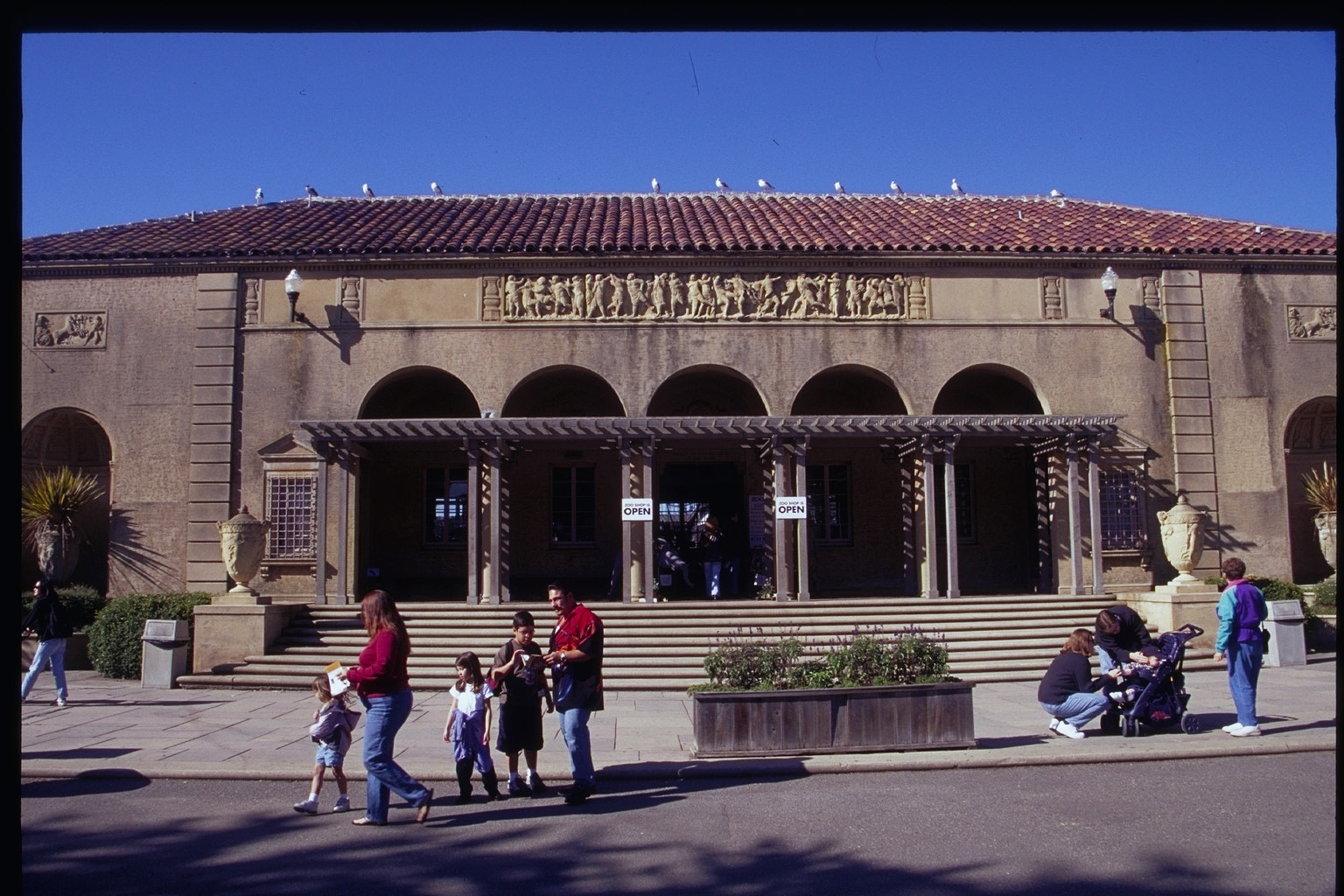


Since 1925, the Mothers Building has sat on the grounds of the San Francisco Zoo, its walls adorned by entirely women artists, some of whom worked alongside Diego Rivera. The building served as the zoo’s welcome center and gift shop from 1973 through 2002 before it was deemed seismically unsound and not ADA-accessible.
And so, the Mothers Building passed its triple-digit birthday with barely any notice, a sad and strange non-event given that its murals were celebrated in 2015 with the release of 2,000 pigeons.
“I recall it being spectacular,” said Nancy Chan, the zoo’s current director of communications, who was with the organization when the building was still operational. “A little crowded with merchandise, but so enchanting.”
“Here we have really important women artists who did amazing work inside and outside that building,” said former Supervisor Myrna Melgar, who sponsored the structure’s landmark designation in 2022. “And people just don't really know about it.”
When it opened in 1925, the Mothers Building was one of the only structures in the West dedicated specifically to the needs of women. The elegant Italianate villa was a place for mothers to nurse their children, rest, and refresh themselves in privacy. (Boys over the age of six were not allowed inside until the 1970s.)
When Supervisor Melgar spearheaded the initiative to landmark the building in March 2022, she timed it to coincide with Women’s History Month. Melgar’s hope was that the landmarking would prevent the building from being knocked down. Yet as the years have passed without a restoration plan, the structure has become more compromised and the possibility of development more complicated.
“I’m worried that if things aren’t done, the building will fail,” said Richard Rothman, a retired city worker and Mothers Building advocate. A wooden lattice and metal mesh was added to the structure in 1989 to protect zoogoers from falling plaster. That wooden structure extends into the loggia, partially obscuring the exterior mosaics made by Helen Bruton, with help from her sisters Margaret and Esther.
Bruton is credited with kicking off the modern mosaic movement, an art form well-suited for the New Deal, since projects could be viewed from the outside where the public could enjoy them.
Bruton crafted her two appropriately-themed mosaics “Children and Their Animal Friends” and “St. Francis” on the cheap with seconds from the Solon and Schemmel Tile Company in San Jose. The variations in color were an annoyance for installers needing uniformity, but a boon for Bruton, not only for the price but because they added a depth to St. Francis’s cloak with their varying browns, according to Wendy Van Wyck Good in Sisters in Art, her 2021 biography of the Bruton sisters.
The Mothers Building is a monument to WPA-era pieces of art, a time period revered in other parts of the city like Coit Tower. The Works Progress Adminstration (WPA), created by the government in 1935, was established to combat unemployment by providing jobs to millions of people suffering in the wake of the Great Depression. The artistic arm of the WPA employed over 10,000 artists and offered women the opportunity to make a living, often for the first time, from their art. Bruton would later work alongside Diego Rivera on Treasure Island at the Golden Gate International Exposition in 1939. And while originally commissioned to paint only the lunettes of the building, Helen Forbes and Dorothy Puccinelli’s Noah’s Ark-themed egg tempera murals grace the 10-foot wainscot of all four walls.
Despite all the artistry and historical import of the Mothers Building, today it languishes. The wooden front doors are swollen shut, the walls laced with cobwebs, the air inside so musty it’s difficult to breathe. The murals on the western wall are slowly disappearing due to water intrusion. Others, however, remain vivid and are worth saving before it’s too late.
“Money is always brought up as the primary problem,” said Woody LaBounty, president of SF Heritage, who has been following the building’s fate for two decades. A 2024 feasibility study by the Architectural Resources Study put the price tag at $13 million for a complete rehabilitation, noting that cost “will continue to increase.”
That’s a hefty cost, but LaBounty has witnessed bigger projects get funded easily. “I am shocked how much money people have that they're able to put into a building that they love,” LaBounty said. “People put $20 million into a building, or $8 million into a little movie theater.”
Rothman agreed. “We have all these billionaires in the city,” he said. “Why can’t we tap them and help fix this building?” LaBounty argued it’s less about the money than usefulness: in 2026, there may be no clear purpose for the Mothers Building.
It also doesn’t help that the Mothers Building sits in a sort of civic limbo, a victim of competing agencies. The building is owned by the San Francisco Recreation and Park Department, but it stands on land leased by the San Francisco Zoo; meanwhile, the artwork contained within the building is under the governance of the San Francisco Arts Commission, creating a thicket of inter-agency red tape.
Yet everyone — Rothman, LaBounty, Chan, Melgar — agrees there are many purposes the building could serve, especially since the zoo does not have much in the way of indoor event space. “This could be an incredible cultural center for the zoo and for the city where you could have talks, you could have screenings, you could have parties where artists come,” LaBounty mused.
Melgar can imagine a rentable venue for weddings and events or a community resource with a separate entrance from the zoo so a ticket is not required for entry. But one thing is clear: “Absolutely the wrong thing to do is just let it decay into nature and have the salt water take it over,” she said.
Yet there may be new hope on the horizon.
The Sunset Dunes are thriving; both the San Francisco Zoo and Recreation & Park have new heads coming in and the possibility of fresh eyes and ideas. “There’s an opportunity to re-envision what goes on at the zoo,” said Melgar. “Including the Mothers Building.”