
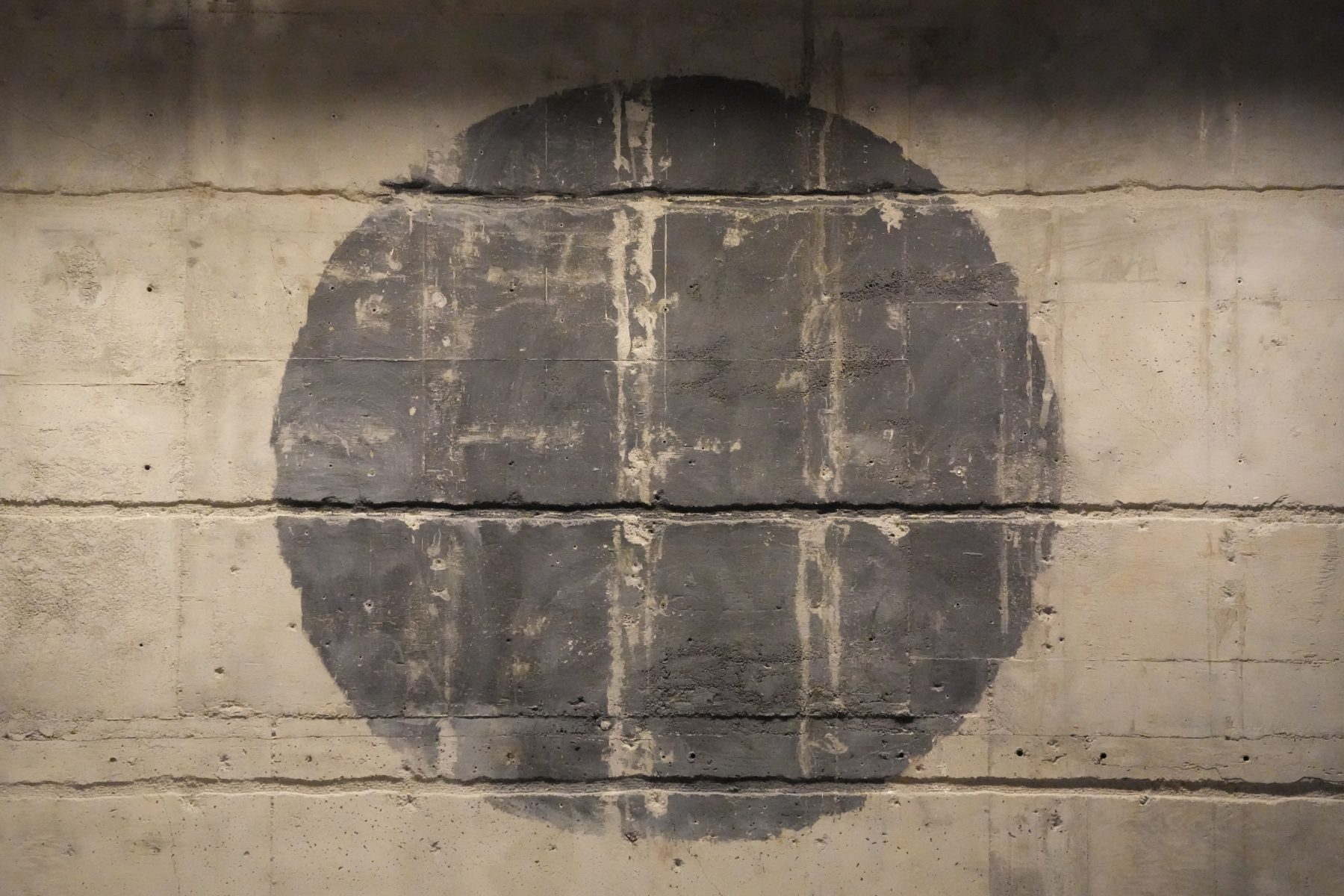

Earlier this year, when contractors removed the wood paneling from the lobby of 555 Market St., they uncovered a giant, black circle painted on the raw concrete wall that could be considered a 20th century masterpiece.
Floating over the building’s airy entryway like a dark planet, the spot calls to mind Kazimir Malevich’s 1923 painting Black Circle, an example of Suprematism, the geometric art movement the Kyiv-born artist launched. The circle inside 555 Market almost certainly dates to around 1965 when the building was constructed as the headquarters for Standard Oil of California (later renamed Chevron). That sphere might be less an example of modern art than a tribute to the mid-century supremacy of Big Oil.
“I would love to know what that was,” Aaron Killen, the building’s property manager said of the circle, which he estimated is between eight and nine feet in diameter.
“I figured maybe it was either a massive clock, or some sort of logo. Maybe it was artwork that they had before. Why it’s black…” Killen wondered, his voice trailing off as he contemplated the shape. “We find weird things.”
The circle was revealed during the $20 million-plus construction of The Breakroom (aka, BRKRM), a new amenity for companies with offices in 555 and 575 Market St. unveiled Nov. 12. The first floor of 555, formerly occupied by Chevron’s credit union, has been transformed into a basketball court, and climbing wall, as well as meeting spaces, with a golf simulator, billiards, and shuffleboard tables. There’s also a bar and restaurant, open to the public, for visitors who don’t mind the sound of bouncing basketballs.
The second level, once Chevron’s cafeteria and later a training room for onetime tenant Uber, is a gym with two pickleball courts. (Disclosure: Gazetteer has an office in 575 Market and like all tenants has use of the space.)
Killen told me that contractors tried to scrub the black circle off but that it wouldn’t budge. Greg Flynn, whose company owns Market Center, was surprised to learn about the attempt to remove it. When architects at STUDIOS, the firm that designed BRKRM, showed him the circle, Flynn concluded it should stay.
“It’s got character,” Flynn said in an interview. “It’s got a little intrigue.”
Records and interviews show the circle, or whatever covered it, was situated above the entrance to the World of Oil, a museum Chevron curated in 555 Market as a tribute to petroleum. Woody LaBounty, president of San Francisco Heritage, a nonprofit dedicated to preserving San Francisco’s architecture, recalled in an email the museum being something “you might see in a mid-century visitors center in a small town, or state park.”
“I saw it once as a kid in the early 1970s, but remember very little,” LaBounty wrote.
Archival newspaper clips LaBounty unearthed for Gazetteer brought World of Oil to life. The front page of the Feb. 1, 1966, San Francisco Examiner business section heralds the museum’s debut six days later.
Underneath a photograph depicting “American home life – 1910 style,” the newspaper describes “life sized, three dimensional dioramas” and “electronically operated displays,” one of which featured a kitchen water pump, high button shoes and kerosene lamps, according to the Examiner. The article refers to the location as the Standard Oil building. The company was Chevron’s precursor, and one of the branches stemming from the 1911 breakup of John D. Rockefeller’s monopoly.
A 1971 article in the San Francisco Sunday Examiner & Chronicle comes closer to solving the circle’s origin, describing a movie shown at the museum’s entrance about the formation of oil deposits, as well as exhibits of giant drill bits, illustrating the process of extracting and refining petroleum. Other exhibits included a model of the first service station (in Seattle, 1907), and a “bulk oil plant,” or temporary storage facility, according to the article.
Bob Vanderlaan, an employee at Chevron from 1984 to 2015, remembers the World of Oil. His description of the museum matches earlier newspaper reports. Vanderlaan was part of Chevron’s team that decided to sell Market Center in 1999. Around that time, he said, the company transported the museum’s exhibits to a warehouse in Richmond, where Chevron continues to operate a refinery.
“We just sealed it up, crated it up, and as far as I know, that’s where it went,” Vanderlaan said.
I showed Vanderlaan photographs of the black circle. He vaguely recalled a globe, perhaps a metal disk, or a compass rose, above the museum’s doorway.
Other than the newspaper clips LaBounty shared, there’s almost nothing about the World of Oil on the internet.
The newer attraction in the museum’s old location can be seen as an example of the cyclical nature of San Francisco real-estate.
In June 2025, Flynn paid $177 million, or $231 per square foot, for Market Center at a time when, he said, 43 percent of its office space was leased. Downtown was still making a comeback from the so-called “doom loop.”
Traces of that time persist much like the black circle above the World of Oil, reminders that even in a forward-looking city, the past isn’t always so far behind.