


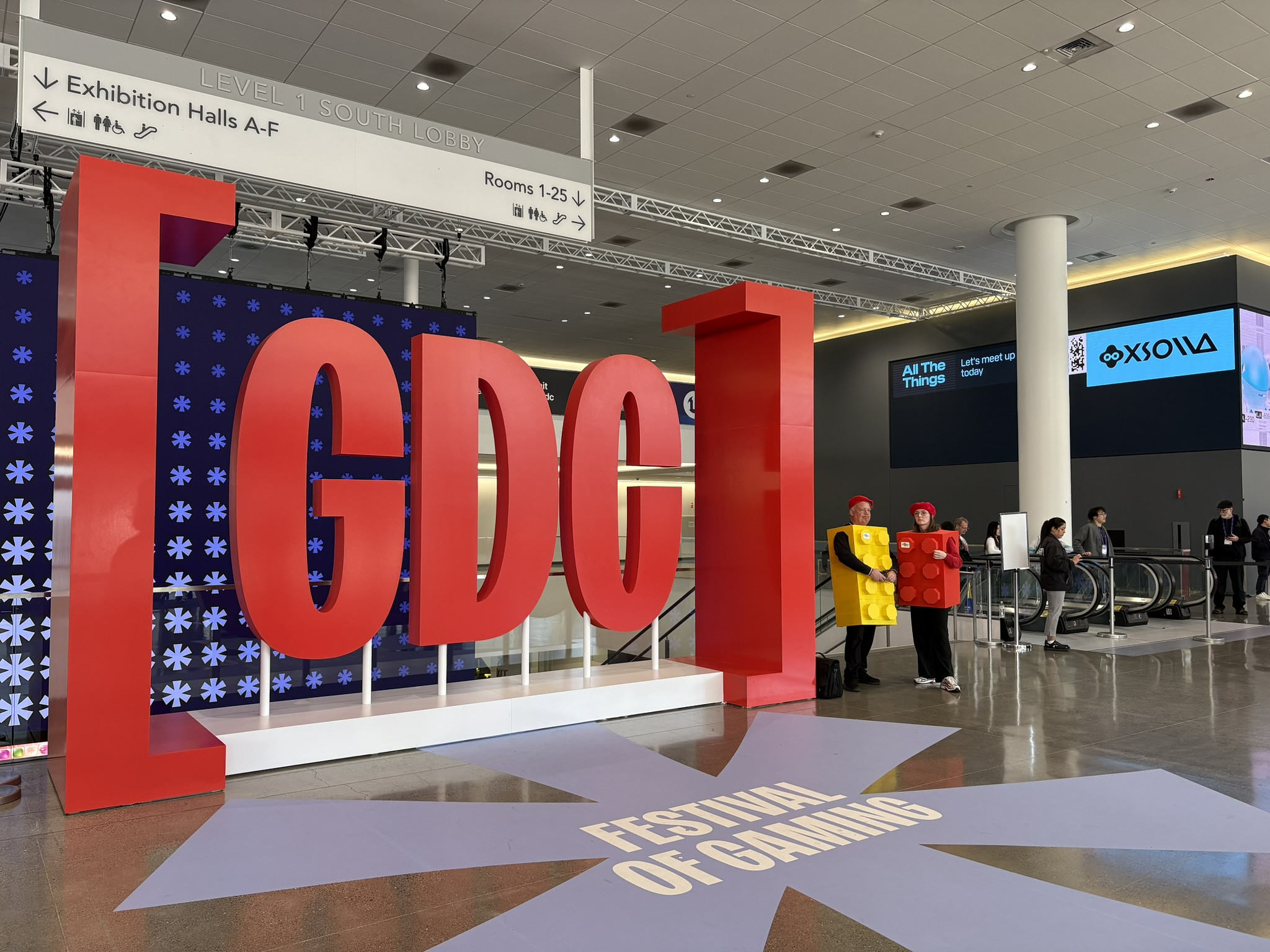
Every day last week, while some 30,000 people streamed into the Moscone Center for the 40th annual Game Developers Conference, Jordan Cerminara stood on the corner of Fourth and Howard streets, hawking games like a carnival barker.
“We’ve got real prizes here at the Skillz Victory Truck, folks! Apple Watches, iPads, all that stuff you people probably already have,” Cerminara bantered into his microphone, to no one in particular.
“All you gotta do is scan the QR code on this gas guzzler behind me and… Join! The! Tournament!”
Behind him rumbled a hulking LED billboard truck, blazing with leaderboards and animations of candy-colored games with names like Bingo Rampage, Blackout Poker, and Brick Blaster Cash. Ads for Skillz, the Las Vegas-based mobile gaming platform sponsoring the affair, flashed constantly on every screen.
The Skillz truck was the only outdoor activation at GDC, and it would not be inaccurate to call it a casino on wheels.
“When you land in Vegas,” one Skillz product manager hanging out behind the truck told me, “it feels like this.”
The activation also set the tone for this year’s conference: Flashy, a little manic, and palpably cash-hungry. As GDC panelists from every sector of the industry discussed how to weather AI disruption and thinning margins, “real money” games — video games that offer cash or crypto payouts to winning players — featured prominently on the expo floor. Monetization is on the rise, not only in mobile casino games and esports, but across other genres as well, like shooters, MMO arenas, and even AI-only battle royales. Forget playing for the joy of it. At GDC, play-to-earn was the future.
This trend in the video game industry is running in parallel to a more widespread cultural shift: It is 2026 in America, and everything is gambling. Sports betting has exploded in recent years, thanks to the rise of user-friendly apps like FanDuel and DraftKings and a 2018 Supreme Court decision that reversed a federal ban and handed legalization efforts back to the states; as of this month, sports betting in some form is legal in 40 states, plus Washington, DC. Prediction markets like Polymarket and Kalshi, which let users place bets on anything from the weather forecast to Anthropic’s IPO date to the war in Iran, have boomed so suddenly that regulation has struggled to catch up as rumors of insider trading abound.
Together, these industries rake in hundreds of billions of dollars and hordes of new users of all ages and demographics, their cultural and financial influence ballooning so dramatically that even industries like cable news have been compelled to get in on the action.
Save for prediction markets and casinos operating on tribal land, gambling is largely still illegal in California, so the real money video game companies that operate here walk a fine legal line. To distinguish themselves from games of chance, many companies market their titles as “skill-based,” meaning the winner is determined by abilities like speed or memory.
AviaGames, a Bay Area-based mobile multiplayer casino game maker with a booth at GDC, is one of these companies.
“It has grown dramatically in recent years,” AviaGames CEO Vickie Chen said of the skill-based gaming market. Last year, its global valuation was about $51 billion, up 16 percent from 2024; by 2030, that figure is expected to double to a whopping $100 billion.
Chen credits this surge to wider access to as well as the growth of secure payment services built for these game platforms. (As if to prove this point, AviaGames was stationed at GDC in the Monetization Lounge, a new “neighborhood” added to the expo floor this year, and was surrounded by advertisements and booths sponsored by services that promise near-instantaneous payouts for victors.)
Chen also said AviaGames titles are less complex, less time-consuming, and geared toward a less male-dominated audience than traditional esports. She said most of their user base are women aged 30 to 55 who play for entertainment. “But,” she said, “the real money part makes people more excited.”
As much as this sounds like gambling, Chen insisted it was not.
“I think the user base is quite different,” Chen said of the sports-betting and prediction market industries. “They are all competing with the system, the environment, maybe the computer. But for skill-based games, the most exciting part is competing with other opponents.”
The legality and potential size of the skill-based games market depends on the platforms keeping bots at bay. While Chen said AviaGames takes extensive measures to prevent AI fraud, there is an undeniable sloppiness to real money games. AviaGame’s website is full of AI-generated faces, and online forums often say the whole genre is full of “scams” and “ad farms.” In 2024, Skillz, of the carnival truck, won a $43 million settlement from AviaGames after suing the competitor for patent infringement and claiming they used AI bots to rig the games, which Skillz CEO Andrew Paradise said in a public statement undermined consumer trust in skill-based games.
But other exhibitors at GDC see bots as a valuable asset: One South Korean company called Nexus believes AI-only games will be the next hot genre, where the fun comes from putting money on your favorite agents and watching them duke it out from above, like a spectator at the Roman Colosseum.
At GDC, Nexus’s head of AI and blockchain, Isaac Lee, presented an example of what this sort of game could look like. It was called MoltyRoyale, a “Hunger Games-style” arena game he and his colleagues made after seeing the hype around Moltbook, the AI-only social media that went viral earlier this year. Lee claims around 40,000 actual humans, mostly based in the US and the Philippines, have trained and unleashed more than 7 million AI agents into the game to compete for a pot of $MOLTZ tokens. (At 7.2 million $MOLTZ, the pot would currently exchange for about $720 US dollars.)
“The monetization layer for players, not for companies, is going to be the next big trend,” Lee said, naming player-to-player trades of in-game items or speculation markets on AI-only games like MoltyRoyale as two likely revenue streams.
Overall at GDC, the signals were strong: Everyone is being squeezed. Everyone is getting more desperate — hell, even GDC itself rebranded this year as the “Festival of Gaming” in a bid to attract wider audiences.
Outside the Skillz Victory Truck, Cerminara, Skillz’s contracted emcee, put it this way: “Everyone’s just looking for new ways to make money.”