

No matter how hard I stare, I can’t see the bird, but I know it’s there.
The marsh grasses provide perfect cover, which is probably why the birds gathered here to scream like mad. From one distant bundle of brush comes a series of machine-gun calls: Ke-ke-ke, ke-ke-ke, ke-ke-ke.
“They can really throw their voices for being such petite animals,” says Whitney Grover, the director of conservation for the Golden Gate Bird Alliance.
We’re standing at Arrowhead Marsh, a strip of protected land in the San Leandro Bay, to catch a glimpse of an endangered Ridgway’s rail, a brown bird shaped like a fat mango with a neck.
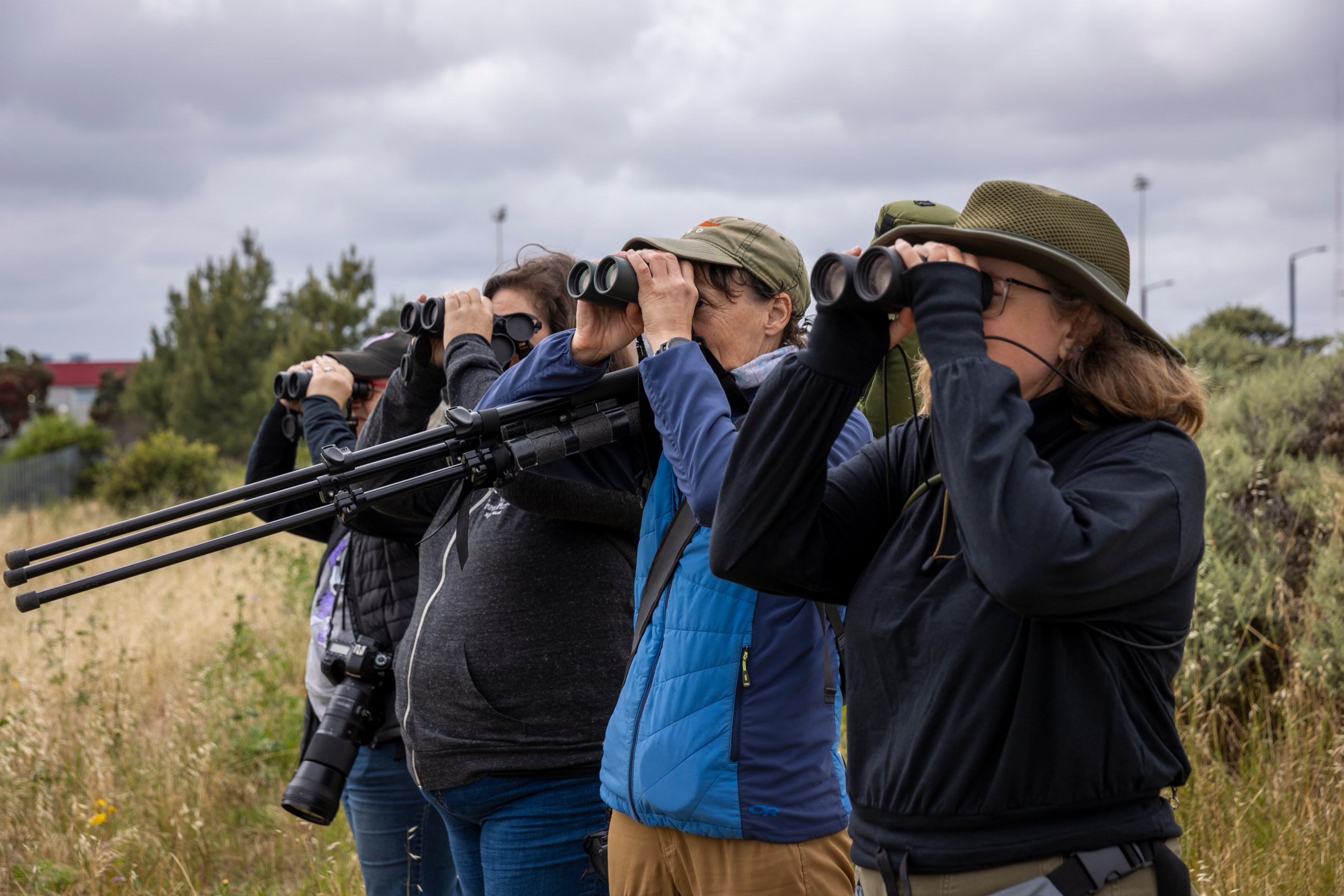
Grover is here with three friends, all experienced birders: Lisa Bach, Lisa Morehouse, and Tara McIntire. They’re the perfect guides for me, an aspiring bird nerd who fell in love with the hummingbirds and crows I feed in my garden. We’re here for the Golden Gate Bird Alliance’s Bay Birding Challenge, in which small teams race to document as many birds as they can in the Bay Area in one day.
Nine teams comprising a few dozen people are competing. For this foursome, Arrowhead is the third stop of the day; the highlight thus far is a bald eagle sighting at Point Pinole not long after sunrise.
The Ridgway’s rail ultimately stays hidden in the grass, but the call qualifies as a legit identification.
As we walk along the fenced-off marsh, however, Grover hears something that stops her dead in her tracks.
Kik-kik-kik-kurrrrr. Kik-kik-kik-kurrrrr.
“Oh my god. It’s a black rail,” she whispers to me.
“They’re tiny and very dark colored so they’re nearly impossible to see,” Grover continues without taking her eyes off the marsh. She raises her phone to record the cacophony.
Once upon a time, birders used paper maps and phone calls to document birds and share their sightings. Nowadays, birds are simply logged in an app called eBird to submit a visual sighting or an ID based on the bird’s call; another app, Merlin, is a handy encyclopedia to identify birds by photo or audio recording.
Arrowhead abuts the Oakland Airport, and the birdsong competes with the drone of planes. To get here, we drove by ugly hotels and an office park along the inaptly named Swan Way. (There are no swans here.) Yet here I am, holding my breath, enraptured by the kik-kik-kik-kurrrr call of the black rail, a creature that I didn’t even know existed until now. Even amid brutal urbanity, natural beauty persists.
Grover explains that the black rail is so endangered that, unlike with most species, the eBird app hides the location of sightings to limit environmental disruptions from excited birders. Rails are sensitive little things, and since we haven’t actually seen the bird, its vocalizing sparks a lively debate. The Merlin app suggests the vocalization is a Ridgway; Grover is unconvinced, suggesting that Ridgway’s rails go ke-ke-ke, without a purr at the end.
“We’ll just have to listen to the recording in the car,” says Morehouse.
The air is crisp, but the sky is millennial gray, not great for bird spotting, but as Morehouse puts it, “it’s fun when it’s hard.” I’m still a little bleary eyed after waking up early. I don’t even have binoculars.
If fishing is a meditative waiting game, birding is the opposite: It’s impossible to rest your mind amid so much stimuli.
Thankfully, McIntire has brought her spotting scope, which looks like something an Army sniper team would use. She waves me over to look through the eyepiece, which reveals a crystal-clear, perfectly stabilized image of a long-billed dowitcher, speckled in auburn and cream.
If fishing is a meditative waiting game, birding is the opposite: It’s impossible to rest your mind amid so much stimuli. As we meander through Arrowhead, my attention is both locked-in and going haywire. There’s a hum of tension as my companions gauge the sights, sounds, and their collective sixth sense.
Sometimes, the tension pays off. I’m midway through asking Bach a question when the other birders ahead burst into chatter. On the water is a tufted duck, showing off his distinctive slicked-back cluster of head feathers. For Morehouse, this one is a lifer: birder-speak for a species spotted for the first time. We coo and fawn over the duck, and as I gaze at it through McIntire’s scope, I swear the bird is judging us. It floats and stares, a star putting up with the paparazzi.
“Any conversation is okay to be interrupted by the sight of a bird,” Bach tells me apologetically.
“Birders are crazy. We’ll drop everything we can to get a lifer, you know?” McIntire chimes in.
McIntire, 55, lives in El Cerrito and works as a landscape architect in Marin. She came to birding after taking a college course in ornithology. Bach, a street and portrait photographer, got hooked during the pandemic. Morehouse, a journalist, became an accidental birder while reporting on rice paddies in Northern California.
All birders have what they call a “spark bird,” the one that ignited their curiosity. Bach’s is the evening grosbeak, a tiny bird with thick streaks of yellow over its eyes. Lately, she’s been about ducks, prompting Morehouse to affectionately call her the “queen of ducks.”
“There are birds that just get you to go to certain places,” Bach shrugs. “Wherever wood ducks are, I’m there.”
There are no wood ducks at our next stop to the south, Elsie Roemer Bird Sanctuary, named for the conservationist who fought to preserve marshland and restore bird populations all around the Bay. Grover is frowning, though. The sand used at the artificial Alameda Beach has now flowed south, creating raised sandbars.
“Man, this really sucks. The water should be higher so the birds can feed,” Grover says with a grimace. “Ninety percent of the shoreline all around the San Francisco Bay was filled or degraded, and we’ve lost all this marshland and beds of eel grass and other parts of the ecosystem.”
A flock of skimmers burst by, eliciting gasps from McIntire and Bach. Birding shows what we lost, what we have, and what could be.
We’re supposed to go to Crissy Field by 2 p.m., but Grover sees an eBird alert for a garganey duck, a bird rarely seen in the Bay Area, in Redwood City. The team (especially duck queen Bach) immediately calls an audible.
Some 45 minutes later, I crack up in laughter as we arrive at the destination: a stripmall parking lot behind a Chipotle.
We gingerly step through a section of bent chain-link fence to access Nob Hill Pond, a little pool of calm water tucked next to the marshes of Bair Island. There are ducks, alright: Ruddies and pintails and caspians and a gadwall.
The garganey, however, is nowhere to be seen. The spirit of birding can seem, sometimes, like disappointment and wishful thinking.
We drive to a nearby cul-de-sac to access a levee on the opposite side of the pond, hoping for a better angle. We don’t find our garganey, but we do run into John Luther and Jim Lomax, two legends of California birding who’ve spent decades criss-crossing the state to document as many birds as possible in each county.
Despite being in their 80s, age hasn’t slowed Luther and Lomax. Luther tells me that he drove 851 miles in a single day to explore Siskiyou and Humboldt counties on a whim last week.
Lomax recently hit a landmark: documenting his 17,000th bird, making him only the second person in California to accomplish that feat. The first was Luther.
Lomax remembers what birding was like before the apps and alerts. “When I first started, there was a fella named Joe Moore who lives in Pacifica. He created a phone line where you could leave a message after spotting a bird,” he tells me.
“He would put it on tape so that if you called that number in the evening, you could hear the list of birds that were called in that day,” Lomax recalls. “There was no internet. Now, in the last 20 years, birding has expanded so much.”
Even after more than 17,000 birds, Lomax is far from done.
“The bird I’d really most like to see in California would be a spoon-billed sandpiper,” he tells me. “But chances are…” He trails off.
“The population of that bird is decreasing so fast that the chances of seeing it get lower every year.”
After about an hour, we give up on the garganey and head to Heron’s Head Park in San Francisco. We’d later learn that other birders reported spotting one 20 minutes after we left.
Like a gambler, a dedicated birder can’t help but take one more shot. On Sunday, McIntire rose early and drove from her home in El Cerrito down to Redwood City in the pale dawn light, hoping to catch her garganey before a 9 a.m. hike with friends in Antioch.
Nothing came of it.
The next day, McIntire’s phone lit up with a notification: The garganey had emerged once more.
“I finished up some meetings and thought, ‘You know what, I’m going to take the rest of the day off,’” McIntire told me.
McIntire was back at Nob Hill Pond by 1 p.m. A few hours passed as she and a handful of fellow birders gazed and gossiped and walked the perimeter of the water. At one point, McIntire took a meeting in her car. As she walked back toward the levee, she saw flailing arms in the distance, urging her over.
She sprinted onto the dirt path in a panic. And there it was, near a thicket of palm trees by the strip mall, floating among a gang of green-winged teals. The garganey stayed there for hours as a crowd amassed on the levee. Like a spotlight, the sun emerged from behind gray clouds, spilling light onto the water.
McIntire told me that nobody knows why this rare and perfect bird chose to rest at this janky little pond beyond a rusty fence in Redwood City. It could have alighted in a national park or a hidden valley. Instead, it chose this scrubby suburb. It makes me think of something Grover told me earlier: Birds appreciate “messiness.” Somehow, despite our best efforts to pave soil under asphalt, the garganey continues to swim.
Given such poetry, I couldn’t help but laugh when McIntire explained why she was so desperate to tick the garganey off her list.
“It’s… it’s just a good-lookin’ bird.”
A version of this story first ran in print in Gazetteer San Francisco Issue 3.