


Pop quiz: Imagine you have millions to burn on a big house in the Richmond, and you come across a listing for a four-bed beauty with a backyard and a renovated interior. The price is $2.9 million, and multiple offers are already rolling in.
What do you expect the final price will be? $3.5 million? Maybe an even $4 million?
How about $4.95 million?
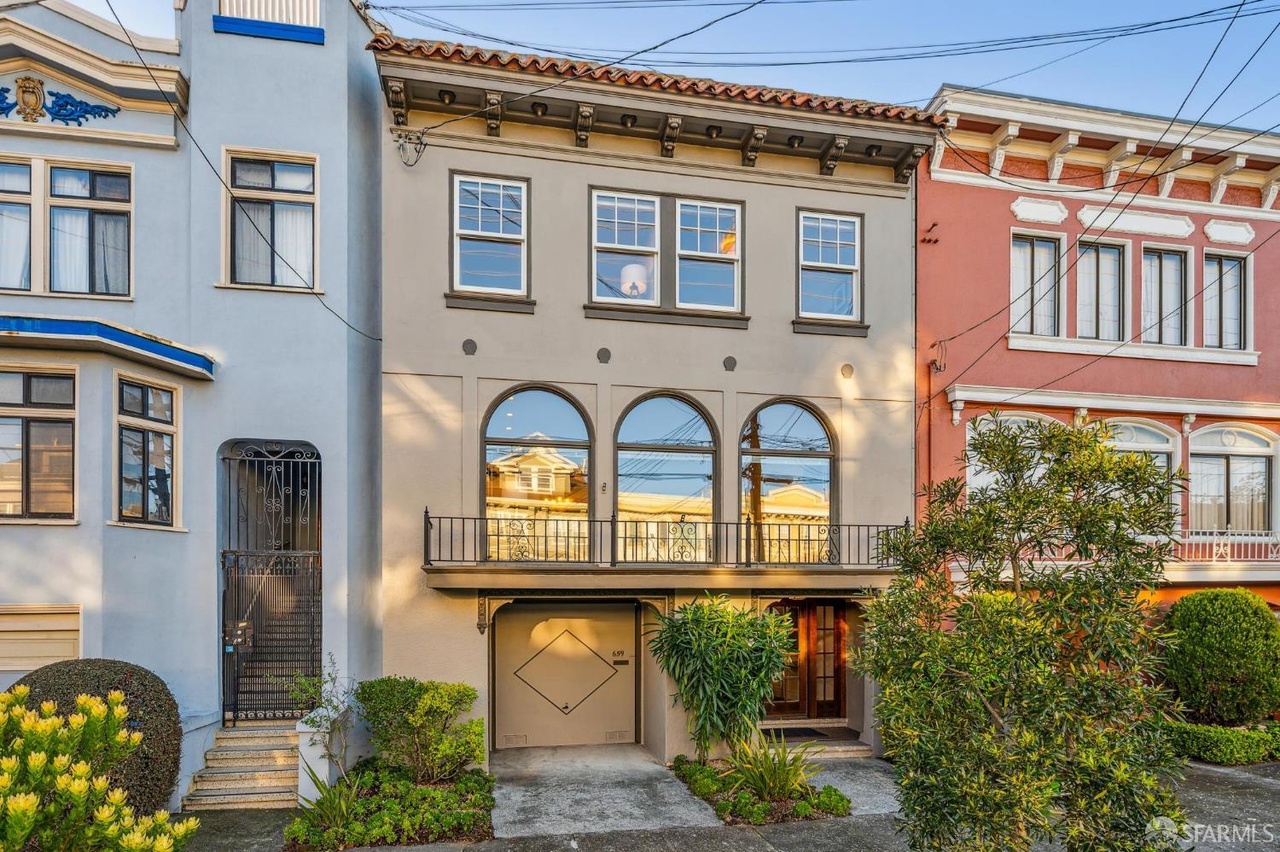
Such was the case with 659 12th Ave. in the Inner Richmond, which sold on Monday at nearly 70 percent over asking price.
The house appears fairly modest from the sidewalk, with a tiny garage entry and a simple facade punctuated by three arched windows; sandwiched between two similar homes, it blends right into the block. Its sale broke a neighborhood price record, according to listing broker and Rivet Real Estate founder Tal Klein.
“I was not anticipating this,” Klein told me. “From the seller’s perspective, I really thought it was going to be more like $3.8 [million], and maybe if I did everything right and prepped the house perfectly, I thought we could break $4 million.”
Instead, Klein watched as 18 offers rolled in, pushing the bidding war higher and higher. Eight offers went over $4 million, all cash. Now, 659 12th Ave. stands as a barometer, and perhaps a metaphor, for the volatile San Francisco housing market, which is soaring due to an uptick in deep-pocketed buyers returning to the Bay.
One reason for the home’s soaring price, Klein noted, is that it touts features coveted by the many moneyed shoppers in the local market, such as a remodeled interior and a backyard that is on the same level as the main floor, uncommon in many of the city’s three-story houses. It’s also a block away from Golden Gate Park and Park Presidio Boulevard, and a short walk to bustling Clement Street.
Perhaps a bigger factor in the price war, Klein added, is the scarcity of homes for sale in the city. She believes that there are other remodeled houses on the same block as 659 12th Ave. that could potentially sell for even higher than $4.9 million.
“But if you approach neighbors there, they’re not thinking of selling. They don’t move. There’s the rub, right? There’s not a lot of turnover,” Klein said. “And it doesn’t seem like that’s going to change anytime soon.”
In practice, it means that a pool of rich people are throwing mountains of cash at a handful of homes in San Francisco, with little concern about the original asking price. As for why, Klein has a theory: More than the AI boom, she sees the market catching fire as wealthy individuals move back to the city after the pandemic, seeking to diversify their investments amid unrest in governance and Wall Street.
Rohin Dhar, a real estate agent in San Francisco who posts frequently about local housing on X, spotted the listing of 659 12th Ave. in February and predicted that it would be a “market indicator” for future San Francisco home sales. He has seen similar cases in other neighborhoods, as with a Sunset home that sold last week for $1.8 million over its $2.3 million asking price.
“Everyone knows the market is hot, but it’s actually hotter than people even think,” Dhar said. “[Developers] might make more condos, but we’re not seeing any more single-family homes.”
Dhar noted on X that it’s now normal for an SF house in the multi-million range to receive 15 offers, but it’s unclear whether “these are the same 15 people” each time.
“If a house gets five offers, [the pricing] might be kind of rational,” Dhar told me. “But against a bigger pool of offers, there’s no real alternative to coming in at the highest price you can.”
This news might just be more doom and gloom for prospective homebuyers who don’t have a couple extra million to burn, but Klein takes a more nuanced angle: San Francisco has always had an up-and-down housing market, tied to shifts in industry and the local economy. She recalled how she bought her Sunset house in 2000 for $200,000 over its initial $400,000 asking price, then watched as the dot-com bubble burst weeks later, sending home prices into a spiral.
“It’s very cyclical and if you look historically, we’ve had these boom-type, overexuberant, must-get-in phases,” Klein concluded. “It’s not going to last this time, either.”