


OAKLAND — Stop reading if you’ve already heard this one: Adolf Hitler got a day pass from hell and returned to Earth to meet with Elon Musk and Peter Thiel to tell them how much he admires their work. The architect of the Holocaust effusively praised not just the tech titans’ attacks on democracy and the cost in human life (cf. DOGE’s killing of USAID and the possibly 14 million people who may perish with it by 2030) but in how skillfully both men manipulate public opinion and the press.
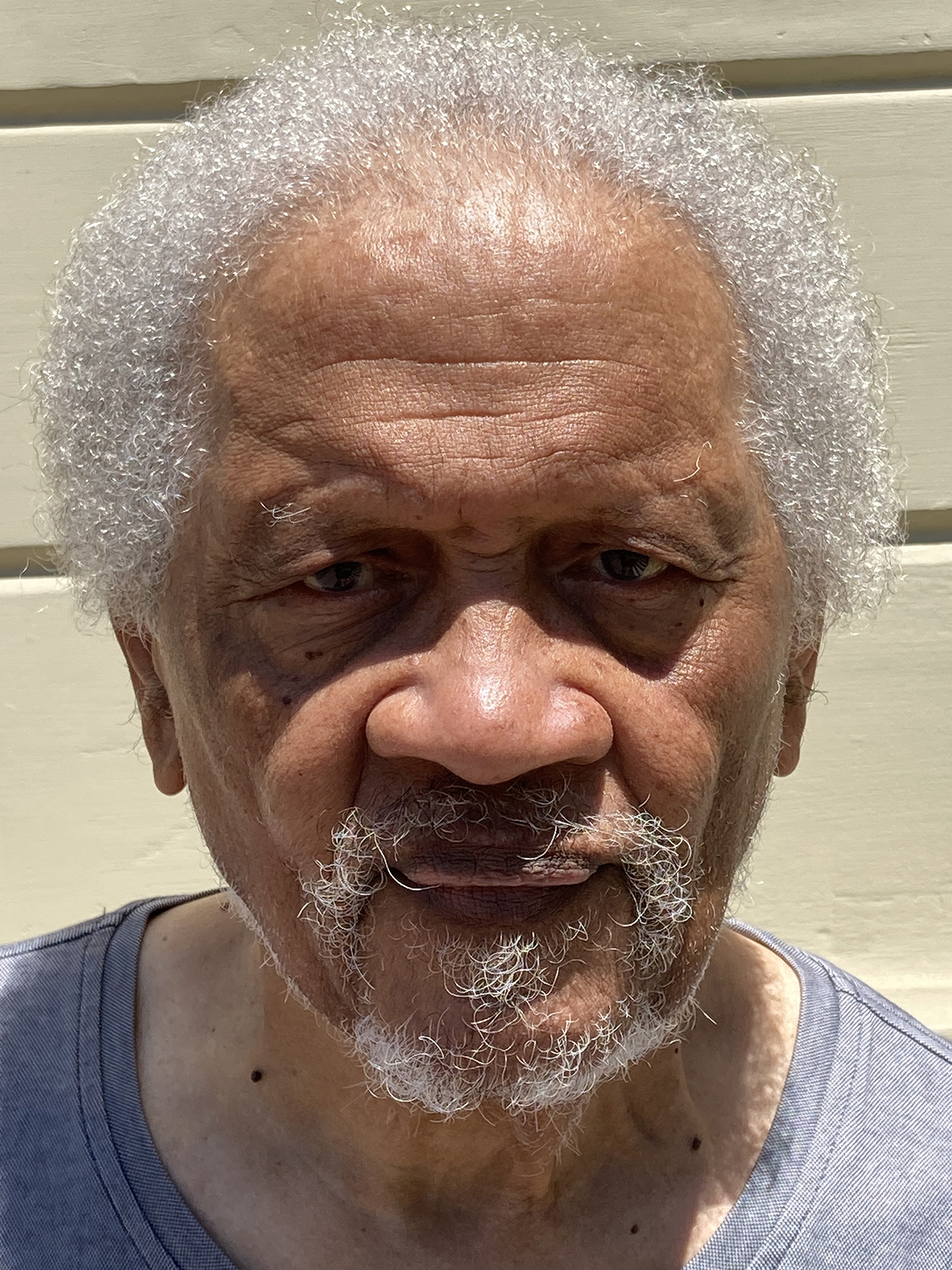
That’s the story of King Ludd’s Revenge, a new farcical play being written by Ishmael Reed, the prolific Oakland author, poet, and composer who was a finalist for the Pulitzer Prize in 1973.
Reed doesn’t hold back when talking about the men who inspired King Ludd. Musk, he says, is “a guy who doesn’t live in the real world” and “the closest we’ve had to a mass murderer,” adding “even his children have awful things to say about him.” Thiel is a “monster,” a “racist,” a “homophobe,” and an “anti-Semite.”
“We take our scripts right out of what's happening today in the real world instead of this escapist stuff that they do on Broadway,” Reed says.
He’s still working on the final version of the play, but Reed hopes to mount it with his wife and collaborator Carla Blank, directing the production in San Francisco in September.
“The actors are very excited; they can’t wait to play Hitler, Thiel, and Musk,” Blank says, uttering a sentence that has probably never been said aloud before.
All Reed and Blank need to bring Hitler, Musk, and Thiel to the stage is money, for which they’re turning to GoFundMe. They’re hoping to raise $5,500. Reed acknowledged that the fundraising is not going well: Despite donations from folks like Wajahat Ali (a writer and playwright Reed mentored) and Heyday Books publisher Steve Wasserman, King Ludd is barely a third of the way to its fundraising goal.
Then, there’s the other money concern: What if Musk or Thiel sue?
Reed previously wrote and produced a play about a public figure called The Haunting of Lin Manuel Miranda, and is quick to note that the law firmly protects works of satire. He also thinks that a lawsuit might actually be good for the show’s fundraising efforts. (So far, neither Musk nor Thiel have publicly acknowledged the production.) “If he sues, that’s a mark in my favor: The message would get even more widespread notice,” Reed says, essentially daring Musk to channel his inner Streisand.
Reed, 88, has been an Oakland mainstay for over six decades. The essays in his 2007 book Blues City: A Walk In Oakland captured the city at a critical moment when gentrification pushed out a working class, multicultural population and turned the Town into a bedroom community of San Francisco. Since 2013, a mural featuring one of Reed’s quotes (“Let Oakland be a city of civility. Let each citizen treat other citizens with good will and generosity”) has adorned a building at 43rd and Market Streets, a testament to his status as a neighborhood fixture.
Despite his deep Bay Area roots, Reed has mounted most of his theater work in New York. (The Haunting premiered at the East Village’s Nuyorican Poets Cafe in 2019.) “I got more from the NY [State] Council of the Arts than any grants given out here,” Reed says. “I don’t get that kind of support here, so a lot of the money has to come out of my pocket.”
Reed and Blank describe King Ludd’s Revenge as a Living Newspaper, a theatrical format that, in the US, dates back to the New Deal when the federal government helped fund the arts to keep people employed with the Works Progress Administration.
“The Living Newspaper idea was to write a script that’s taken verbatim from things these men [Musk and Thiel] have stated in public and what they really believe,” says Blank. “It was a way of punching up the words and images of actual events so that people could really see them.”
Before its WPA incarnation, the Living Newspaper was a form of Soviet propaganda intended to reach the largely-illiterate working class in the years after the 1917 Bolshevik Revolution, according to UC Irvine professor emeritus of history Lynn Mally, who devoted her early career to studying Soviet culture.
Soviet-era Living Newspapers dramatized the news in a satirical manner, not unlike Reed’s work-in-progress. “Heavy-handedness is fine,” Mally said, though those shows favored allegorical characters rather than public figures.
By comparison, American Living Newspapers, many produced by the Federal Theater Project, were less satirical and more straightforward, per Sharon Musher, an historian of the New Deal who teaches at Stockton University. The shows were also often political. “The Living Newspaper had a perspective, and it was very far to the left,” Musher said.
This may explain why the Federal Theater Program lasted just four years: Even with the censors taking shears to the scripts, the shows were too provocative. Often they would end with an audience member (a plant) standing up and demanding “What is to be done?” and the actors onstage responding by spurring the audience to take action.
Reed and Blank may not revive the Living Newspaper as a form or Oakland theater as a scene with King Ludd, but that doesn’t mean they’ll stop finding ways to expose figures like Musk and Thiel in their work.
“We’ve got to keep up with them,” Reed says. “It’s up to playwrights to tackle the issues of the day, especially radical playwrights.”