

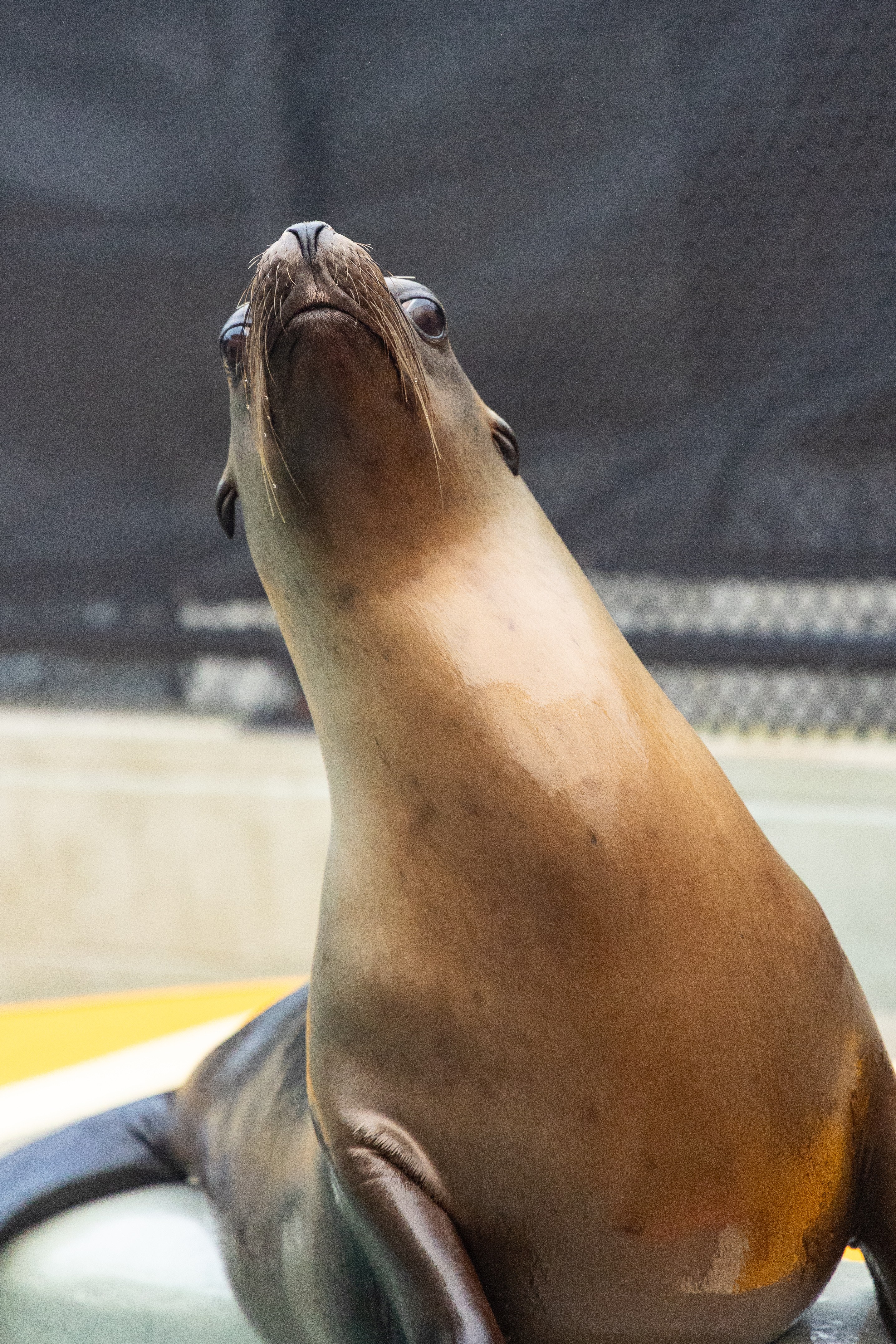

During a casual walk with my kids on Ocean Beach in September, we had a surprise encounter that has become more common in recent months: in the sand, not far from Vincente Street, we saw a large dead sea lion. A few feet away, we spotted a younger, smaller one. As I moved closer, I got a clear view of its whiskers and eyes, and saw it twitch its hind flippers. It was alive.
A small crew of volunteers from the Sausalito-based nonprofit Marine Mammal Center was watching from a distance and one of them let us know we were getting too close. (The group advises keeping at least 150 feet of distance from sea lions.)
Shortly after we spotted the animals on Ocean Beach, things moved quickly. More trained volunteer responders from the center arrived with rescue equipment and an animal carrier similar to the kind used for pets, to take the juvenile sea lion away moments before the sun set into the sea.
Many sea lion strandings this year have been attributed to harmful algal bloom (HAB) events, in which toxic algae made up of pseudo-nitzschia, a diatom (microalgae) at the very base of the marine food chain that produces a toxin called domoic acid proliferates and causes serious harm to sea life. Domoic acid accumulation in sea lions can cause lethargy, disorientation, unpredictable behavior, twitching, tremors, and seizures. Warming oceans and other factors like ocean acidification contribute to the proliferation of toxic algae leading to more sea lion deaths along the West coast.
The upcoming rainy season may make the problem worse, according to Raphael Kudela, a distinguished professor of ocean sciences at UC Santa Cruz. “We’re coming into what’s probably going to be a really large El Niño, and we know that also increases the probability of these toxin events,” Kudela told Gazetteer SF.
The center has been responding to an unusually high number of California sea lions suffering from domoic acid poisoning, according to Giancarlo Rulli, associate director of public relations for Marine Mammal Center. This year’s outbreak is the largest in the history of the center, which first diagnosed domoic acid toxicosis in California sea lions in 1998. The center has received between 300 and more than 600 phone calls a day on its hotline in recent months; its volunteers and employees have responded to sea lion and other animal strandings along 600 miles of coastline between Mendocino and San Luis Obispo counties.
As of October, the center had rescued 291 sea lions affected by domoic acid poisoning, with most of the rescues happening since July. Normally, the number of animals rescued for domoic acid poisoning is between 75 and 90 per year, with the majority of those being sea lions, Rulli said. Within its response range, the major sea lion stranding hot spots this year are spread across Monterey, Santa Cruz and San Mateo counties, with additional cases in Marin, Sonoma, and San Francisco counties.
Kudela noted that sea lions can also wind up in the bay or rivers when they’re disoriented. “Animals are foraging on things like anchovy and sardine and squid, and those are the organisms that are eating the toxic algae,” Kudela explained. “And if it’s a nice bloom going in, say the Gulf of the Farallones, then, sure enough, you’re going to see a hot spot of strandings if the animals start coming in.”
The dead sea lion I saw in September was left behind on Ocean Beach. When I visited the beach over the next few days, its carcass had been lightly scavenged by other animals. While domoic acid does spread through the food web, there’s not enough data that points to poisoning through scavenging.
Kathi Lefebvre, a research biologist with the Wildlife Algal-toxin Research and Response Network of NOAA’s Northwest Fisheries Science Center, has studied domoic acid for over two decades.
“If birds or pets consume the gut contents of carcasses, there may be a potential for poisoning in some cases, but we haven’t seen that yet,” Lefebvre wrote in an email. “We have detected domoic acid in terrestrial predators, but have not documented any acute toxic events through scavenging.”
According to Sue Pemberton, associate manager of marine mammal stranding at the California Academy of Sciences, dead sea lions are left on the beach “almost all the time.” Pemberton and other responders from the Academy examine dead sea lions or other marine mammal carcasses to determine species and age, gather data like length and sex, and, depending on research priorities and interest, may also collect parts.
“It’s illegal to possess any parts of marine mammals without permits,” Pemberton said. “You can’t chop the head off a sea lion because they want it,” Pemberton said in reference to a gruesome incident on Ocean Beach where a decapitated sea lion was found in September.
The rescued juvenile sea lion I witnessed that day was not affected by domoic acid poisoning. Researchers named it Junebug and treated it for malnutrition, muscle and joint stiffness, and an abscess. After several weeks of rehab at the center’s Sausalito hospital, Junebug was released in Point Reyes National Seashore.
The juvenile sea lion had received a clean bill of health from the center’s veterinarians, who were also pleased with the sea lion’s robust weight gain and foraging ability while competing with penmates. Like all sea lions rehabilitated by the center and released into the wild, Junebug was also sent off with a tag on its flipper.
After our experience with Junebug on Ocean Beach, I am eager to visit Point Reyes with my kids to see sea lions in a happier setting. Who knows, I might even spot a young one growing stronger by the day, with an orange flipper tag.