

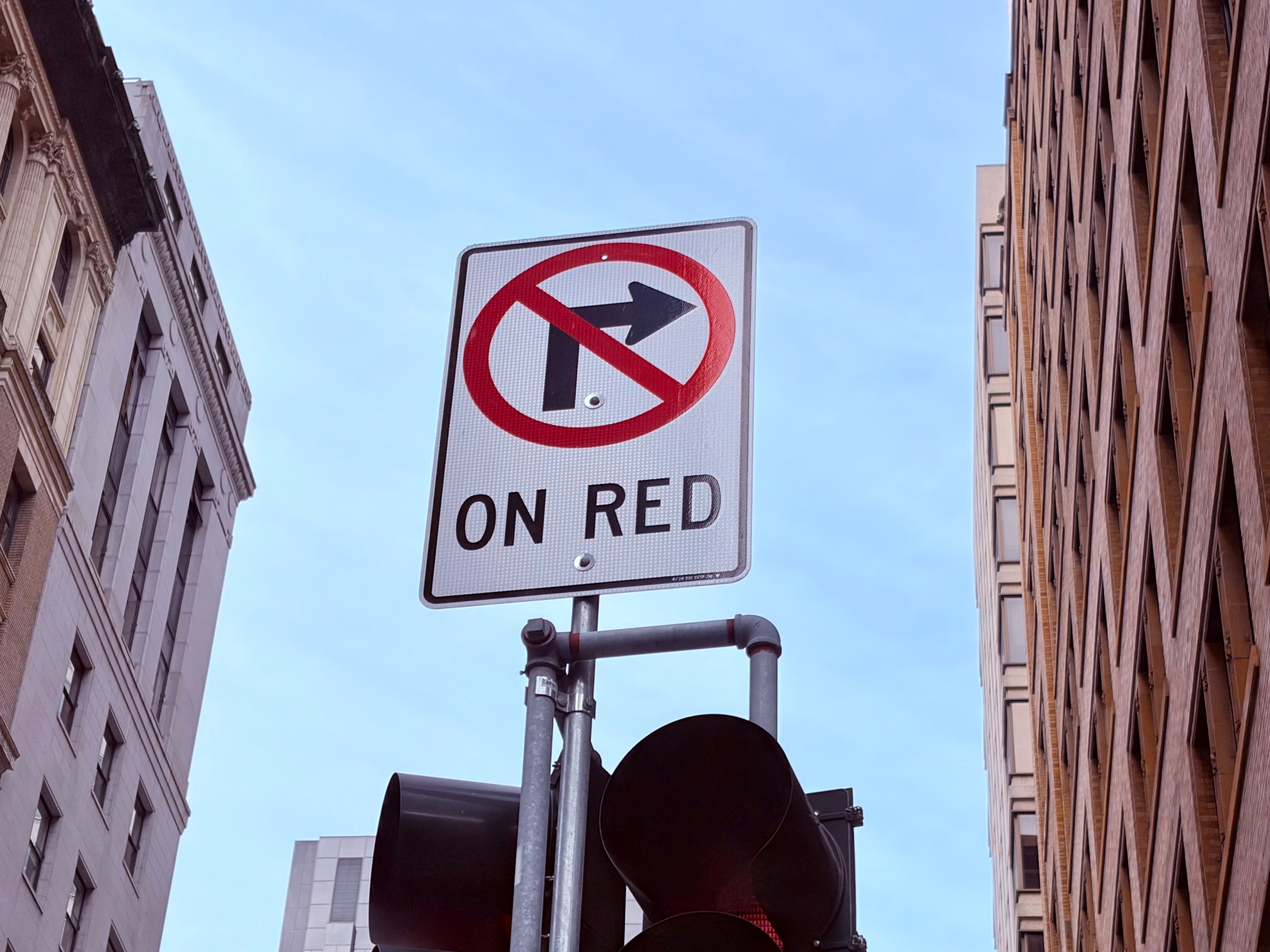

In 2021, the San Francisco Municipal Transportation Agency spearheaded an effort to protect pedestrians and streamline traffic by installing “No Turn on Red” signs throughout the Tenderloin.
The effect of the signs was substantial: The rate of “close calls” between cars and walkers decreased by 80 percent, and the neighborhood also saw a 70 percent drop in cars blocking or creeping into a crosswalk, according to the SFMTA.
Now, transportation advocacy group Streets Forward is calling on the city to install “No Turn on Red” signs at every single intersection across San Francisco.
The city already expanded the program to 200 intersections in downtown SF in 2024, and is on the cusp of approving “phase three” to more than 150 intersections northwest of downtown, including along major thoroughfares like Van Ness Avenue and Gough Street.
Luke Bornheimer, executive director of the nonprofit Streets Forward, told Gazetteer SF that implementing “No Turn on Red” across the city is a “low-hanging fruit” policy that would bring immediate benefits to road safety while spending minimal city funds.
“We’re saying, look, phase four of this program should just be the rest of intersections in San Francisco. The current plan is an incremental approach to something that is proven to increase safety,” Bornheimer said. “Maybe that approach made sense early on, when you’re launching a pilot, but now we see the results.”
Lurie has said that “traffic safety is public safety,” and in December 2025 pushed an executive directive to make streets safer for pedestrians, cyclists, transit riders and drivers alike. The full “No Turn on Red” proposal fits neatly into this vision, Bornheimer said, without any need to make drastic infrastructure or bureaucratic changes.
SFMTA’s prior analysis found 20 percent of accidents between pedestrians/cyclists and cars at intersections with signal lights was due to a driver turning on red. However, the benefit of the “No Turn on Red” policy is evident not just in San Francisco, but around the country. Washington, DC, for example, saw a 92 percent decrease in drivers who fail to yield to pedestrians at red lights, and a 97 percent decrease in vehicle-to-vehicle incidents.
In contrast, research by the National Highway Traffic Safety Administration found that allowing turns on red increased crashes between pedestrians and cars by 44 percent, and accidents involving cyclists by 59 percent. The agency and other transportation experts have been aware of the risks of right-on-red policies for decades; A 1981 study found that allowing turns on red raised accident rates “significantly at all study sites” across the country. Other consequent studies in multiple cities around the US have found similar results.
The Tenderloin report by SFMTA and research from other cities suggests that the vast majority of drivers abide by “No Turn on Red” rules, even without needing to increase enforcement by police. Bornheimer noted that he has heard from a number of drivers who feel turning right on red is challenging and anxiety-inducing — “Especially when people are honking at them, rushing them, making them feel unsafe.”
Some experts have questioned the ultimate value of implementing a “No Turn on Red” policy because of data that suggests it has only a small impact on traffic fatalities, but advocates argue that reducing the volume of accidents and injuries, even minor ones, has long-term benefits for public safety.
Streets Forward’s analysis suggests that putting “No Turn on Red” signs at every intersection with a traffic light would cost about $258,000. SFMTA estimates that transforming a four-way intersection with “No Turn on Red” signs costs about $4,000. Prior phases, including the currently proposed phase-three expansion, are subsidized by a Highway Safety Improvement Program grant administered by the Federal Highway Administration that covers 90 percent of the total cost, according to SFMTA. The city matches 10 percent of the cost using Prop L tax revenue, the agency told Gazetteer.
In order to be approved, a project proposal must be reviewed by SFMTA staff and considered in a public engineering hearing before going to the SFMTA board of directors for a final decision. In practice, however, a push from the mayor or the Board of Supervisors would be an influential factor in the SFTMA passing and implementing an ambitious policy like city-wide “No Turn on Red,” Bornheimer said.
“You can imagine the mayor putting out a statement that says, ‘I’m supporting this proven public safety improvement at every traffic light in the city,” and then MTA would see it has the mayor’s backing, and move on the technical process to get it approved,” Bornheimer added.
Streets Forward is asking the public to sign its petition to bring more political attention to its proposal. The “No Turn on Red” campaign is part of what it calls the Intuitive Intersection Initiative, which also includes efforts to paint every crosswalk in the city and add bike and scooter parking to daylighting zones.
Allowing right turns on red is a vestige of the 1970s oil crisis in America, based on a flawed theory that drivers would save gas, Bornheimer said. The policy was exacerbated by the fear that states could lose federal funding if it didn’t abide by the right-on-red mandate. This “status quo mentality” after more than 50 years is bad for cities, he said.
“When we think about what things that can be done city-wide to make it safer and easier to get around San Francisco, ‘No Turn on Red’ is one of the easiest things we can do,” Bornheimer said. “Why should anyone not have this improvement near their home, school, work, or their merchant corridor?”