

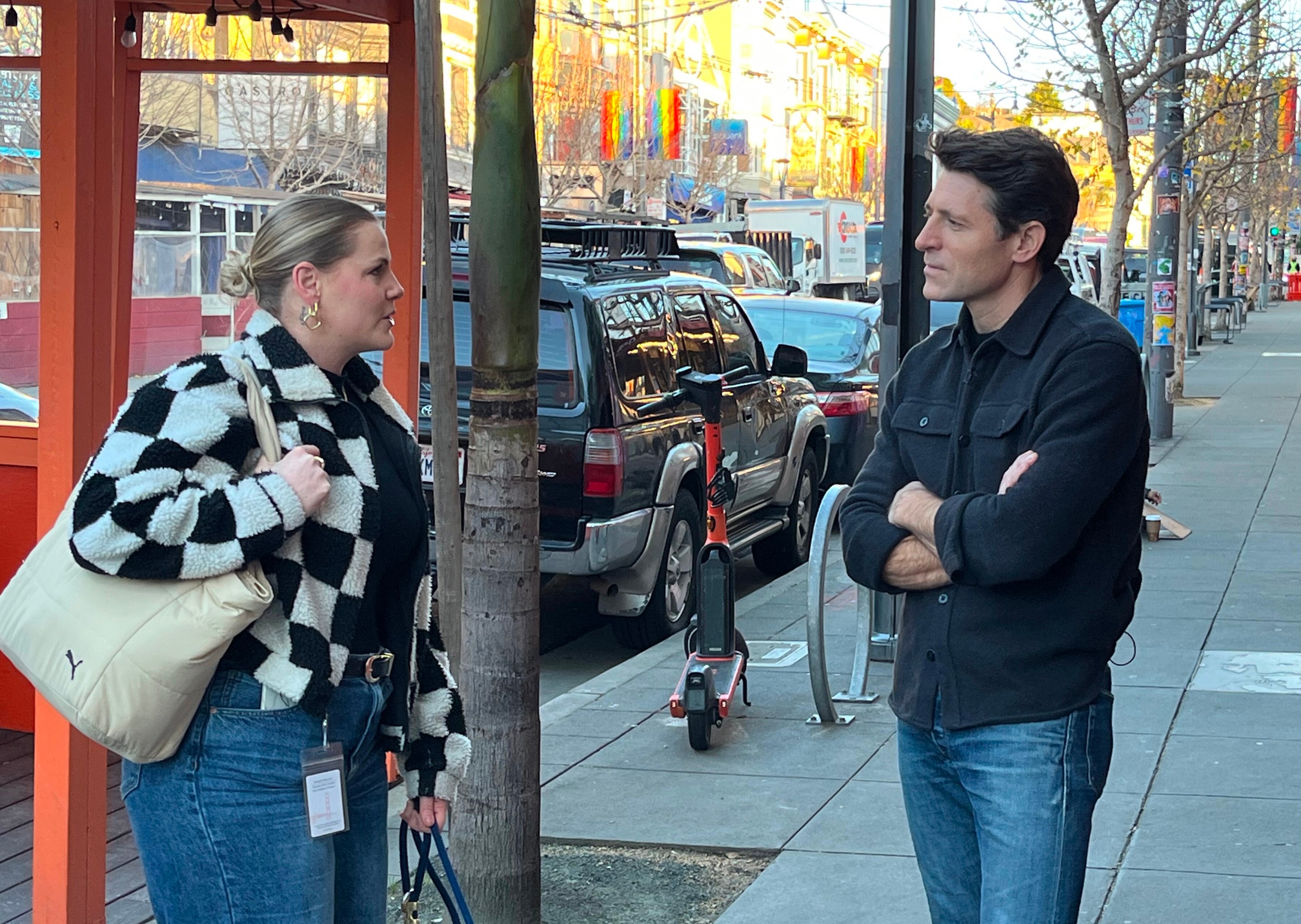
Tony Dokoupil was in San Francisco today, standing on the corner of 17th and Castro.
“I’m Tony Dokoupil, I’m the new anchor of the CBS Evening News,” he told me when I ran into his crew after dropping my kids off at school.
Dokoupil has the bland good looks, strong chin, and immovable hair of an actor playing a news anchor in a movie. As it happens, news anchor is a job that has lost almost all of its cache in the 21st century, yet Dokoupil’s hiring has been closely watched since his network’s parent company, Paramount, was gobbled up last year by David Ellison’s Skydance Media. Ellison, son of Oracle founder Larry Ellison, installed controversial anti-woke opinion editor Bari Weiss as CBS News’s editor-in-chief; Dokoupil is Weiss’s first big hire.
Dokoupil’s rollout started with him in Grand Central Terminal seeing if anyone could pronounce his last name. (They mostly couldn’t.) He was supposed to go on a 10-city tour to meet the “average Americans” he lauded in a tweet on Jan. 1, but had to postpone it when he was drafted to do a special Saturday night broadcast about the kidnapping of Nicolás Maduro of Venezuela.
That broadcast featured a softball interview with the so-called Secretary of War Pete Hegseth, and was described by Variety’s Daniel D’Addario as one in which “the administration’s perspective was aired so thoroughly as to raise the question of when an interview becomes a press release.”
He followed that interview a few days later with a tribute to Secretary of State Marco Rubio that somehow managed to use AI-generated memes as an indicator of his success and ended with Dokoupil saying something Walter Cronkite surely would never have uttered on air: “Marco Rubio, we salute you! You’re the ultimate Florida man.” (The White House loved it.)
Now, here he was in the Castro, perhaps to meet the ultimate San Francisco man, or at least announcing he now sits at the desk once helmed by Walter Cronkite, known in his time as “the most trusted man in America.”
“I’m asking people where they would rather live, the past, the present or the future, because San Francisco has built so much of the future,” Dokoupil told me. “Amazingly and mysteriously, people mostly say they want to live in the past or the present. I mean, overwhelmingly, almost no one says the future. So the future has kind of a marketing problem.”
He probably understands: Nobody is giving the future a fair shake.

Dokoupil said he lived in lower Pacific Heights about 20 years ago when he worked for a PR company right out of school; he’s been back to the city since then to cover news stories. His next stop would be Cincinnati, then Denver, Detroit, Chicago, and Pittsburgh.
Our interview now over, I watched as Dokoupil interviewed other average people like Quinta Chapman and her husband Matthew Thomas, both from England, who were fresh from their morning workouts and had no idea who Dokoupil was. The anchor asked Chapman about the past, present, and future. She said she’d like to live in the present — because she’s concerned about it, and can affect the future.
Dokoupil said her answer was “mindful.”