


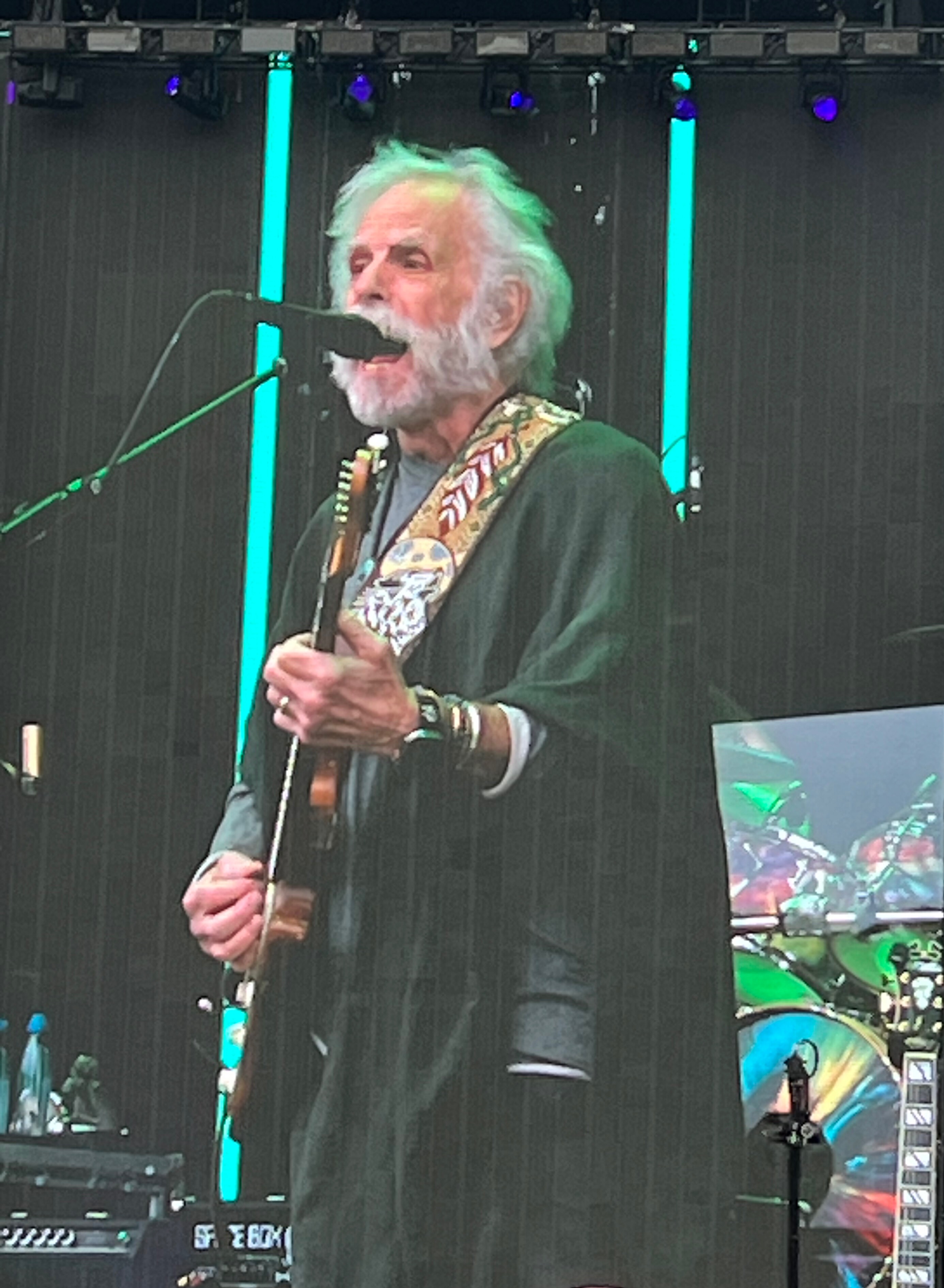

When Bob Weir took the stage in Golden Gate Park in August, he was as curious a presence as when I first saw him play live 40 years earlier, though in a completely different way.
The Grateful Dead co-founder, who died over the weekend, played his final shows with Dead & Co. at the park this summer. He was shaggy, wearing bracelets and birkenstocks, and some kind of robe or pancho. A friend observed that with his hat and white beard, he looked like Gandalf. Over the years, as he played in other bands, including RatDog, The Other Ones, and Bobby and the Midnites, Weir’s appearance evolved radically.
When I first saw him in the 1980s, Weir was a neatly dressed guy, known for his short shorts. At my first Dead concert at Red Rocks, in Morrison, Colorado, I noted his sneakers, which helped him to occasionally leap out of the long shadow of his considerably more famous bandmate, Jerry Garcia. This wasn’t David Lee Roth, or even Pete Townsend, it was the Dead: Weir’s leaps were modest, and yet at every show I saw when he embraced the spotlight, the crowd loved it, yelling, “Bobby!”
By August 2025, Weir had grown into a 77-year-old man, who, as it turns out, was fighting cancer. According to his family, he was diagnosed in July, and had begun treatment before the final summer shows. As I watched him, he frequently wiped saliva from his beard. He grew briefly irritated with himself when he forgot or mangled lyrics, shaking his head in frustration. The crowd around me roared with appreciation. “Bobby!” I heard them shout again.
What hadn’t changed at all, was Weir’s countenance on stage. Beyond the shorts and sneakers that I identified with, his expression was beguiling. Rolling Stone’s Richard Gehr and Daniel Kreps referred to it as Weir’s “slightly off-kilter stage presence.” The New York Times wrote about how Weir was mistakenly thought of as the “spacey kid” trying to keep up with Garcia, and bassist Phil Lesh, who died in October 2024. Those qualities, as well as Weir’s guitar skills, come across in his interview and performance with Garcia on a 1982 Late Night with David Letterman clip found on YouTube.
To me, Weir sang with a particular look in his eyes that was part glare, and part plea. He looked at you, but also through and past you at the same time. It was as if he was asking you to believe in the music, and at the same time, daring you not to.
You can hear this quality in his songs, including “The Other One,” and “Estimated Prophet,” which holds a special meaning for me. My family doesn’t share my appreciation for the Grateful Dead, so I undertake my seances with the band when I’m alone. The one sliver of an exception is my son, who has taken a liking to “Estimated Prophet.” I took him to one of the August shows; alas, he couldn’t make it to the second set when Weir sang the song, likely for the last time.
The song is about a deluded person who believes him or herself to be a seer. Weir has explained that it was based on the bug-eyed fans he’d see at the backstage of shows experiencing a vision, who has a “rave he’s got to deliver.” The song points to a distrust of false prophets, especially their self-aggrandizement and pride. “If I find myself being proud of something, I try to find the challenges that are associated with that, because I don’t trust pride,” Weir told Rolling Stone in March. “I try not to allow myself to go there. Being prideful is not going to get you much of anywhere, as far as I can see.”
Weir, like “Estimated Prophet” and so many Grateful Dead songs, had a mystical quality that’s hard to define. My guess is that he’d prefer that his legacy be appreciated for the way he made us feel. And that he’d prefer his contribution to be appreciated the same way he said we should feel about Garcia when the lead guitarist died in 1995.
Weir made a brief public statement at the time, captured in the 2017 documentary Long Strange Trip, without taking any questions:
“Well, I guess some sad news has come our way. This morning, Jerry Garcia, our friend, my brother, passed away. It’s a big loss for the world, for anyone who loves music. And I guess not much could be said about that, except that we also have to remember that his life was a — far more a blessing for all of us, and I think we should, perhaps if we’re going to dwell on anything, dwell on that. Thank you.”
No, Bobby: Thank you.