

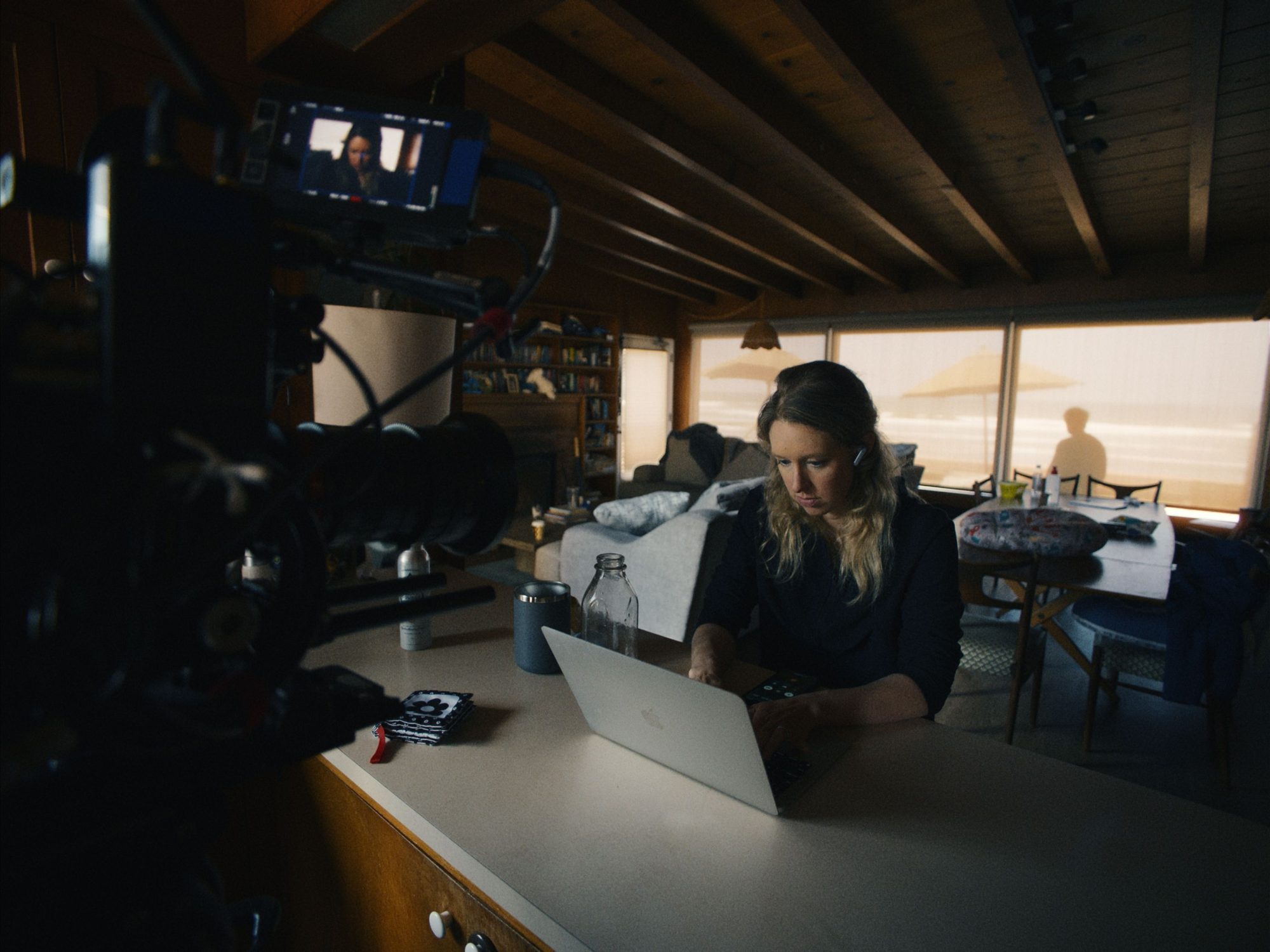

It was with a certain amount of dread that I found my seat in a packed theater at the AMC Kabuki 8 in Japantown on Sunday to see You Can See Everything, Nathan Fielder and Lance Oppenheim’s documentary about Elizabeth Holmes. Watching her onscreen was the first time I looked at Holmes’s face, or heard her voice, since I studied her in person in a federal courthouse in San Jose when she was sentenced to 11 years in prison in 2022.
I covered the Theranos fraud case as a legal reporter for Bloomberg News for more than four years, starting when Holmes was criminally charged in 2018. After the implosion of Theranos, Holmes struck me as another Steve Jobs-worshipping technology huckster who had achieved the Valley dream of siphoning millions from investors, notably Rupert Murdoch and the DeVos family, who were even less sympathetic than she was. The scale of Holmes’s fraud was unusual, but the fake-it-until-you-make-it playbook she relied on was well worn by the time she was revealed to be a fake.
While the collapse of Theranos (thanks to reporting by the Wall Street Journal’s John Carreyrou in 2015) pointed to an obvious fraud, the task of proving that Holmes was responsible for the crime wasn’t so simple for the prosecutors. The case boiled down to whether Holmes lied when she claimed Theranos’s device could accurately evaluate hundreds of blood test results when in fact it could only read at most about a dozen. It required prosecutors to convince a jury of Holmes’s criminal intent; they had to show that Holmes knowingly deceived investors.
This is the same starting point of Fielder’s inquiry in the film. Though he interviews Holmes after she was convicted, and shortly before she’s headed to prison, the criminal prosecution features prominently in the start of the film. Fielder can’t seem to fathom how Holmes continues to insist on her innocence.
About 30 minutes into the almost three-hour film, Fielder asks Holmes what happens if he uncovers something that makes her look “guilty — really guilty.”
“I’m not guilty,” Holmes says.
“You really feel you did nothing wrong?” Fielder asks.
“I did not,” Holmes tells him.
“You never tried to deceive anyone?” Fielder asks.
“I’ve never tried to deceive anyone,” she insists.
Holmes’s well rehearsed response, her proclamation of innocence, surely practiced many times with her defense lawyers, could’ve come straight from the testimony I watched from my seat in the courtroom.
It is highly unusual — in fact, it’s unprecedented in my two decades of legal coverage — for a white collar criminal defendant to speak to the press during trial. Most do not want to talk, and are advised not to by their lawyers who know their client’s comments might hurt their defense.
But at trial, as in the film, Holmes couldn’t seem to help herself from speaking. Looking back, as strange as this was, it makes some sense. Holmes’s success was due in no small part to her talking, telling the story of going from Stanford dropout to head of a multibillion dollar biotech company. She spoke to the press: Inc. put her on its cover beside the all-caps headline, “The Next Steve Jobs.” She spoke with investors: Theranos was valued at $9 billion at its peak.
Arguably, it was her talking that led to her downfall: The Journal’s Carreyrou read a 2014 New Yorker profile of Holmes by veteran reporter Ken Auletta and couldn’t make sense of the founder’s explanation of her company’s core tech: “A chemistry is performed so that a chemical reaction occurs and generates a signal from the chemical interaction with the sample, which is translated into a result, which is then reviewed by certified laboratory personnel.” Carreyrou decided to look beyond Holmes’s talk.
One early morning during Holmes’s trial, I found myself in the courthouse elevator with just her and her mother. I showed up that day walking gingerly, leaning on a trekking pole and wearing new sneakers, thanks to plantar fasciitis, a painful foot condition. I could feel Holmes take an unusual interest in me hobbling into the elevator. Immediately, and seemingly genuinely, she inquired about what was wrong.
I was taken aback. Her level of interest would be unusual coming from any stranger; it was especially odd coming from the defendant at a criminal trial I was covering. Holmes listened to me, and looked at me, not with her famous stare, but intently, as I explained what happened.
In our brief exchange, Holmes did what she’d done with investors like Murdoch and Larry Ellison, board members like Henry Kissinger and James Mattis, attorneys like David Boies, and reporters like Auletta: She connected. For a moment, despite the consequential events that had brought us together in that courtroom, Holmes made me feel like we were the only two people in the world. (Well, besides her mother, Noel, who had a look of resigned acceptance as if she understood what her daughter was doing and was powerless to stop her.)
Even facing a long prison sentence, she saw an opportunity to use her voice and connect.
On another occasion, we were both at the courthouse one evening and she walked by alone. “You’re here late,” I said to her. “You’re here late,” she replied, like we were two colleagues spotting each other in our cubicles after hours.
Watching Fielder’s film, I was reminded of our courthouse interactions. The co-director’s far more intimate encounters with his subject helped me finally understand why Holmes’s story is so compelling: It’s a tale about how a person uses deception in interactions big and small to get what she wants. That’s true for millions of dollars in capital and for a reporter who may give her a small reprieve from the negative coverage she’d been getting for years.
In You Can See Everything, though, it’s obvious that Holmes’s greatest deception may be of herself: Even after her company is revealed to be a fraud, she’s been convicted, and is on the verge of imprisonment, she wants — needs — to believe her own story.