

On a recent Monday afternoon, Willie Brown’s usual corner table at Sam’s Grill & Seafood Restaurant was waiting for him.
Almost every day, a politician or candidate shows up at Sam’s in the financial District seeking Brown’s counsel, which he serves up as regularly — and as bracingly — as the signature martinis he orders.
If that seems like something you might’ve read from a bygone era a decade or two, or six, ago, it remains true to this day. At 92, Brown, the maestro of Sacramento and San Francisco politics, is still the man to see. And for four days a week, sometimes five, Sam’s is the place to see him.
I first learned of Brown’s unique power lunches when I moved to San Francisco 26 years ago. Brown was in the first year of his second term as mayor, and his Friday lunches with friends and powerbrokers (most were both) was one of the things that made him more of a celebrity than a public servant.
I marveled at the eye-popping colors and textures of Brown’s expensive suits; the younger women he dated, even as he was (and still is) married to his first wife; and how allegations, and investigations, rolled off him without leaving a mark.
So it was with deep curiosity, and, I’ll admit, a measure of awe, that I found myself sitting across from Brown.
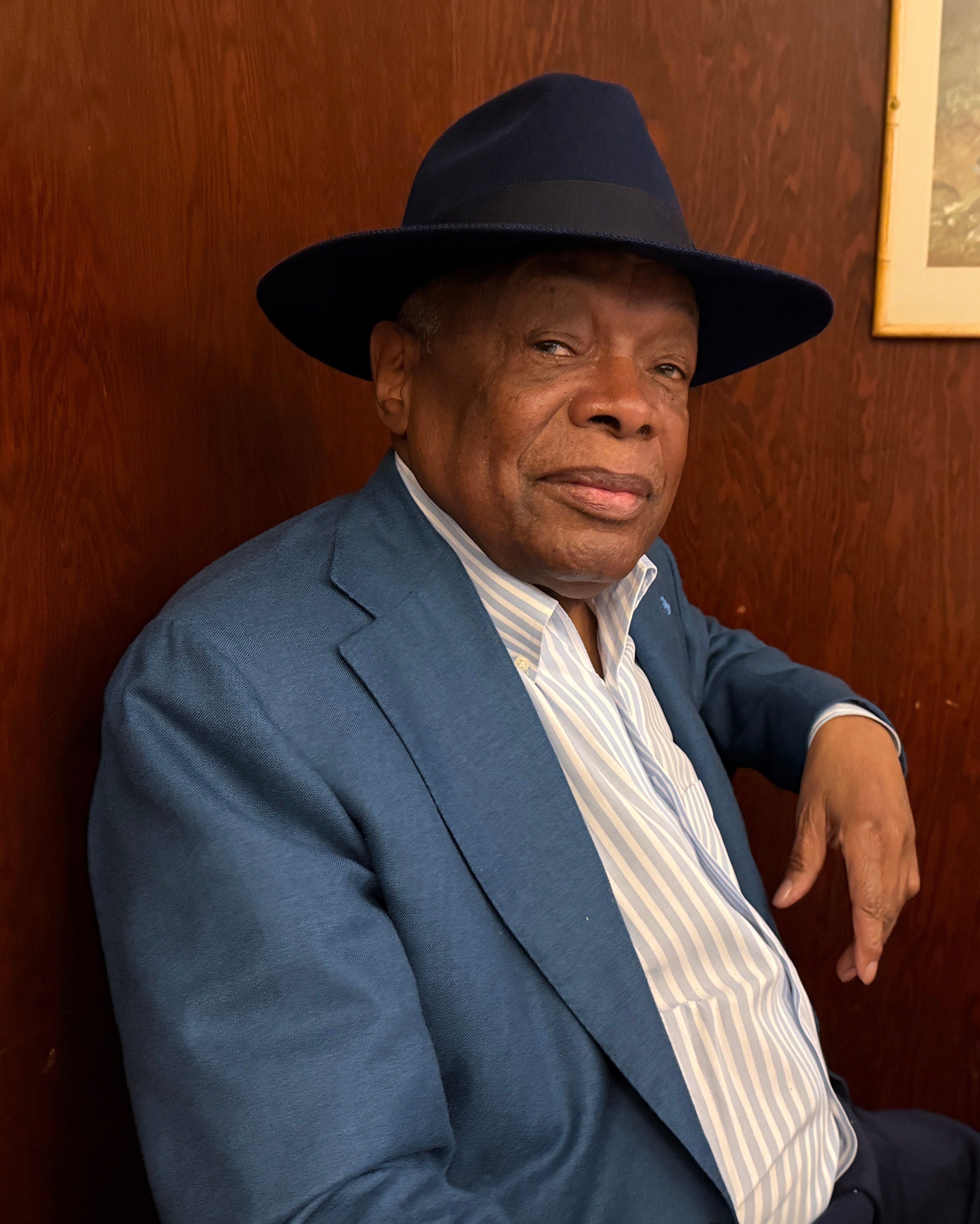
As Brown entered, I watched him being greeted by customers and restaurant staff. He strolled past the wooden bar, and set his black, wide brimmed Borsalino fedora on a hook above his designated chair that reads “Mayor Brown” on the back. (A gift from the restaurant for his 90th birthday, it turns out.) He had no entourage, no security. Brown hasn’t owned a car for 15 years. When he can’t walk to his destination from his condo at the St. Regis Residences, next to the San Francisco Museum of Modern Art, he takes the city bus, as he did to meet me that day.
Brown gave a regular order to Maria Adams, his longtime server: a “James,” short for James Bond; A Grey Goose vodka martini, no garnish, shaken not stirred, poured ice cold into a slightly taller and wider glass etched with his name. (A gift for his 91st birthday.)
Even entering his tenth decade, Brown remains undiminished, a still vital embodiment of the city he ran and arguably still runs after a fashion. As the city is reshaped by AI and its attendant wealth, Brown’s connection to it, like the Bay Bridge named after him, is foundational. I saw this in the way fellow diners, often complete strangers to Brown, interrupted our lunch to say hello, to shake his hand and connect to some part of the city’s more graceful, and gracious, past. One man walked by and tipped his hat, saying simply “Your Honor.”
I, too, wanted to connect. Covering City Hall for Gazetteer SF, I sought Brown for his take on the city and what he thinks of its current mayor, Daniel Lurie.
As we spoke, Brown easily recalled precise dates and events that seemed to describe multiple identities, and lifetimes. His flamboyance belies a remarkable resume of public service. In between his years growing up in segregated Mineola, Texas, and the end of his second term as San Francisco’s mayor in 2004, Brown was a janitor, a dental hygienist in the National Guard, a criminal defense lawyer representing pimps and prostitutes, and a civil rights leader. In 1969, representing San Francisco in the California Assembly, Brown co-wrote a bill that decriminalized gay sex in the state, and fought for six years to get it passed. He served in the state assembly for 30 years, 15 of them as speaker.
Brown’s conversation can shift rapidly to oratory, punctuated by his hand hitting against the table like a gavel. He laughs frequently, even at dark topics, answering questions with wide, looping tales. He told me about his favorite trip to Paris, one of many, to celebrate his 75th birthday with about 100 people, a number that, as he told the story, grew to 120.
“It was almost impossible for me, actually, to do the trip, because I had an illness,” he said. “I had brain fluid leaking through my nose.”
At this, he let out a long, sustained chuckle that took me by surprise. Doctors at UCSF detected a crack in Brown’s skull, which they surmised he sustained much earlier in life, and insisted on immediate surgery. (Brown suspects the cause was sports he played, or fights, from when he was a teenager in Mineola).
He recalled a visit from then Gov. Arnold Schwarzenegger who, because Brown was still feeling the effects of anesthesia, looked to him like an alien.
“Lo and behold, I’m stuck in a fucking hospital,” Brown said. When his chief of staff paid him a visit, “I told her, ‘See if there’s any money in my pocket, in my clothing.’ She goes in the closet there at the hospital, and she comes back. ‘Yeah, yeah, as usual, you have some money here.’ I said thank you, and she left.” Brown paused.
“I got dressed, I called a taxi, and I never went back for a second visit, not to this day,” he said matter of factly.
Forty minutes into our meeting, I noticed he was deep into his martini. I asked if he wanted to eat.
“Yes!” he said. “I thought you invited me to lunch. I didn’t invite you, you invited me!”
Brown got the salmon and mashed potatoes. I figured he knew the menu, so I copied his order. Brown was served a small loaf of sourdough bread as he prefers it: buttered on the inside and reheated until the crust is burnt and hardened.
I asked him how much time he had to talk.
“I figured that you would ask about three questions, and I’d have an enjoyable lunch with somebody else,” Brown said. I told him I had a long list of questions and he’d better cancel those plans and settle in. At that, he let out a deep, gleeful laugh.
It occurred to me that I was unconsciously reenacting a version of the weekly lunches that Brown had with Herb Caen, the Pulitzer prize winning columnist for the San Francisco Chronicle. The two ate at Le Central Bistro for 35 years, and grew so close that Brown officiated Caen’s marriage (the columnist’s fourth) to Ann Moller Caen, who died in August. Brown maintained similar close relationships with Chronicle columnists Phil Matier and Carla Marinucci, whom he still lunches with on occasion.
Brown likes journalists, and not just because they like writing about him. “Usually, the press has better information than any of my political friends, and many of the people who write as press people are far more interested in accuracy than many of my political friends. And I live for accuracy — period. Which means that I sometimes have to suffer through my own missteps.”
Those “missteps” run the gamut of silly (a 1997 quip about Golden State Warrior Latrell Sprewell) to serious (his ties to a controversial development deal at Hunter’s Point), but for the most part, Brown has remained one of San Francisco’s most beloved figures — not the usual fate for politicians, especially ones whose City Hall was raided by the FBI in 1999. (Brown himself was never accused of wrongdoing.)
I asked if when he was mayor, the press generally had access to him.
“I insist!” Brown said, still speaking in the present tense as if he was still serving as the city’s executive. “I insist that you get to me if I’m the mayor.”
Brown’s insistence made me think of the man who currently occupies his office. Daniel Lurie “doesn’t have a good relationship with the press,” Brown told me. The observation squared with my own experience covering the mayor, and that of other journalists I’ve spoken to who feel Lurie is insulated and overly managed by his public relations team.
“Every politician needs to have their own personal relationship with the press,” Brown said. “It’s the only way they’re going to be able to interpret whatever the press asks about, or whatever the press writes about.”
Lurie, Brown said, has sought his counsel, right here at Sam’s, in fact. Brown’s approach with Lurie is to answer the mayor’s questions, not to offer unsolicited advice. Lurie’s distance from the press hasn’t come up yet in their talks, Brown said. “But it will.”
Brown’s harshest criticism of Lurie stems from the current mayor’s push for Propositions D, E, and F, which Lurie says will “Clean Up City Hall” by, in part, further consolidating his power. Brown told me he reads every piece of campaign literature in his mailbox, and recently received a flier promoting the push for the upcoming November election. It is paid for by Mayor Lurie’s Yes on D, E & F Committee. Its top three funders, Michael Moritz, Chris Larsen, and John Pritzker, are billionaire Lurie allies, who together have contributed more than $5 million to the advertising campaign.
“What do you mean ‘Clean Up City Hall?’” Brown asked. “This fucking guy’s been the mayor for almost two years. What the fuck could he be talking about?”
Brown was picking up steam. “How can you say City Hall is corrupt? You want to clean out City Hall corruption? You have won the election. You are now the fucking mayor. You now have all the authority. You have all the authority on this issue, and I don’t like City Hall being described as some kind of a fucking cesspool. I don’t understand that.”
To Brown, Lurie’s “Clean Up City Hall” campaign misleadingly “condemns” the entire Board of Supervisors, and hundreds of city workers, including commissioners and volunteers. “That piece of literature is a great mistake,” Brown told me, adding that he plans to take the issue up with Lurie personally. “I will confront any elected official whom I think is misstepping,” he said.
While Lurie is widely viewed as a moderate, Brown is also critical of politicians to his left. He is an institutionalist who views the Democratic Socialists of America as a threat to Democratic party unity, and its return to power. While he finds New York City Mayor Zohran Mamdani “impressive,” he is deeply concerned about the DSA’s momentum, particularly in Nithya Raman’s race against Los Angeles Mayor Karen Bass.
“We’ve got the fucking Democratic Socialists kicking our ass,” Brown said. “We shouldn’t be losing to folks that nobody knows who they really are. ”
Just then, a woman who looked to be in her 20s came to the table to introduce herself to Brown, another interruption that he gladly entertained. The woman told Brown that her friend, Dr. Tim Baker, a dentist from Fresno, told her to say hello.
“That crazy kid?” Brown said to the woman. He asked her to have Baker call him at 2 p.m. The woman was uncertain if Brown understood who she was referring to.
“OK,” she said. “Dr. Tim Brown from Fresno?”
“Yeah,” Brown said. “We talk often enough.”
After the woman left, he turned to me and said in a low, authoritative tone: “That’s what you have to do if you’re the mayor.”
Everyone, it seems, wants a little of Brown’s time. Earlier this year, Maria Adams, our server, told me Gov. Gavin Newsom, whom Brown appointed to San Francisco’s Parking and Traffic Commission, and later, in 1997, to the city’s Board of Supervisors, dropped by Sam’s unannounced. Adams told me she admonished Brown for not letting the restaurant know ahead of time that Newsom was coming. Brown said he had no idea – that the governor correctly assumed he’d find Brown at his usual spot.
I asked Brown what he thought about Newsom’s decision not to run for president in 2028 if Kamala Harris does.
“You believe that?” Brown said.
“You know better than me,” I responded.
“We politicians would never decline — never decline — to run, if we thought we could win,” Brown said. Newsom’s statement “would only be applicable if he didn’t think he could win.”
If Newsom concludes he can win, “he runs,” Brown said.
What about Harris, I asked. Brown dated Harris from 1994 to 1995, and as mayor supported her successful 2003 campaign for San Francisco District Attorney. Brown said he hopes Harris decides against running. He envisions the former Vice President as a future Chief Justice of the Supreme Court.
“I’m Newsom,” Brown said, meaning he’s picked his candidate. “I think I can win with him. And I want to win the presidency.”
In a follow-up phone conversation a few days after our lunch, I asked Brown about Manny Yekutiel, the candidate for District 8 Supervisor who dropped out of the race after multiple allegations of sexual assault surfaced. (News of Yekutiel’s withdrawal from the campaign broke just before Brown and I spoke again.)
Brown told me that he supported Yekutiel’s candidacy but didn’t endorse him. In the call, Brown said Yekutiel shouldn’t have withdrawn from the race.
Yekutiel “was going to win that race the way all things were going,” Brown said. The alleged sexual assault Yekutiel is accused of “didn’t happen last month,” Brown added. “It didn't happen ten months ago.” Why, Brown asked, would Yekutiel’s accusers wait until less than 30 days before the election to disclose the allegations? “This has got to be the kind of thing that people do for one purpose,” Brown speculated.
As our lunch at Sam’s ended, Brown said he was headed to a Film SF Alliance event, and later, to a fundraiser for a candidate running to represent Sacramento in Congress. I thanked him for the conversation, which lasted more than two hours, and expressed my admiration for his fedora.
“That’s the Texas in me,” Brown told me. “It comes from my uncles. They all wore hats. But then again, in the early days, lots of Black folk wore hats. Black men wore hats regularly, and Black women really wore hats.”
He pulled the brim down over his forehead, harder than expected, and flattened it with both hands. I asked him why.
“I just moved it down a little bit,” Brown explained. “Because I don’t want to look completely Texas, and not completely a cowboy,” he said, laughing at himself.