
In January 2013, Stephen Kosslyn needed advice on building a San Francisco school from scratch. Naturally, he turned to Jeffrey Epstein, the powerful, behind-the-scenes financial advisor who served a 13-month sentence for attempting to procure an underage prostitute.
By the time he reached out to Epstein, Kosslyn had already gained renown for his research on psychology and the human brain. He pioneered the field of cognitive neuroscience at Harvard University and, later, as director of Stanford’s Center for Advanced Study in the Behavioral Sciences, where he unlocked new discoveries on the biology of learning and the mind’s eye.
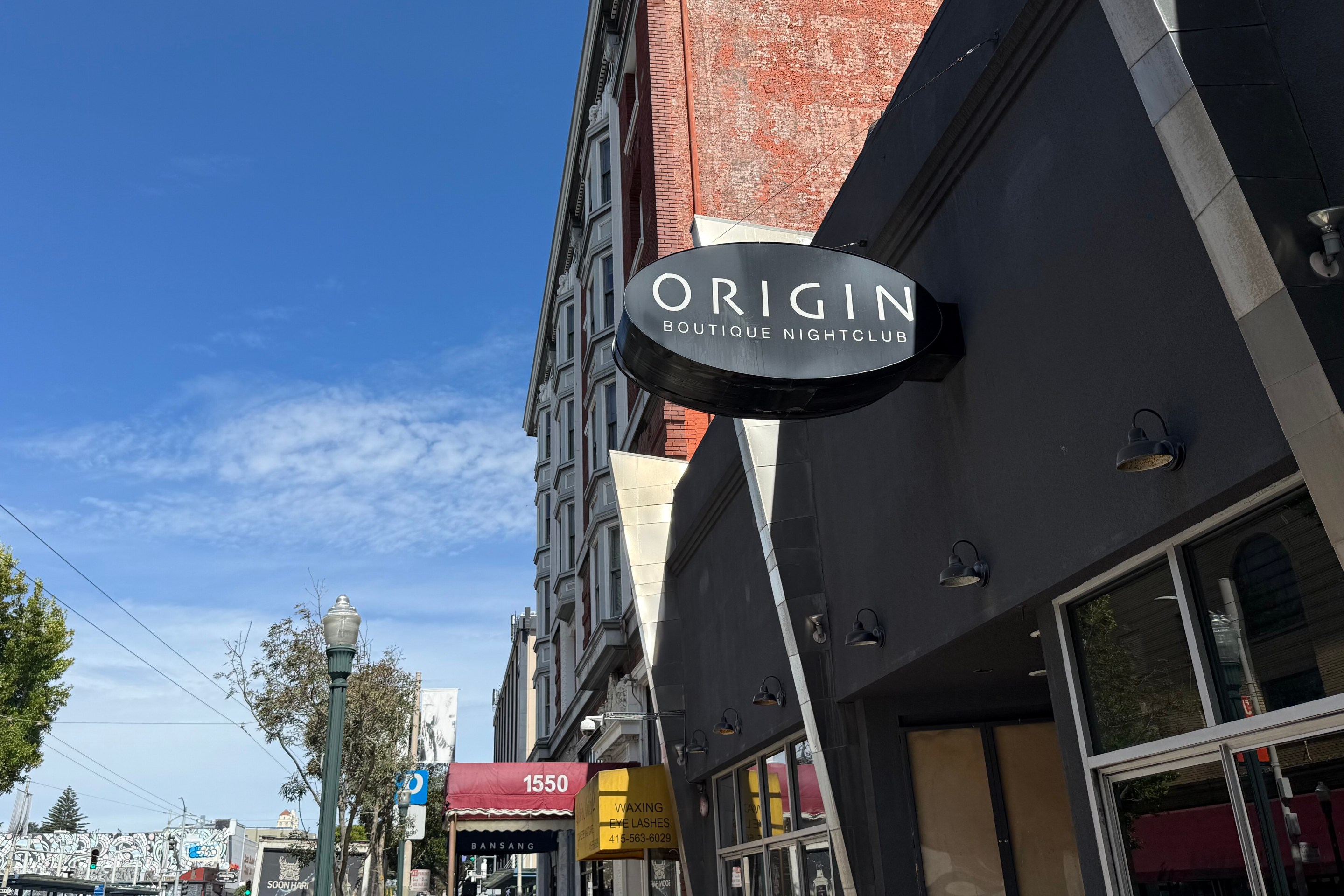
His next project would take him to San Francisco. Minerva University, located at 14 Mint Plaza, is an institution that has been dubbed “hardest US school to get into.” It grew out of the Minerva Project, founded by former Snapfish CEO and president Ben Nelson, who hired Kosslyn as founding dean in 2012.
The college touts itself as a revolutionary alternative to conventional universities, built for elite students who want “global immersion” and remote courses in lieu of campus life. Minerva has about 650 students who live in four communal “residences” around the world, starting in a Tenderloin dorm for freshman year.
Minerva is mentioned in the Epstein files hundreds of times, and dozens of emails show how Kosslyn, Nelson, and Chair Emeritus Bob Kerrey, the former US senator and Nebraska governor, leaned on Epstein as a consultant to develop the Minerva Project.
After publication, Samantha Morales, a spokesperson for Minerva University, sent a statement that read, “Minerva University condemns Jeffrey Epstein’s criminal conduct and the harm inflicted on survivors. The events described in the article predate the establishment of Minerva University as its own independent nonprofit university in 2019.”
Morales also noted: “No individuals mentioned in the article are employed by Minerva University or serve on the university’s governing board. The safety and wellbeing of our students and broader community remain central to our mission, along with our commitment to the highest ethical standards.”
In a response to Gazetteer sent after this story was published, Sharan Chandradath Singh, Chief Growth Officer for Minerva, explained that Kosslyn had a “pre-existing relationship with Mr. Epstein that Mr. Nelson was not aware of until well after Mr. Kosslyn joined Minerva”
Singh went on to note that “any of Mr. Kosslyn’s and Mr. Kerrey’s interactions with Mr. Epstein were of their own volition, but nothing related to Minerva ever resulted from any such interactions. Minerva Project did not receive any funding from Mr. Epstein nor did Mr. Epstein provide any contacts, affiliates or referrals to Minerva... Mr. Nelson was not aware of Mr. Epstein’s criminal history when that conversation took place in NYC, and Mr. Nelson neither solicited nor received any advice, funding or any other type of support from Mr. Epstein related to Minerva Project. Furthermore, Mr. Kosslyn and Mr. Kerrey have not been involved with Minerva Project for some time.”
We are still waiting to hear back from Kosslyn.
By January 2013, Kosslyn was already trying to connect Nelson with Epstein. Kosslyn met Epstein in the 1990s, and between 1998 and 2002 received $200,000 in donations from Epstein to support his research.
A decade later, even despite Epstein’s criminal record, Kosslyn sought him as a counselor after he joined Nelson on the Minerva Project. The duo traded dozens of emails between 2013 and 2014, arranging personal calls, meetings with Minerva leadership, and even the use of Epstein’s New York City apartment by Kosslyn for a personal trip.
The first released email in the Epstein files that mentions Kosslyn and Minerva is dated Jan. 16, 2013. In it, longtime Epstein assistant Lesley Groff asks Kosslyn for Nelson’s contact info so the latter can speak with Epstein on Jan. 19.
The conversation seems to have not been all positive. On Jan. 20, Kosslyn followed up on the call, suggesting an in-person meeting with Nelson and Epstein in NYC. Epstein didn’t address the idea, instead responding with just nine words: “i think the idea is pie in the sky.”
In his response, Kosslyn seemed eager to agree on Jan. 21: “Me too. I think it has almost no chance of succeeding,” he said of the Minerva Project.
Kosslyn’s LinkedIn profile says he was hired as founding dean by Nelson in December 2012, tasked with finding department heads and faculty for the university program, and worked there until March 2018.
His early conversations with Epstein, however, suggest that Kosslyn was halfhearted about the job. In a Jan. 21 reply to Epstein, he wrote that the potential failure of Minerva “provides a way for me to get Robin out of California” and to the East Coast, referring to his wife, the psychologist Robin Rosenberg. Kosslyn cast doubts on Nelson’s ability to raise enough money to keep Minerva going, and noted his plan to bail for a gig at Harvard if that was the case.
Epstein wasn’t convinced. He told Kosslyn that “i would actively look for other things while not maintaing [sic] a very high profile with minerva, bens answers were odd,” referring to his call with Nelson.
“I don't see how I can avoid having a high profile at Minerva; they want to use me as a marketing tool,” Kosslyn replied.
Epstein then began corresponding with Kerrey, asking the former senator in February 2013 whether he knows Bill Gates and inviting Kerrey to his house to talk. Kerrey told Epstein that he wasn’t able to meet, and then also turned down an offer to hang out with Epstein in March because it coincided with a family vacation to Belize.
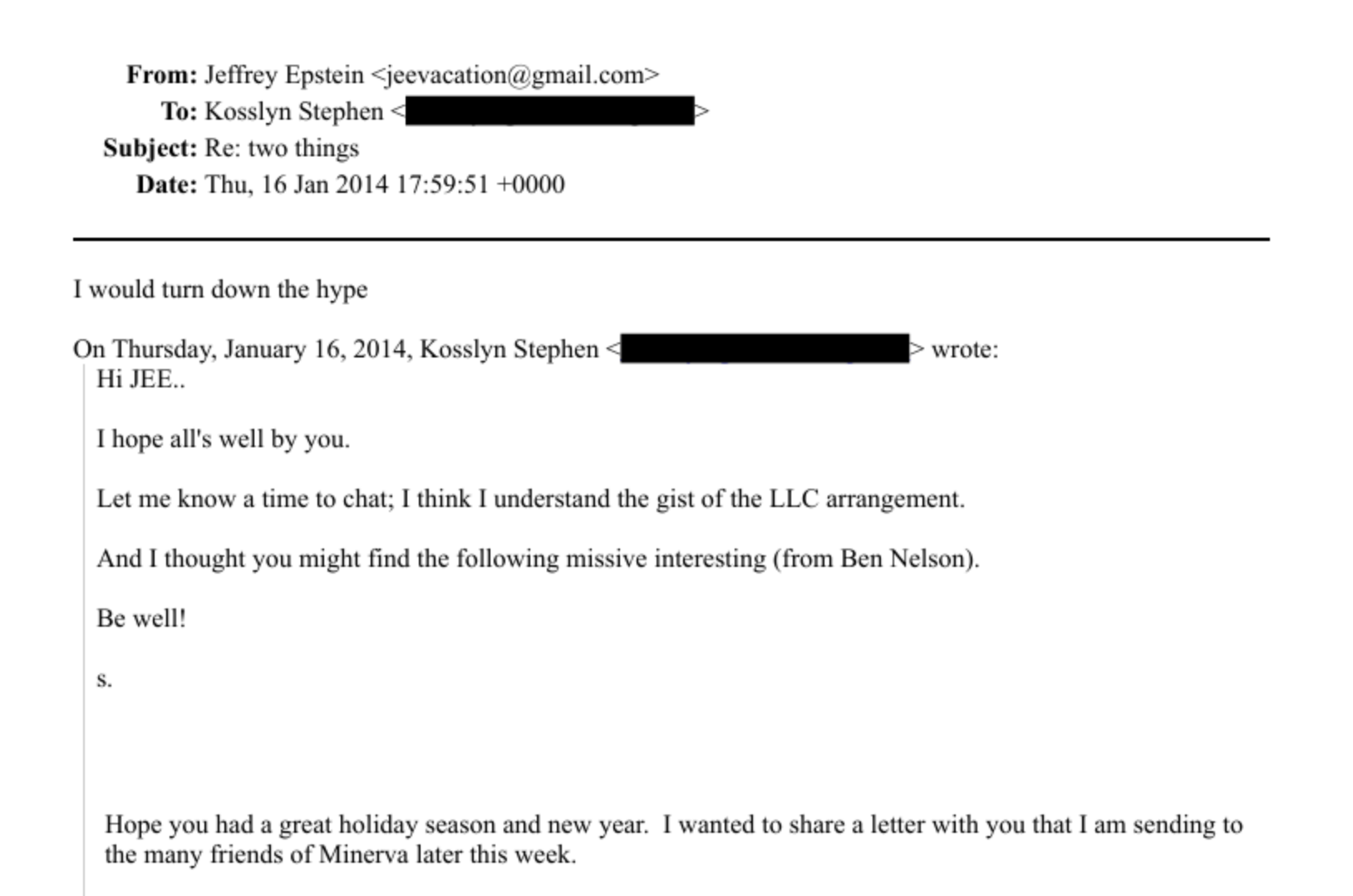
Despite his misgivings about the project, Epstein kept courting Minerva leadership, including inviting Kosslyn to spend a few days at Zorro Ranch, Epstein’s residence near Santa Fe, New Mexico. A few months later, in January 2014, they began talking about Minerva again, with Kosslyn asking about LLC registration and showing off Nelson’s mission statement on the university (then known as Minerva Schools).
Epstein’s response? “I would turn down the hype.”
Passive-aggressive energy or not, Epstein continued to help and advise Kosslyn. In April 2014, Epstein let the psychologist borrow his NYC apartment, to Kosslyn’s delight. They then continued speaking and meeting through the summer, with Kosslyn stating that “It’s amazing how we pick up where we left off…” and then mulling what sounds like a tense June conversation between the two.
Then, in July 2014, a crew of Minerva leaders met with Epstein. The email lists the group as Kosslyn, chief of product Jonathan Katzman, accreditation lawyer Teri Cannon, chief operating officer Miriam Rivera, and chief marketing officer Robin Goldberg. (Cannon became the founding president of Minerva University; the others have departed the company.)
All along, Epstein maintained his doubts about Minerva succeeding. In February 2013, he told Kosslyn to be “careful careful with minerva,” with Kosslyn reaffirming that he thinks “there’s no doubt it is very likely to fail.” In July of that year, Epstein talked about Minerva with scientist and AI theorist Roger Schank, stating that Kerrey and Kosslyn are “only init [sic] for the money.”
Schank’s response: “He has enough I would have thought. (Maybe not Steve).”
In August 2014 — after he met with Minerva leaders — Epstein replied to Kosslyn’s queries about influential investors to approach by mentioning Peter Thiel, but adding that “charity is not what you want, as a biz, I’m having trouble seeing the risk return.”
The following month, Epstein told Kosslyn that he met with Kerrey. The judgment was clear: “too used to not being questioned properly,” Epstein said of the former politician.
Despite the negativity, they continued to talk after the launch of Minerva University in 2014, including about subjects far more abstract than education. In December, a few days before Christmas, Kosslyn emailed Epstein again, asking to meet in NYC and wondering “why SOME people crave ‘meaning’ in their lives…”
“lets talk today,” Epstein replied. If Epstein shared the meaning of life with Kosslyn, the emails do not record it.
Editor’s Note: After this story was published, Sharan Chandradath Singh, Chief Growth Officer for the Minerva Project, sent an email with detailed comments on the matter. For the sake of clarity, we have published the full body of Singh’s email below and updated our story based upon his comments.
“Thank you for reaching out for responses to your questions, and for seeking to ensure that your reporting is accurate.
“An important clarification up front is that Mr. Nelson is the sole founder of Minerva, and both Mr. Kosslyn and Mr. Kerrey joined Minerva 2.5 years after its founding.
“Mr. Kosslyn had a pre-existing relationship with Mr. Epstein that Mr. Nelson was not aware of until well after Mr. Kosslyn joined Minerva. Mr. Kosslyn introduced Mr. Epstein to Mr, Nelson in NYC on a single occasion and Mr. Nelson, not knowing anything about Mr. Epstein’s criminal background or allegations, did not have a positive encounter and did not want to pursue any kind of further interaction between Mr. Epstein and Minerva. It appears from your research that the lack of positive connection between Mr. Nelson and Mr. Epstein is confirmed.
“To be clear, any of Mr. Kosslyn’s and Mr. Kerrey’s interactions with Mr. Epstein were of their own volition, but nothing related to Minerva ever resulted from any such interactions. Minerva Project did not receive any funding from Mr. Epstein nor did Mr. Epstein provide any contacts, affiliates or referrals to Minerva.
“To summarize, Mr. Nelson was not aware of Mr. Epstein’s criminal history when that conversation took place in NYC, and Mr. Nelson neither solicited nor received any advice, funding or any other type of support from Mr. Epstein related to Minerva Project. Furthermore, Mr. Kosslyn and Mr. Kerrey have not been involved with Minerva Project for some time.
“We trust that these responses answer your questions sufficiently, and demonstrate that Mr. Epstein had no formal or informal engagement with Minerva Project, nor did he have any influence on its establishment and growth since.”
We also received an email from Samantha Morales, a spokesperson for Minerva University and added those comments. Here they are in full:
“Minerva University condemns Jeffrey Epstein’s criminal conduct and the harm inflicted on survivors. The events described in the article predate the establishment of Minerva University as its own independent nonprofit university in 2019. No individuals mentioned in the article are employed by Minerva University or serve on the university’s governing board. The safety and wellbeing of our students and broader community remain central to our mission, along with our commitment to the highest ethical standards.”