


I’d lived in San Francisco for nearly a year when David Fincher’s The Game was released in September 1997. It was the first locally-set movie I’d seen in a theater since moving here, and I enjoyed it so much, I went back to the Kabuki for a second screening the following weekend.
Rewatching it 28 years later, it’s clear that my abject ignorance about the city was what allowed me to enjoy the experience.
Michael Douglas plays Nicholas Van Orton, the scion of an old money family who’s facing his 48th birthday — the same one when he witnessed his father take his own life. Douglas, who’d built a career playing morally ambiguous men (Wall Street, Fatal Attraction, Falling Down) is ideal for a fable set in a distorted San Francisco stripped of real neighborhoods and rendered as shadow, echo, and ambient threat. Each time the real city intrudes and touches Nicholas, he loses a piece of himself.
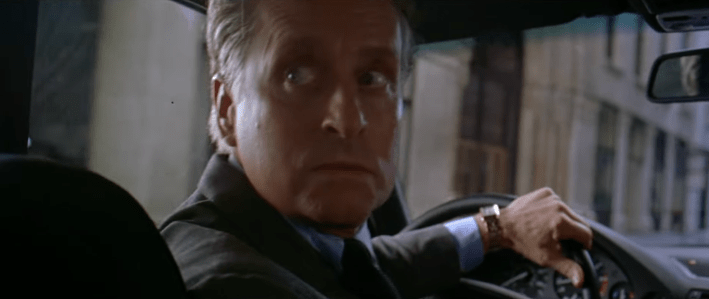
We meet him inside a Billionaire’s Row mansion with a porte cochere and tree-lined drive. If that seems improbably large, it’s because these scenes were shot at the Filoli Estate in Woodside. Shoehorning it into Pacific Heights, Fincher deludes us into sharing Nicholas’ unearned sense of importance; he inhabits a fantasy world of inherited wealth that mirrors his fabricated self. As he hands his black BMW 740iL off to an attendant outside the Merchants Exchange Building — performing as the Van Orten Building — it’s clear that San Francisco is something Nicholas doesn’t inhabit so much as block out.
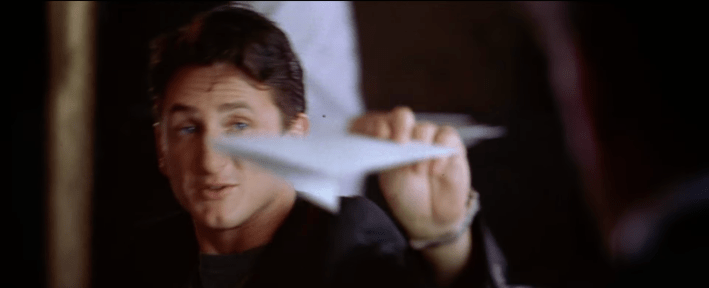
After rolling calls in a paneled executive suite, he meets younger brother Connie in the main dining room of the City Club, an Art Deco jewelbox on the 10th floor of the old Pacific Stock Exchange. As white-jacketed servers attend to tables of white-haired white men, Connie (Sean Penn) arrives late wearing a borrowed sport coat and a knowing smile: “I used to buy meth off the maitre d’,” Connie says.
In town for his brother’s birthday, Connie offers a gift that sets the movie in motion: a chance to take part in a game he describes as “a profound life experience.”
Nicholas reluctantly promises to visit the offices of Consumer Recreation Services, but because his world is so small, he finds himself in the company’s lobby after a meeting. After completing the intake process, Nicholas has the first of several run-ins with Bay Area counterculture: high-tech pranksters leave a clown with a hidden camera where his father leapt to his death and hack his TV. Back at the City Club, a waitress named Christine (Debra Kara Unger) spills wine on him and is fired on the spot for being insufficiently deferential. This last literal collision knocks him out of his orbit: she emerges from the worker spaces Nicholas has never seen. She’s creative, confrontational, and off-the-cuff: pre-tech, working class San Francisco embodied.
This is not a meet-cute; it’s an incursion. Nicholas’s version of the city is rigidly hierarchical, but screenwriters John Bracato and Michael Ferris depict a Potrero Hill waitress who isn’t cowed by his wealth; Christine’s sarcasm and sensuality unsettle Nicholas by flattening the hierarchy that has defined (and enabled) his life.
As the “game” reveals itself, Christine leads him through rear entrances, micro-streets and service corridors — thresholds into the inner workings of the city Nicholas avoids. After trailing her into an alley, he witnesses a hit-and-run; at Treasury Place, he confronts a rumpled PI, then shoots out his tire. As soon as Nicholas steps off his known map, danger hits.
Location management makes a multi-course meal out of the Financial District’s alleyways so Fincher can use the close confines as a structural device. As Nicholas is shoved deeper into the city’s common areas, his fear and confusion grow.
Through escalating set pieces, chaos penetrates Nicholas’s curated luxury. When a tire blows on his BMW during a confrontation with his paranoid brother, he pulls over outside the Mark Hopkins. Arguing in the fog with the hotel’s gray retaining wall as a backdrop, the Van Orton brothers resemble escaped fugitives.
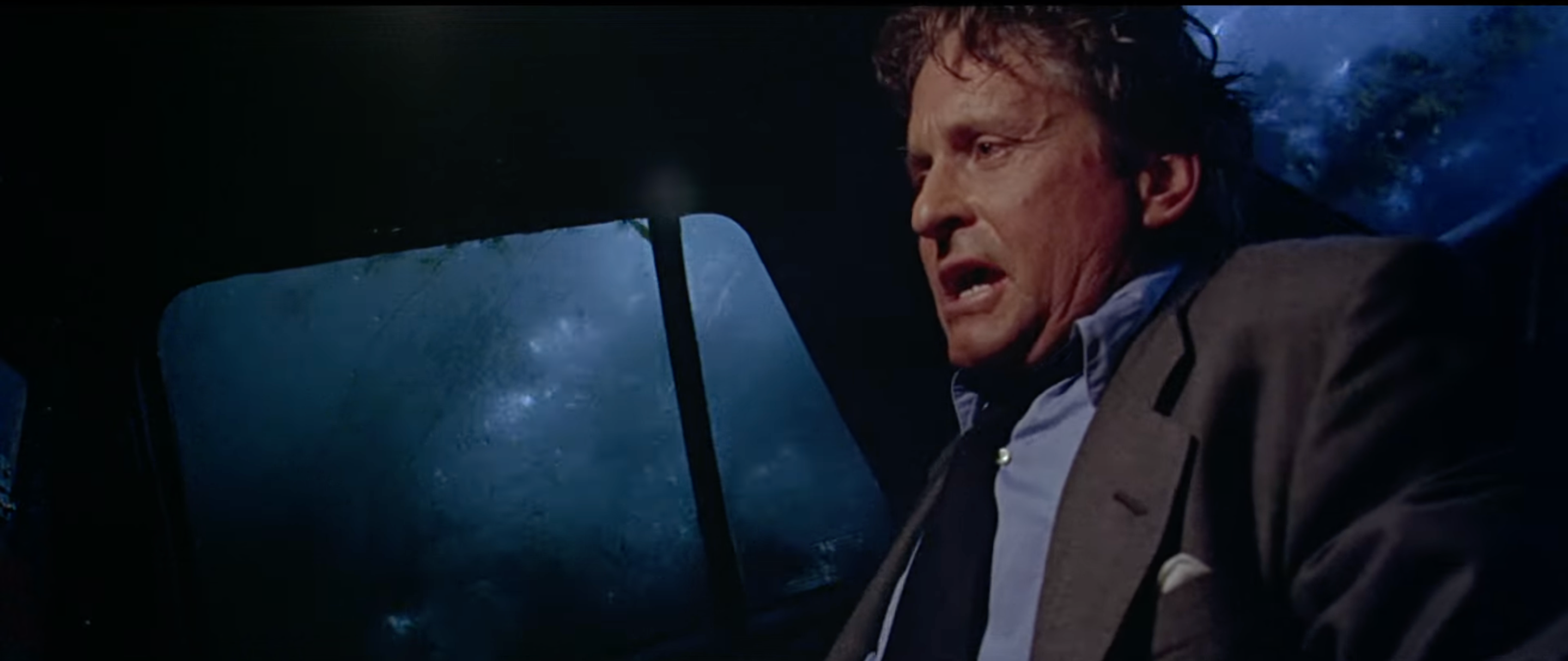
When Nicholas risks the cultural contamination of a taxi, the driver locks him in, mashes the accelerator and ditches, sending him off a pier at the end of Harrison Street. When he breaks the surface with the Bay Bridge behind him, it’s only because he acquired a window crank via the game hours earlier. Like a city dweller, Nicholas starts to learn that improvisation is key to survival.
The rising action forces him through a series of humbling takedowns that culminate with him waking inside a mausoleum in a cemetery in Mexico. Lacking cash and ID, he hops a bus to the border with other migrants and reenters San Francisco as a stowaway sleeping in the back of a semi cab on the 280 freeway. It’s hard to imagine a longer journey to Billionaires Row.
Finding a seizure notice on the gates of his mansion, Nicholas’s fear is replaced by fury. Like the fatally poisoned detective in D.O.A. (1950) — also shot on location in San Francisco — Nicholas is bent on tracking down the people who murdered his identity. He forces his way into Consumer Recreation Services’s cafeteria (the former Letterman Army Medical Center at the Presidio), drags Christine to the roof, and padlocks the door. Behind them, empty FiDi office towers hover in the dark.
Barricaded and frantic as the real San Francisco saws through the door, Nicholas is completely isolated. Unable to face the figurative death of his ego, he chooses actual death by stepping off the ledge.
When he awakens on an airbag beneath the shattered glass of The Palace’s Garden Court (this game is expensive), the game’s architecture finally reveals itself.
For two hours, Fincher has dragged Nicholas through alleys, kitchens, and back-of-house infrastructures — all the parts of San Francisco he never acknowledged. Now he’s lying dazed in the wreckage of a Gilded Age atrium, surrounded by the very people who constructed his torment: service staff, his brother Connie, business partners, and Christine. The city he’s ignored has given him a second chance.
Nicholas spends the first act in conference rooms overlooking Montgomery Street, but he walks out of a rebuilt hotel on New Montgomery as a new man. Under neon lights from a parking garage and The House of Shields that gleams off wet asphalt, he asks Christine out on a date. This San Francisco seems alive, full of possibility.
It’s fashionable to ding The Game for its implausible twist, but the climax is less interesting than what it exposes about Nicholas. Everything he perceived about himself — his wealth, his control, his distance from the city around him — turns out to be production design. Like George Bailey and Ebenezer Scrooge, he’s not the richest man in town because of what he owns, but because he comes to learn, he has a community.
The game doesn’t transform him, it reduces him to his barest essence so he can figure out who the hell he is, still a driving reason why people move to San Francisco.