
Welcome to Drinking Companion, a column about our favorite bars in San Francisco. Each month, we’ll be toasting the places that inspire us to get dressed, go out, and get a drink or two. Next up: Specs’.
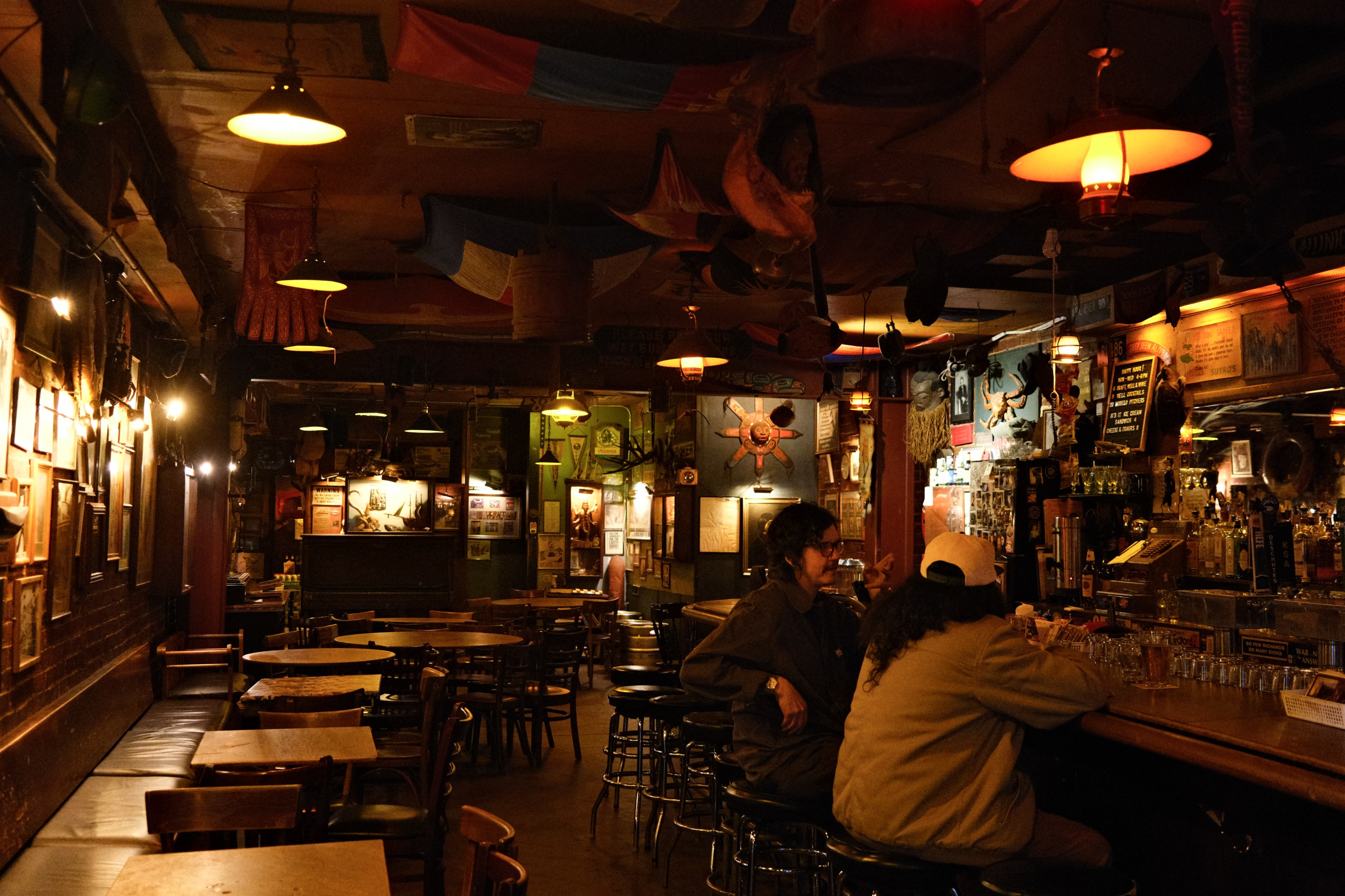
Specs’ Twelve Adler Museum Cafe is, in every way except for the massive petrified walrus penis mounted to the wall, a normal bar. Much like the home of a granny whose decor favors personal history above haute, this nearly 60-year-old watering hole in North Beach is inviting, cozy, and a little musty. Specs’ doesn’t care what you think.
The walls of Specs’ narrow room are lined with curio cabinets of trinkets, pro-union memorabilia, trophies of the sea, posters, pencil sketches made on cocktail napkins, and assorted rara avises. Hundreds of postcards mailed to the bar over the years sit in scattered boxes, ready to spark conversation at the bar or in one of its tatty cushioned wooden booths.
Your options behind the bar are run-of-the-mill at best, but the prices are fair enough. Order a mixed drink if you please, but don’t expect the bartender to shake it. You can see plenty of that on the other side of the wall at Garden of Eden.
Hungry drinkers are offered just two menu options: bottomless crackers and a slice of gouda from a wheel fit for an Escalade. Unlike at McSorley's Old Ale House in New York, there are no raw onions.
This little alleyway, called 12 Adler Place though its current address is technically 12 William Saroyan Place, has been a fixture in the San Francisco nightlife scene for a century.
The bar, in its current form, was opened in 1968 by a thick-lensed sheet metal worker. Richard Simmons, aka Specs, had arrived in San Francisco as a merchant marine in 1951 by way of Massachusetts. His story is as North Beach as it gets: Simmons met his wife, Sonia, at Vesuvio just across Columbus Avenue, and settled in a flat above City Lights, where he’d live for the rest of his life. Simmons’ employees were widely considered among the most loyal and long-standing bartenders in San Francisco thanks to Specs’ above-average pay and attention to workers’ rights. The staff has been unionized since day one, and they receive retirement and health benefits.
Known as no-nonsense and neighborly, Simmons famously held birthday and anniversary parties complete with oyster-packed feasts paid for by Simmons and added to, potluck style, by patrons. Anyone and everyone, even those 86’ed, were welcome.
He was also known for his humor. Business cards that sat in stacks on the bar were apparently gendered: The one for women said “Madam, the gentlemen prefer to sulk in silence,” and the one for men read “Sir, the lady is not interested in your company.”
Several paint jobs below its surface is a deeper history of 12 Adler Lane. It once served as a Prohibition speakeasy, then a social and political club for Alaska fishermen, and eventually, a servicemen’s bar. After the war, it became a bohemian hangout.
Then came Tommy’s Place, the sawdust-coated club owned by SF’s first lesbian bar owner, Tommy Vasu. With her bar, Vasu joined the wave of queer nightlife that thrived in North Beach in the 1940s and ‘50s. Vasu was known for her suits, her Sinatra-like swagger, and her blond girlfriends: San Francisco Chronicle columnist Herb Caen described her as a “gentleman among ladies.” It was this same journalist who coined the term “beatnik” in his coverage of Specs’, though Simmons maintained that his ragtag clientele included more bohemians than Beats. The difference, by his definition, was that the former was more concerned with politics and the latter with getting stoned and laid.
Despite the tenuous acceptance of openly queer establishments in San Francisco, Vasu was targeted in a crackdown on queer bars amid the growing moral panic of the McCarthy era. The bar was eventually raided, and after authorities discovered heroin that many believe to be a police plant, they forced it to close. After Tommy’s shuttered, a new nightclub called Frank's, owned by Frank Guidera, took over and became known for Middle Eastern music, jazz, and belly dancers. Then came Specs’, now in its fifth decade.
A magnet for the bohemian, the traveled, the artistic, the blue-collar, the fringe, and most importantly, the friendly, Specs’ attracts a consistently diverse and interesting crowd.
Simmons’s daughter Elly runs the bar, keeping libations flowing and a busy calendar of live music, readings, and meetups for thinkers, feelers, and, of course, drinkers.
Go if you like: John McPhee, rolled-up sleeves, labor rights
Ask for: a draft Modelo
Leave: your mouth shut if you can’t speak without saying AI, API, KPI, ROI, IPO, or SaaS
Avoid if you want: to hear any song released this century
Specs’ is open Sunday through Wednesday from 4 p.m. to 1 a.m., and Thursday through Saturday from 4 p.m. to 2 a.m.