

“E” moved to downtown San Francisco two years ago after a stint in the Outer Sunset, not realizing then that his new apartment was mere blocks away from what would become one of the most contentious sites of protest in the city. (E asked that his name and the street he lives on not be used to protect his safety.)
Living close to 630 Sansome St., which houses an immigration court and ICE HQ, motivated the 23-year-old to begin documenting immigration enforcement actions this summer and get involved on the ground to protest the transporting of detained immigrants to and from the city.
“Having my level of access, it’s easy to know what’s going on and when to get out there,” E told me. “I’m able to take on a lot of roles I wouldn’t be able to otherwise if I was elsewhere in the city.”
On Friday afternoon, E noticed a small rally unfolding outside the 630 Sansome facility. It was organized in part by a group called Dare to Struggle, as a response to the killing of Renee Nicole Good in Minneapolis by ICE agent Jonathan Ross. E left his personal protective gear at home, not expecting much of an altercation: “It seemed like just a rally,” he said.
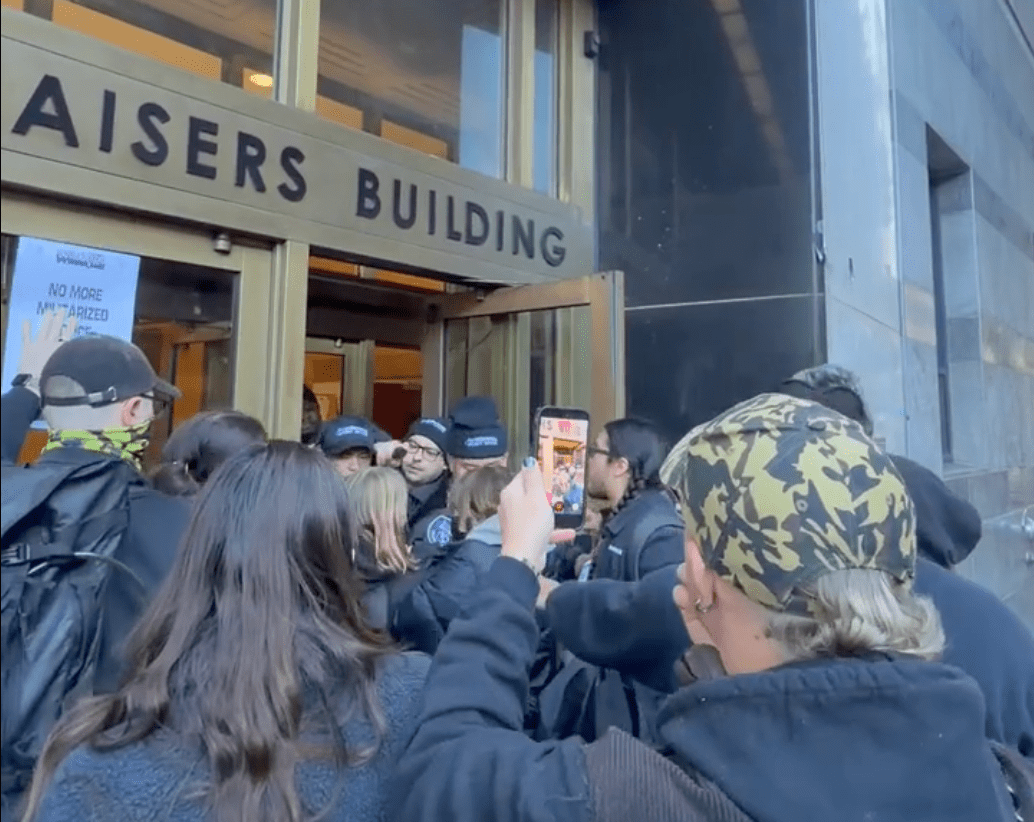
After initially picketing and circling the block, E noticed some protesters looking for a way into the facility, poking at the Washington Street entrance before moving to the main entrance on Sansome Street. Concerned about an unplanned escalation, E dropped his banner and began running to the front.
“I’ve seen what happens in the past. Security isn’t just going to let you into the building unless you have a case. But a bunch of people started pushing at the doors, and then someone got pulled inside,” E said, referring to a young woman who was dragged into 630 Sansome by a federal agent while she was on the sidewalk, then detained.
In a video of the incident captured by Mission Local, two Allied Universal security guards fight with protesters at the doorway before one of them pulls a pepper-gel gun and shoots it into the faces nearest him. E, who recorded his own video from the doorway, got tagged “straight in the eyeballs” by the stream and fell to the ground, he said.
“I was not trying to get into the building. I was actually trying to prevent people, and I got sprayed as I went to grab a person they were dragging into the building,” E said. “I didn’t touch anyone, I didn’t touch the doors. I was just recording the whole time, including a person getting arrested inside, and they kept trying to block my view.”
It was his first time getting pepper-sprayed. A few protesters flushed his eyes with water and then helped him back to his apartment, where he took a shower and used aloe gel to cool his skin: “It felt like a first-degree burn all over my face, as if someone spilled hot chili oil on it,” he noted. (This reporter was also assaulted and hit by pepper gel in August.)
After less than an hour, E donned a mask, goggles, and fresh clothes and went back down to 630 Sansome.
“I was determined to get back there in time to show they couldn’t take me down. I’m at almost every protest that happens there. The security guard who sprayed me? I know him, I’ve gotten in his face before. He loves to smirk,” E claimed.
This is not the first time E has been physically attacked by private security guards and officers while protesting. In October, E attempted to stand in the way of a white van leaving 630 Sansome, but was choked and shoved to the ground by a man in plain clothes who would not identify himself. In a video of the incident provided to Gazetteer, a pair of bystanders tell E that he should call the police to report the assault. E did just that; he alleges that SFPD never came.
“I waited outside of the Sansome facility for almost an hour and nobody showed up. I went back to my apartment and told SFPD to meet me there. They never showed up,” E told me.
The repeated escalation and aggressiveness of guards and federal agents at 630 Sansome is a critical factor for protesters of all stripes to consider in future actions, E said. He doesn’t discourage “more dangerous” and militant forms of protest, such as blocking ICE vehicles.
Instead, he calls for more planning and communication between protesters, especially on the ground, so that everyone has a role based on their skillset and can support one another.
“When people are prepared and there’s a plan, you can win results,” he said. “But without that, you’re just going to get arrested and brutalized.”
E is troubled by the news that the immigration court at 100 Montgomery will close at the end of the year, with staff and cases consolidating at the Concord immigration court, a 40-minute drive from the city.
“It sounds in part like a tactical decision to limit protest. What they’re doing here is so public, everyone can see it,” E said of the ICE clashes downtown. “If they go out into the suburbs, there are fewer eyes, they can be more private with their crimes.”