

In 2010, Gap wasted $100 million on a logo refresh that it phased out in six days.
If you’ll recall, this new Gap era was cold, Bauhaus-y, even. The San Francisco-based company dropped its OG Gap font for Helvetica, and its classic blue box was replaced with a weirdly-fading box to the side. As a Gap spokesperson put it at the time, it was supposed to transition the brand out of “classic” and into “modern, sexy, and cool.” It was none of those things.
People hated it, for one, because it looked belabored, like the product of a hundred marketing executives who’d spent a hundred hours on something that could have taken 15 minutes. (That’s probably close to the reality.) But the underlying reason that the brand reboot was so reviled was because it killed whatever nostalgia people felt toward Gap. Customers didn’t want to change the Gap of their youth, the Gap that made hard-wearing, not-too-expensive khakis and T-shirts that you could believe Lenny Kravitz and Joan Didion would wear outside of their ad shoots. It was the thing you (or, more likely, your mom) grabbed at the mall and you just wore. People didn’t want a new Gap: they longed for the Gap of the ‘90s.
I bring that up because, more than 15 years later, the Gap and creative director Zac Posen are harkening back to the company’s ‘90s peak quite explicitly in another attempt to rebrand. They’re going back to the source, but not quite. It’s more like an AI hallucination of the ‘90s.
Call it Midlife Crisis Gap.
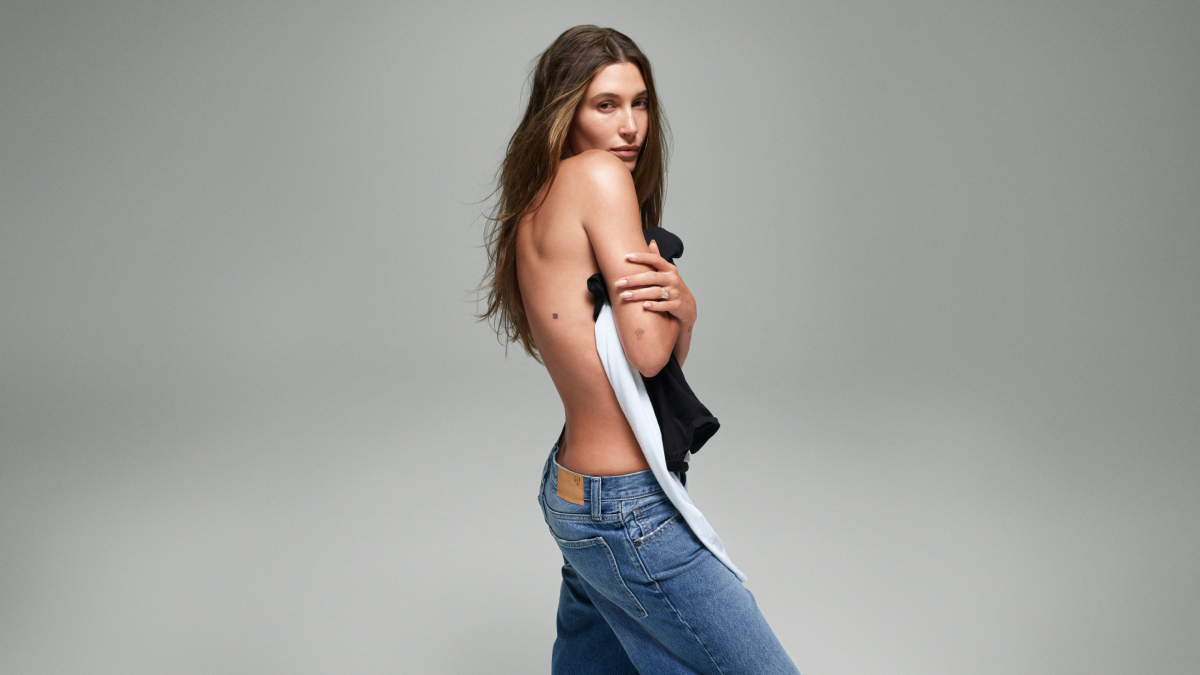
There’s the Hailey Jean, in low-rise and wide cuts, that Gap is launching Thursday. Named and seemingly created for Hailey Bieber, she of lip gloss and being married to Justin Bieber fame, is quoted as saying it is “focused and saturated in the spirit of the ‘90s, and the whole campaign draws from the decade.” (“It’s not just focused, it’s saturated,” you can imagine the first ChatGPT output read before someone prompted it not to use that telltale construction.)
There’s also Gap’s troubled “happy stripe” re-launch from a couple of months ago: One of its most famous striped knit sweaters from the '90s was revived in a limited-run capsule of shirts, sweaters, and dresses.
All of it feels off, what Freud might’ve called unheimlich: our memories and feelings about that time, but askew.
The happy stripe had a pretty good run of press surrounding it, until it was revealed that the stripes were not going to be knit; instead, the stripes would be printed on synthetics. Even if it looks roughly the same as its predecessor, it is a subpar copy, a perfect metaphor that will also never last a half-dozen washes. (Besides, ‘90s happy sweaters can still be found for about the same price secondhand, even if they’re made in part with acrylic.)
The ad campaign for the Hailey Jean, branded as a 1996 throwback because it is the year Bieber was born, features The Cranberries’ “Linger.” It yearns for a time when photos were shot on film, and magazines were used to moodboard instead of Instagram saves, and phones had long cords. Cute enough, I guess! But “Linger” came out in ‘93; ‘96 was the year of Bone-Thugs-n-Harmony, the Macarena and “Santeria.” The ad yearns for a version of the ‘90s that didn’t exist, and perhaps never did. In its attempt to reference itself, it ended up referencing Calvin Klein instead. What Gap did was throw a bunch of signifiers into a blender and produce an enshittified version of the ‘90s, which is kind of what the whole brand feels like lately.
Gap didn’t just get the past wrong; it’s getting today wrong too. Young people don’t romanticize the company because of Hailey Bieber’s basic jeans or throwback stripes or whatever. People want Y2K nostalgia-core Gap because it looks cool, sure, but because it wasn’t flimsy and about to disintegrate on your body within three wears. Everyone wore Gap, from Naomi Campbell to your dorky uncle, because it was widely available, inexpensive, and it lasted. Gap wasn’t aspirational; it was just there.
The Hailey Jeans will probably sell, and it certainly won’t be as disastrous as the Gap’s failed aughts rebrand. The happy stripe reboot has already sold out. Gap isn’t going anywhere, but it’s gonna have a hard time ever feeling like itself again.
A few weeks ago, I went to the now-closed Gap on Lakeshore Avenue, just to see if there were any hidden gems lying around, or at the very least a good pair of khakis. Everything was thin and plasticine and piled high atop each other; no one wanted the khakis, even for $10. It was grim.
Perhaps it makes sense that the Gap’s Posen has aligned itself so closely with San Francisco again: The city, like the company born here in 1969, is deep in its slop era. Everything is a slightly “off” reproduction of what came before and a little bit worse for it.