

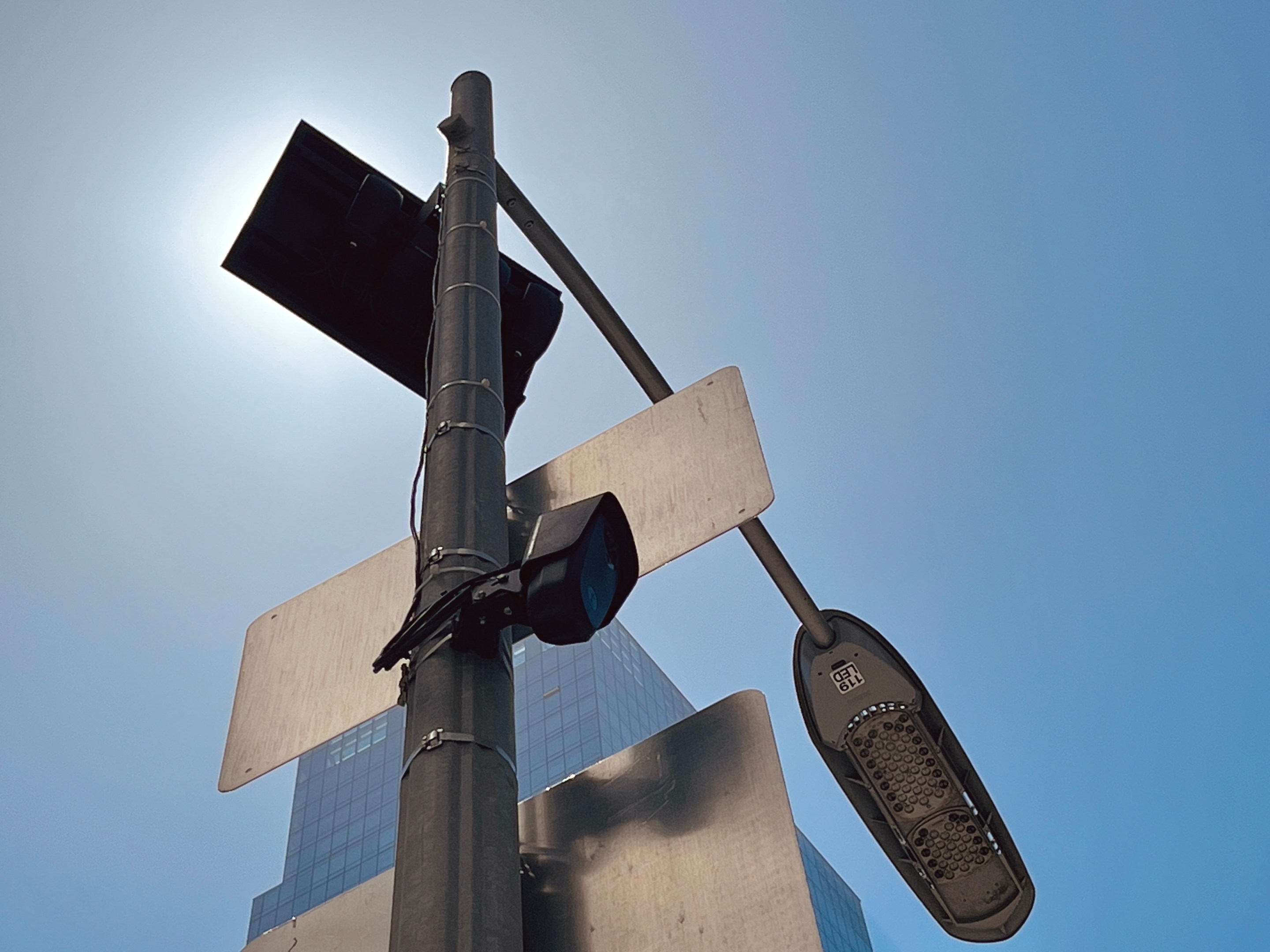
The San Francisco Police Department uses two kinds of cameras to crack down on crime: Standard CCTV-style “public safety” cameras and Flock automatic license plate readers (also called ALPRs).
Both technologies help police track suspects, and images from both are used for all types of policing from basic thefts to longer-term investigations. In particular, the department has been touting the efficacy of Flock Safety cameras, which the city began installing en masse in 2024.
Today, there are only seven public safety cameras installed in San Francisco. Meanwhile, more than 400 Flock cameras have been placed around the city.
However, they’re regulated in very different ways, with far less public input and review of where Flock cameras are installed and used.
Public safety cameras can only be installed at the discretion of SFPD’s Chief of Police after a public hearing in the area of the proposed location, with neighborhood feedback used to determine whether the installation “would enhance public safety,” according to a city ordinance passed in 2024. The department is also required to create annual reports detailing the location of the cameras, crime statistics in the vicinity of the cameras, the number of times SFPD requested copies of images, and the number of times recorded images were used in arrests, among other criteria.
No such public input process exists when Flock’s automatic license plate readers are installed, beyond the initial hearings that took place before the Board of Supervisors approved the “19B” automatic license plate reader policy in 2023.
When asked about the dramatically different protocols for oversight and transparency between the two camera types, SFPD spokesperson Mason Lee stated that it is “because Flock cameras are automatic license plate readers, although they are called ‘cameras.’”
“We are not aware of any new public safety cameras (these are not ALPR) being installed,” Lee told Gazetteer SF.
In addition, SFPD spokesperson Allison Maxie noted that Flock cameras are unique because their captures are “limited to license plate and vehicle information.”
Jen Kwart, spokesperson for the office of City Attorney David Chiu, also emphasized that Flock ALPRs “do not record video”: “Given that there is a difference between public safety cameras and ALPR technology, the Board of Supervisors made different determinations about what should be required for implementation of each of these programs,” Kwart said.
That distinction belies how powerful Flock’s automatic license plate readers are, even compared to the passive recording by public safety cameras. Flock’s use of AI means that the cameras don’t just capture license plates, but an entire spectrum of characteristics about a vehicle, including accessories like roof racks, damage, and even bumper stickers. This tool allows law enforcement to sift through a vast collection of images using AI. Unlike automatic traffic enforcement cameras, Flock ALPRs aren’t triggered by a specific action like speeding; they continually snap images of every car that passes by.
This means millions of images can be stored and shared with a variety of law enforcement partners; while Flock has incentivized police departments to enter its nationwide network of ALPR data, the American Civil Liberties Union, as well as other data-privacy advocates, argue that Flock’s infrastructure leaves the risk of leaks and improper data-sharing even when a law enforcement agency opts out.
The SFPD’s policy on ALPRs allows the agency to share data with “law enforcement partners, as part of a criminal or administrative investigation” on an “as-needed” basis. Last month, an audit released by SFPD found there had been 299 illegal searches of its Flock network over the course of a year. In addition, a San Francisco Standard investigation uncovered how out-of-state agencies, such as police departments in Georgia and Texas, had accessed SFPD’s Flock data 1.6 million times, potentially breaking California law to do so.
Flock has gone so far as to remove the phrase “Flock does not own and shall not sell Customer Data” from its terms and conditions, according to the ACLU; the company also has a contractual right to use existing surveillance data even after a city terminates its contract.
These risks are a big reason why a number of cities, including large municipalities like Austin, Seattle, and most recently, Los Angeles, have banned or terminated Flock Safety contracts for ALPRs.
Zachary Schwartz, managing director of the advocacy group DeFlock SF, told Gazetteer that the “sheer number” of images captured by more than 400 Flock ALPRs creates privacy risks for every driver on the road: “Where people drive is where they go and what they do,” he said.
“With Flock, there is almost no transparency, especially compared to the rigorous public approval process for the ‘public safety cameras’. SFPD is not required to, and doesn't, alert citizens to expansions to their network or the locations where the cameras are, claiming that it is to prevent vandalism,” Schwartz said.
The city’s policy on public safety cameras, on the other hand, limits the sharing of images to SFPD officers ranked Sergeant or higher who are working on an active criminal investigation. The only exception is if the city’s Department of Emergency Management, which oversees camera records, receives a court order by an outside agency or individual; the Board of Supervisors also must be notified in the case of a court order.
The images captured by each are also stored for substantially different periods of time: Public safety camera footage is deleted after 30 days unless it is deemed necessary for an active investigation; ALPR data is maintained by SFPD for a year, with the right to keep images for up to five years if it is “connected to a criminal investigation or criminal intelligence file.” The ALPR policy states some forms of “storage records” can even be kept for up to 10 years.
DeFlock’s Schwartz argues that SFPD should openly publicize the location of Flock ALPRs and disclose when it is expanding its system, as it does with public safety cameras.
“Audits of the system should not be done internally, as we’ve seen those have failed to prevent two illegal leaks of data to federal agencies,” he continued. “All the information we have about Flock contracts and its cost is because of public records requests.”