
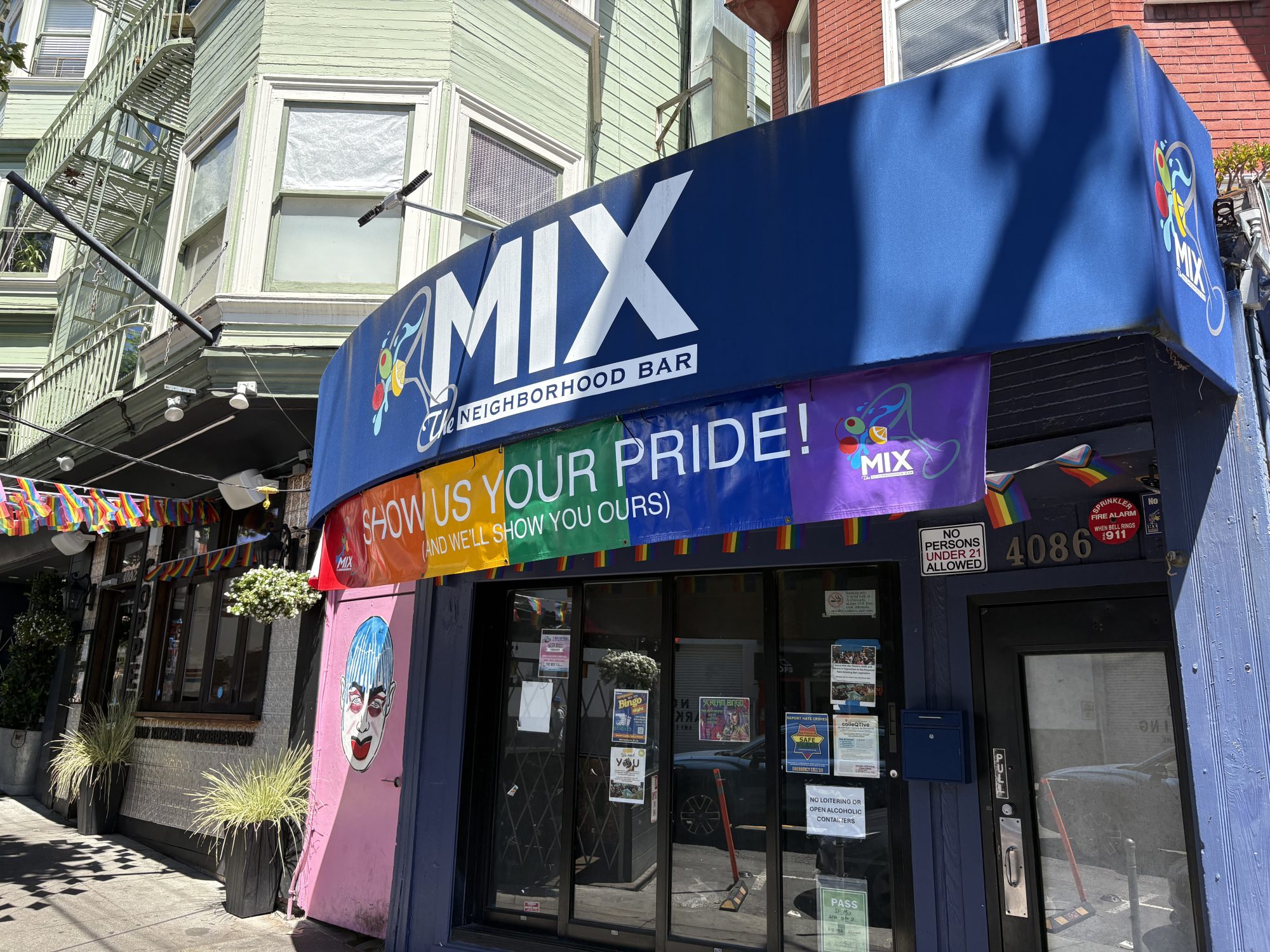

It was close to midnight on Memorial Day weekend when Hart Owen noticed something strange in the doorway of Mix, a bar in the Castro.
Owen had just handed her ID to the bouncer when she was directed to turn and face a small camera before being allowed into the bar.
“I was just kind of taken aback,” Owen recalled. The camera was hooked up to a monitor and a forensic ID scanner. It looked like the sort of high-security kiosk you’d find while going through airport security. “Why is this at a gay bar, of all places?”
The machine Owen encountered is called a Patronscan Guard+, a biometric and personal data collection device made by Servall Data Systems, a surveillance tech company headquartered in Alberta, Canada. Mix is one of at least three bars in the Castro, including Badlands and Toad Hall on 18th Street, that wheel out the Patronscan kiosk each night to collect the personal data of every customer that comes through the door, including names, addresses, genders, and even how they behave inside the bar.
Beyond giving bar management teams the ability to “verify guests, spot fake IDs, and enforce venue policies,” Patronscan’s main selling point is access to “flag networks,” or private databases of blacklisted patrons that can be accessed by other local bars that use the Patronscan system. At least nine bars in the Castro are synced into the same flag network that Mix is a part of.
Management from Mix, Badlands, and Toad Hall did not respond to requests for comment about when or why they first started using the surveillance tech in their businesses, so I stopped by Mix last Thursday night to check things out for myself.
Like most private surveillance cameras, the Patronscan kiosk at Mix hides in plain sight. In the dim light of the bar, the black machine is easy to miss. I was also not instructed to face the camera when I handed my ID to the bouncer; when I asked if I would be photographed, the bouncer told me the camera had in fact already taken my picture. They said Mix bouncers are not required to verbally tell each patron that they’re being photographed by the Patronscan device. Instead, they rely on a small informational plaque posted to the kiosk below eye level to inform customers what data is being collected and how it will be used.
“It’s posted signage,” the bouncer shrugged on Thursday, when I suggested tipsy customers might not read the fine print on their way inside.
The bouncer told me that the collected personal and biometric data is stored on the Patronscan platform for 30 days. Then, it’s automatically deleted unless a patron has been flagged for bad behavior, “like fighting or stealing,” in which case it’s stored indefinitely.
They were unsure when exactly Mix had purchased the tech — which could cost a venue $4,200 per year, according to previous reporting from OneZero — but they said it been part of their nightly duties for a while. “I’ve been here for a year, and it’s been here longer than me,” they told me.
The regulars I spoke to in line outside corroborated this. “I think I remember seeing Badlands use it around a year and a half ago,” said Ben Gonzalez, a 25-year-old data analyst who was waiting in line with his friends last Thursday night. When I asked Gonzalez’s group if they were at all unnerved by the increase in surveillance, they shrugged. “I’ve posted worse things on Instagram than whatever they take,” one of them said.
Owen, however, sees potential for serious privacy risks. In today’s political climate, she said, “it’s really not great to have lists of gay people.”
Patronscan scanners are stationed in bars, restaurants, casinos, and entertainment venues in more than 700 cities globally, according to its website; in the US, that includes Sacramento, San Diego, Orlando, Portland, New York, and Chicago, in addition to San Francisco.
Launched in 2005, the company has been the subject of several legal disputes in recent years as surveillance technology and consumer tech literacy grow more sophisticated. In 2020, Canada’s privacy commissioner sent a cease and desist letter to Patronscan after the company was discovered using the government office’s official logos, creating “a misleading and false impression” that its services are approved by city, state, or federal officials.
In 2023, Illinois residents filed a class action lawsuit against Patronscan for violating an Illinois biometrics privacy law by collecting biometric data from eventgoers without first obtaining their consent, calling the technology “Orwellian.”
In 2019, when the Board of Supervisors banned the use of facial recognition software by city agencies, including the police, the measure was widely supported by locals and inspired similar policies nationwide. That policy does not apply to private businesses like the Castro bars, but the reception at the time signaled widespread distrust toward surveillance tech companies. But now as the technology grows more normalized and a new generation of AI boomers flood San Francisco, the attitude toward Big Brother is shifting in the city.
The morning after we chatted in the Castro, Gonzalez told me over Instagram DM that he was unaware Mix could share patron data with neighboring businesses but did not see a problem with it. “I think it’s cute that they share it amongst other bars,” he wrote. “It’s like a little cybersecurity community.”
Editor’s Note: Since this story published, Patronscan posted a statement explaining how they handle users’ personal information. Our follow-up story with their explanation can be found here.