
Shawn Smucker needed the weekend to hibernate.
On Friday, the poet, writer, and bookshop owner from Lancaster, Pa., was scheduled to hop on the phone with Gazetteer SF to talk about his poem “Please Use AI,” which went mega-viral last week after a popular poetry account on Instagram reposted it.
In seven days, the post was liked by nearly 670,000 people, and seen by some 13 million. Soon Smucker’s words — his sarcastic urging for people to, yes, please use AI instead of calling your friends, instead of struggling, instead of nearly anything — had flooded the internet. Smucker’s online following exploded. The poem’s success even brought new fans streaming into Smucker’s bookstore, Nooks, excited to talk to the author about how he had managed to capture lightning in a bottle.
By the time came for our call, Smucker politely requested to reschedule, calling the response to the post “overwhelming” and the scene at his bookstore “insane.” He temporarily removed Instagram from his phone and took his own advice, grounding himself with his family and friends.
Fortunately, Smucker was refortified by Monday. He hopped on the phone with Gazetteer to talk about virality, loneliness, and how to go forward after authoring a hit poem.
The following conversation has been edited for length and clarity.
Your poem has absolutely blown up. What has the reception been like?
I mean, I’ve just been completely shocked. I wrote it probably three or four weeks ago initially and got a really great reception from my immediate crowd, which, you know, isn’t huge, but just a lot of positive feedback. And in those initial days, I really only got one negative comment before it kind of went bigger, which was something that was then echoed later. It was this idea of like, “Well, yeah, this is great if you have friends.” And I think that’s really valid pushback. But anyway, it was about three weeks after that [the account @fossilizedflowers] shared it on Instagram and collaborated with me on the post. That was kind of what just set it off into a completely different atmosphere than anything I’ve ever written before. And again, it’s still probably 90 percent positive, but whenever you get into that sort of larger sphere, you just get all kinds of people coming out, and it’s hard to know at that point if these are real people who are commenting, if these are bots, if these are people just trying gonna stir up conflicts so they get extra followers. So, at that point, it gets a little messy, but for the most part I’ve just gotten really good feedback from it.
You’ve written poems about movies, war, Jeff Bezos. What do you think made this particular poem resonate with so many people?
I think loneliness is such a big deal right now. I think it’s kind of this foundational thing underpinning what so many people are experiencing. I really think that at the heart of the interest in this poem, the attraction to it, was this sort of harkening to a time when we did talk to our friends about stuff, when our first outlet was, “I’m going to call this person and see what they think about it,’ or even ‘I’m going to text this person.” Now so much of what we do is digitized and, in some ways, sanitized and made a lot simpler. Like, it is a lot easier to do a quick search and find answers than it is to pick up the phone and call someone, but I have a feeling that it’s this desire to reconnect that people have become so interested in.
It’s sort of ironic then that the negative comments you got boiled down to, “What if you don’t have friends? What about people who are lonely?” What was your reaction when you first saw that sort of response?
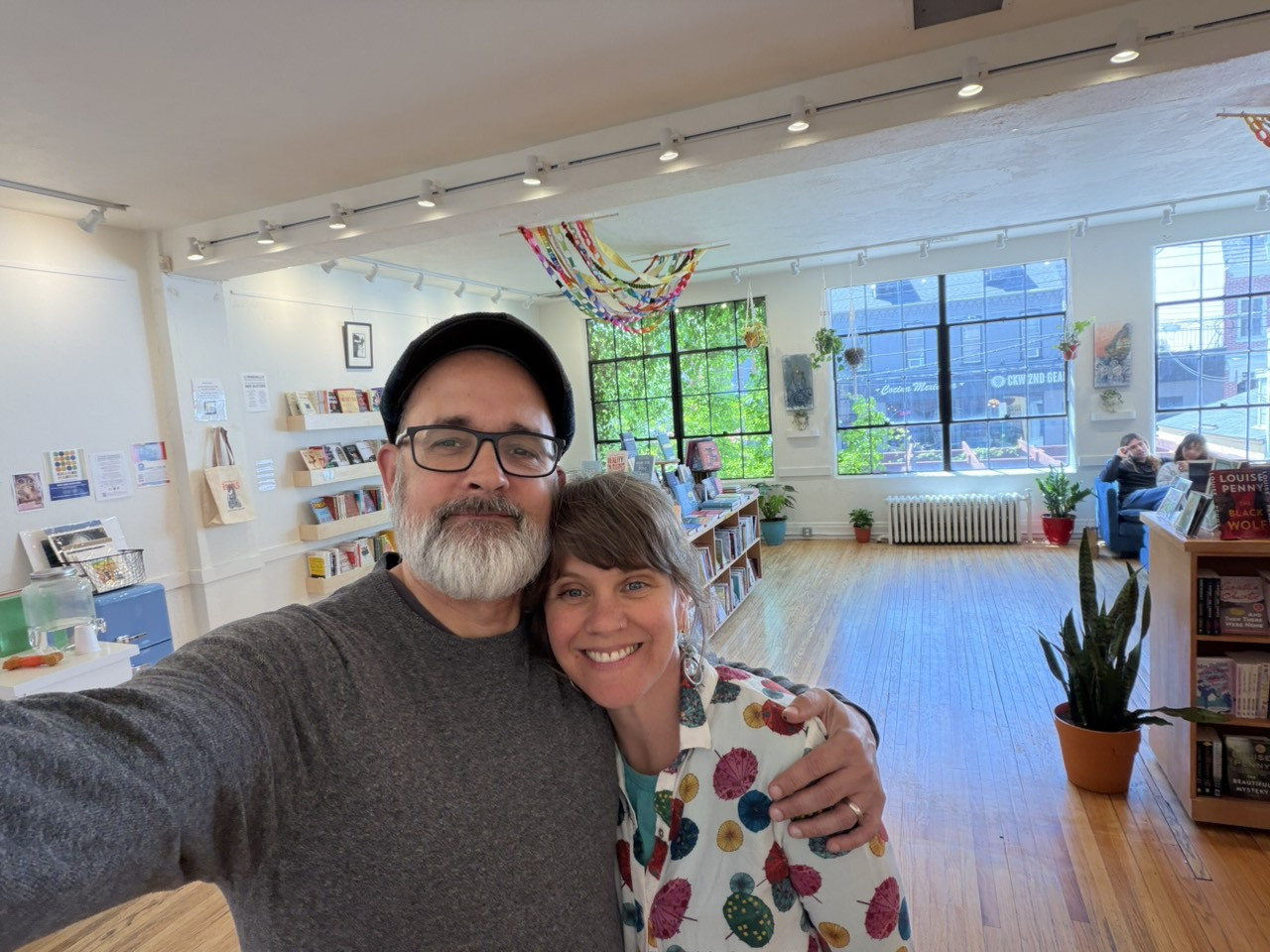
Exactly. Yeah, at first I just felt bad. Honestly, I was like, “Oh shoot, I didn’t even think about that.” I’m definitely writing this poem and superimposing my own experience of community onto the world, and I realized that I’m very fortunate to have the community that I have in the area that I live. I grew up around family. I’ve got, like, 30 cousins. My life is very much community-based. My wife and I have a bookshop, so we’re interacting with people all the time. When I started to see those comments it was kind of a gut shot because I thought, “Wow, there are a lot of people out there who don’t even have that as an option,” you know? And that, I think, is one of the huge contributors to the flourishing of AI. It’s coming along at a time when people don’t have connection, so it is such a simple replacement. So, at first, I just felt bad, and then I started to see a lot more people jumping onto that response of, “Well, I don’t have people to call, so AI is really good for me.” And I think… [sighs] I get it. I understand the attraction to it. But I also feel like it’s kind of this self-defeating thing, where we don’t have friends so we turn to AI, which makes it even less likely that we create friendships, you know? So in that way I think it’s even more scary than I thought, because I’m realizing like, oh wow, there’s a whole sector of our society that will probably really come to depend on this for that feeling of connection.
Did you respond to those people in the comments?
I responded to a couple of people, usually just saying, “Oh wow, I hadn’t thought about that.” You know, “Sorry.” But those comments generally weren’t super well-received. And I get it. The original commenters were kind of like, “Well, you know, I’m glad you’re sorry, but what does that do?” So yeah, I don’t know. I think there are a lot of lonely people out there, and I think we’re just creating tools that are really not helping. I think they’re sort of addressing maybe the symptoms, but not really getting to the heart of the problem that we have right now, which is a lot of lonely people.
What made you sit down and write this one?
I was laying on the couch with my youngest daughter, who’s 9, and she’s kind of at that age where I’m wondering how much longer is she going to want to curl up on the sofa with me. She had fallen asleep, and, as I was laying there with her, I was just thinking about how human it is to be close to someone, and it just kind of hit me that AI, for all of its knowledge, will never have that experience. We’re using this tool for things it was probably never intended to to fulfill because it will never experience getting older. It’ll never experience a physical sense of closeness, or how it feels to know that you’re growing older and your body’s changing, and your kids are getting older, and so I was thinking about that and then for some reason it popped into my head like to come at it from that angle. I thought it would be fun to be a little cynical or sarcastic and just say, yeah, please use AI. Because it is simpler, it is more sanitized, AI’s probably not going to break your heart the way real life does, so just go ahead and use AI.
What even made you think of AI in that moment in the first place?
I mean, it’s been something that my wife Maile and I have been talking about a lot. We’re both writers, so, you know, it’s just so front and center right now with creativity. And that’s kind of the other disclaimer I have, like, I don’t know anything about AI when it comes to the medical field or, you know, writing code or other technological uses. Like I’m not saying that we should all just, you know, throw AI out. For me, it is so based in either creativity or relational situations, and I just see the damage that it’s doing to those two areas.
As writers, Maile and I talked about it a lot, and then recently I saw that Nobel Prize winner Olga Tokarczyk has said that she uses AI to generate ideas and, like, refine her ideas, and I was just so devastated by that. When I’m reading a book, I want to connect with the author. I want to know what their ideas are, and I want to know where this has come from in their consciousness. I don’t really want them to be using something that has scraped every other creative’s ideas and combined it and then take from that. So anyway, we’d been talking about it a lot, and it’s just kind of been on my mind.
Yeah, we see that in journalism too, writers starting to use AI. The cognitive atrophy of it concerns me, but I can also see how it would seem useful for, say, speed. Have you ever been tempted to use AI to write poetry, or to write in general?
I’m not tempted to use it. I’m aware of it, so it occasionally has come into my brain, like, “Wow, this would be so much faster if I used AI.” But it’s not to the point where I really thought, “Should I or shouldn’t I?” if that makes sense.
I co-write and ghostwrite books for a living, which would totally be AI-able. You know, like, I’m taking transcriptions from interviews that I’ve done with people. So I’m looking at 10 to 12 hours of interviews that could so easily just be tossed into Chat or something, like, hey, turn this into a book. That would save me a whole step of writing a first draft. Now, I’m sure I’d have tons of work to do after that. Go through and edit it or redo it or whatever. But this idea of it being quicker, I think it’s maybe a little more tempting for people when there’s money involved or your career’s on the line. But I don’t even think about it when it comes to my own creative stuff, like poetry or the fiction that I write.
In San Francisco, everyone is, like, manic about AI. It plays a really big role here. Can you describe the attitude toward it in Lancaster?
Well, first of all, I’m amazed at how much baby boomers especially just seem fascinated by this technology. And I think they use it without any thought to, like, where this content is coming from, or who is controlling the way the AI’s going to respond, and what kind of resources are being used to prop this whole thing up. They really use it out of almost naivety, like, “Oh, isn't this cool? I can make a picture of myself jumping into the Grand Canyon on a hang glider. Isn’t this hilarious?” So that’s one of the approaches I see.
The other main one, and this would be more from the younger generation, is the real antagonism towards AI data centers. That’s been front and center here, because we do have large tracts of land available. There was a recent episode in Columbia, Pa., which is about 15 to 20 minutes west of Lancaster. They had a town hall about a company that had been developing AI data centers and was looking to purchase a couple hundred acres right outside of Columbia. The city council had pretty much approved it, and then hundreds of people showed up at the meeting. The line to comment was out the door. There were people listening through the windows. There were people who brought their lawn chairs and were lining the streets trying to listen to what was going on. It was just such a huge response of people who did not want this data center built outside their small city, and it changed the mind of the town council. They decided not to sell the land to this company. So those are the two main ways I see people engaging with AI here.
You’ve said on your Substack that you have six kids with a big age range. How do your kids feel about AI?
I mean, they know how we feel about it, so if they are using it, they’re not telling us. [Laughs] My youngest is 9 and my oldest is 23. For my youngest kids, it’s not really on their radar. But I do get the sense that our middle daughter, who just graduated from high school, and our middle son, who will be a junior next year in high school, I do get a sense that there’s a real pressure to use it, especially in high school.
Can you share any numbers on how much this poem has helped grow your audience, and do you think you’ll approach your work any differently now that it’s blown up?
Yeah, it’s definitely impacted how I think about my social media. My Instagram followers probably tripled. My Substack followers almost doubled. Substack, I don’t think I’ll change much about what I was doing there. Instagram, I had always viewed as pretty private and local, thus all the pictures of my kids and my family and things like that. Like before, you know, my meager following, it was either friends or friends of friends. Or at least it felt that way. Now there are so many complete strangers on there. I deleted Instagram from my phone for the weekend because I felt like I needed a break and wanted to kind of think through some of those things. But no, I don’t think it will impact how I write.