

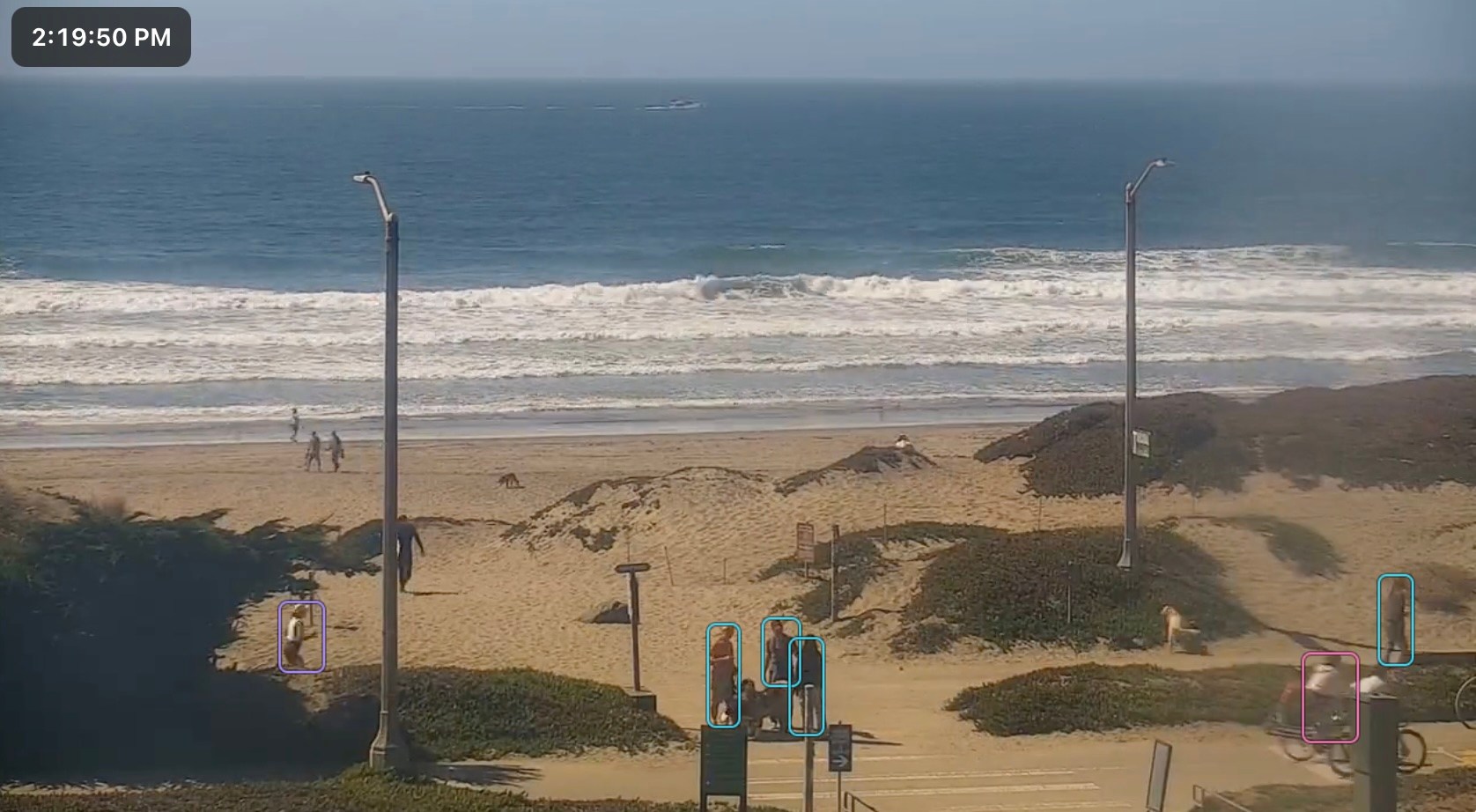
The video is oddly mesmerizing: through a haze, a still camera captures images of people at Sunset Dunes, the San Francisco oceanfront park stretching from Sloat Boulevard to Lincoln Way. Pedestrians are framed in neon blue rectangles, runners in purple, and bikers in pink. An occasional off-leash dog is a treat.
The people, and colors, come and go from every direction. Played at the default setting of 10x speed, one could be forgiven for wasting a portion of the workday watching these figures set against the continuously breaking waves, and ebb and flow of plovers.
The point of Sunset Dunes Visitors, the website hosting the video, is to estimate how many people walk, run, and bike through the entire park. It being San Francisco, and an election season no less, it’s hard not to read a political motive into the visuals.
In November, residents will vote on Proposition G to determine whether Sunset Dunes should be closed on weekdays, reopening the Upper Great Highway to traffic from 4 a.m. to 6 p.m. (G revisits Prop. K, which created the park only two years ago.)
The creator of the website insisted on anonymity, apparently to maintain a safe distance from the political debate, but was willing to answer a few questions.
“I thought of it as a science project others might find interesting,” they wrote via email. “I didn’t expect it to cause a stir.”
The cameras were installed by Surfline, and are used by surfers to monitor ocean swells and waves from home to better time their outings. The company maintains dozens of such cameras worldwide. Using Surfline video, Sunset Dunes Visitors can count people, using primary footage from a camera at Taraval Street, and secondary, back-up one at Ulloa Street.
The site’s creator used clips for seven days from 7 a.m. to 6 p.m. to estimate visitors parkwide. In a one-week period, the website estimates 50,320 people visited Sunset Dunes. (Select the Taraval setting on Friday, Sept. 25 from 2 p.m. to 3 p.m. for peak plover and dog watching). The website was a weekend project inspired by arguments they read about how many people are using the park.
“It occurred to me that the camera might show how many people pass through one section of the park, and I was curious whether motion detection on grainy video could produce a decent estimate,” they wrote. “I was also interested in playing with a few motion detection models.”
The Sunset Dunes Visitors creator emphasized that the site doesn’t track or identify people, or store any information. Instead, it detects motion based on an object’s speed, and guesses if it’s a pedestrian, runner, or cyclist.
The longer one pokes around the site, the more one realizes how nice it is to watch a beach scene without cars in it, which surely explains why the argument to preserve the park with a vote of “no” on Prop. G, has support ranging from the San Francisco Chronicle and the Sierra Club, to GrowSF, the pressure group funded by technology executives and aligned with Mayor Daniel Lurie.
While Lurie is officially on the fence about Prop. G, Alan Wong, the District 4 Supervisor the mayor appointed and endorsed for November, favors it. The measure is serving as a proxy fight in the local congressional race, with Supervisor Connie Chan in favor of G, and State Sen. Scott Wiener in opposition to it. The site’s founder professed neutrality on the issue — with some leanings.
“I’m not affiliated with any campaign or election group,” they wrote. “For what it’s worth, I think Sunset Dunes has been a positive change for the neighborhood, and this was meant to be a fun way to see how people use it.”