

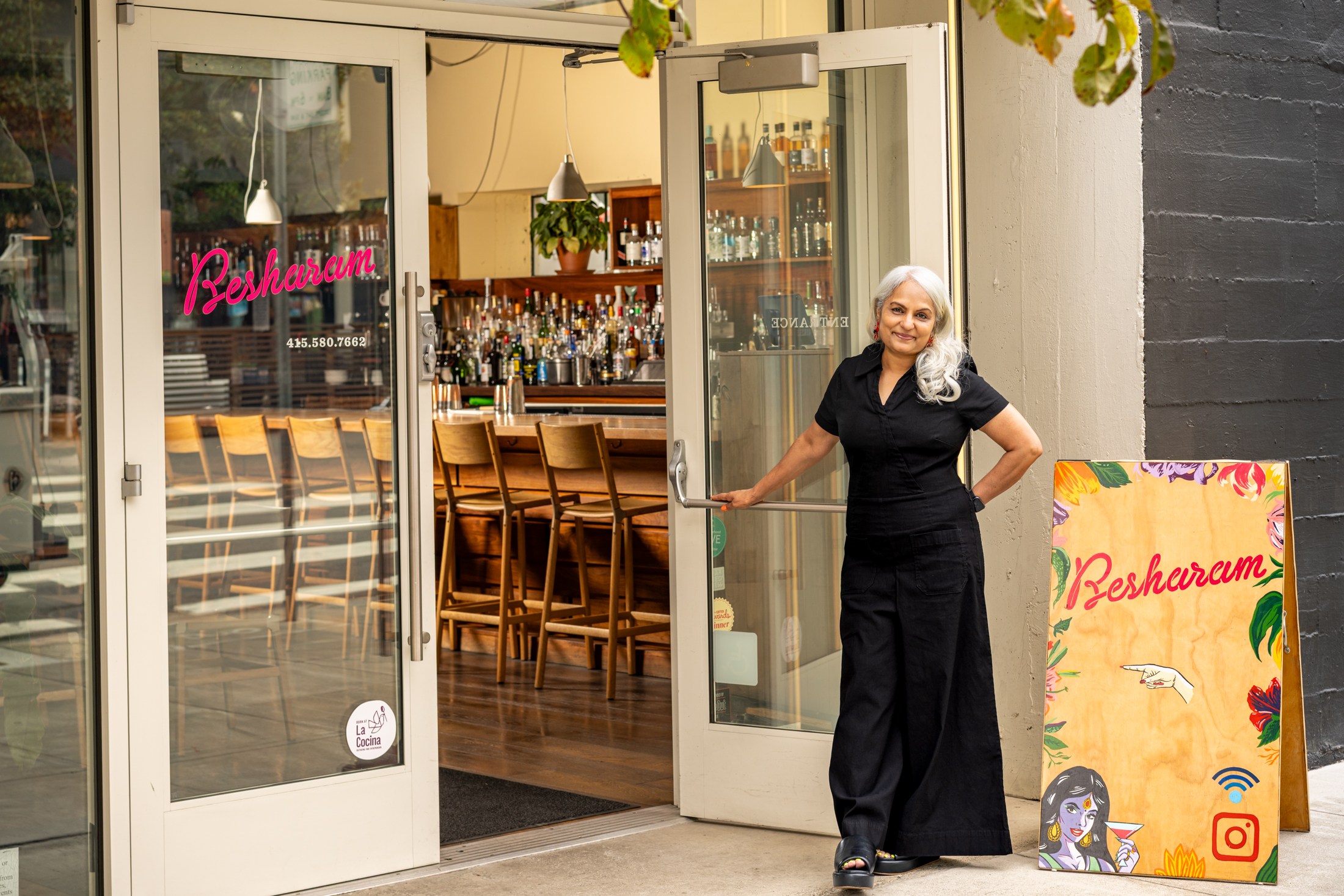
When chef Heena Patel arrived in San Francisco in 1992, she wasn’t aware of the term “first generation,” let alone that at 25 years old, she’d earned that designation twice over, first in England, and then in the US. Now, at her Dogpatch restaurant Besharam, Patel is on a mission to provide mentorship and community for first-generation immigrants in San Francisco.
“As a first [generation] immigrant, you try to raise a family. You learn a new language. You try to build a community. Everything is new. You don’t have any friends…” said Patel, who is in her early 60s. “You lose a bit of yourself.”
When hiring someone to join her team, Patel looks past the person’s resumé: “I want to see not what’s on the paper, but what they are hungry for and what the potential of that human being is. What I ask them is to stay a little longer with me so I can shape them.”
Patel grew up in Mumbai, India, and spent summers in her parents’ home region of Gujarat, known for its lush landscape and emphasis on vegetarian cooking. She opened Besharam at 1275 Minnesota St. in 2018, initially as a partnership with David Patterson’s Alta Group. She took over Besharam completely in 2019, and in that same year, it was named Eater SF’s Restaurant of the Year.
At Besharam, which roughly translates to “shameless” in Urdu, Patel serves Gujarati dishes she learned from her mother reimagined with California produce. Her husband Paresh is the beverage director and sommelier.
After the pandemic, she restructured the menu into three chapters, each drawn from three major phases of her life that influence her cooking. The menu begins in Manek Chowk, Ahmedabad’s famous night market, featuring dishes like dahi wada, fermented dal fritters soaked and crushed with chutneys, and ringan no oro, a charred eggplant stew. The second phase moves onto Khau Galli (which translates to “eating lane”), a nod to India’s vibrant street food lanes; dishes include drunken pani puri with mint water and vindaloo keema, a spicy minced meat dish, prepared with Impossible meat. The last phase is inspired by Chandni Chowk, one of Old Delhi’s most famous markets, featuring richer dishes such as cheese-filled kulchas and masala mushrooms. Patel, who is self-taught, was a James Beard Award Best Chef semifinalist in 2022.
Patel gives her staff opportunities to learn the ins and outs of operating a restaurant, beginning with the food and its presentation. In addition to culinary training and career mentorship, she pushes back against limiting beliefs and stigmas about their position in society that immigrants often internalize. “I want them to realize you can be more than a dishwasher,” she said.
Much of her kitchen hails from Guatemala and Mexico. They often speak primarily Spanish and have typically never interacted with Gujarati food. Much of their informational and cultural exchange with Patel occurs first through hand gestures until they eventually reach their own kitchen language.
“It’s hard to express yourself when you don’t have the language. You don’t have the confidence. But you have the abilities. You have the dreams,” she said.
She hopes that after working at Besharam, her employees feel equipped to start careers as chefs or open their own businesses.
More than a mentor, Patel aims to be a friend to her staff. Many first-generation immigrants have left behind family members, sometimes even their children. On top of all that, ICE is operating at an unprecedented scale this year, including forceful detainments at SFO, heightening anxiety among immigrants in the Bay Area.
Her personal mission to soften some of the emotional, cultural, and socioeconomic struggles faced by her immigrant employees is largely because she sees much of herself in them.
Patel spent the first 20 years of her life between Mumbai and the Gujarat city of Thasra. At 22, she married her husband Paresh, and the pair moved to London.
When she and Paresh, then 25 and 29, respectively, moved from London to the Bay Area on a business visa with their three-year-old daughter, “I only knew that I wanted to survive this place,” Patel recalled. The city reminded her of Himalayan towns like Mussoorie and Nainital, and she was determined to make it work.
The couple started a flower shop and a liquor store next door to each other in San Rafael in the fall of 1992.
“I didn’t know any names of the flowers, but I was so eager to have a life here. Everything was a challenge. I was learning to drive, learning the language, learning the food, the culture around me was a shock. Everything was different,” Patel recalled.
“But the only thing that grounded me is cooking my own food,” she continued. “It brought back memories of spending time with my family, my sisters, my aunts. I shared with my daughter things like, this what I remember about my mom making this, and that helped me miss my home less. That was the beginning of me introducing myself through cooking.”
It would be a while still before Patel realized she could turn her family’s recipes into her own restaurant.
While working towards obtaining citizenship and raising her two children, Patel got a second job at a German deli next to the flower shop. She’d never eaten meat and suddenly was knee deep in Reubens. For ten years, she’d close the flower shop at 6 p.m. and then walk next door to manage Hof Brau until 10 p.m. The world of food service was foreign to her — neither she nor her husband came from restaurant families — but she soon fell in love with it as a bustling community in itself.
In 2013, she joined the San Francisco-based BIPOC and immigrant women’s culinary incubator La Cocina with the idea of starting a mobile food business. Through that program, she launched Rasoi Kitchen, a booth at the Ferry Building Farmers’ Market serving some of her family’s favorite recipes of hers.
During that time, she also worked back of house at Jardinerè and State Bird Provisions to learn more about running a full-service kitchen and, in 2017, closed Rasoi to open Besharam. She also returned to La Cocina, this time as a board member, to assist the next generation of women entrepreneurs. (She left that role in October to focus on a different generation: her first grandchild.)
“Having this restaurant is the freedom I wanted: To raise a family and to have my own voice,” said Patel. “I have this space where I can express myself through freedom and through food, and I want that same space for the people who I hire.”