

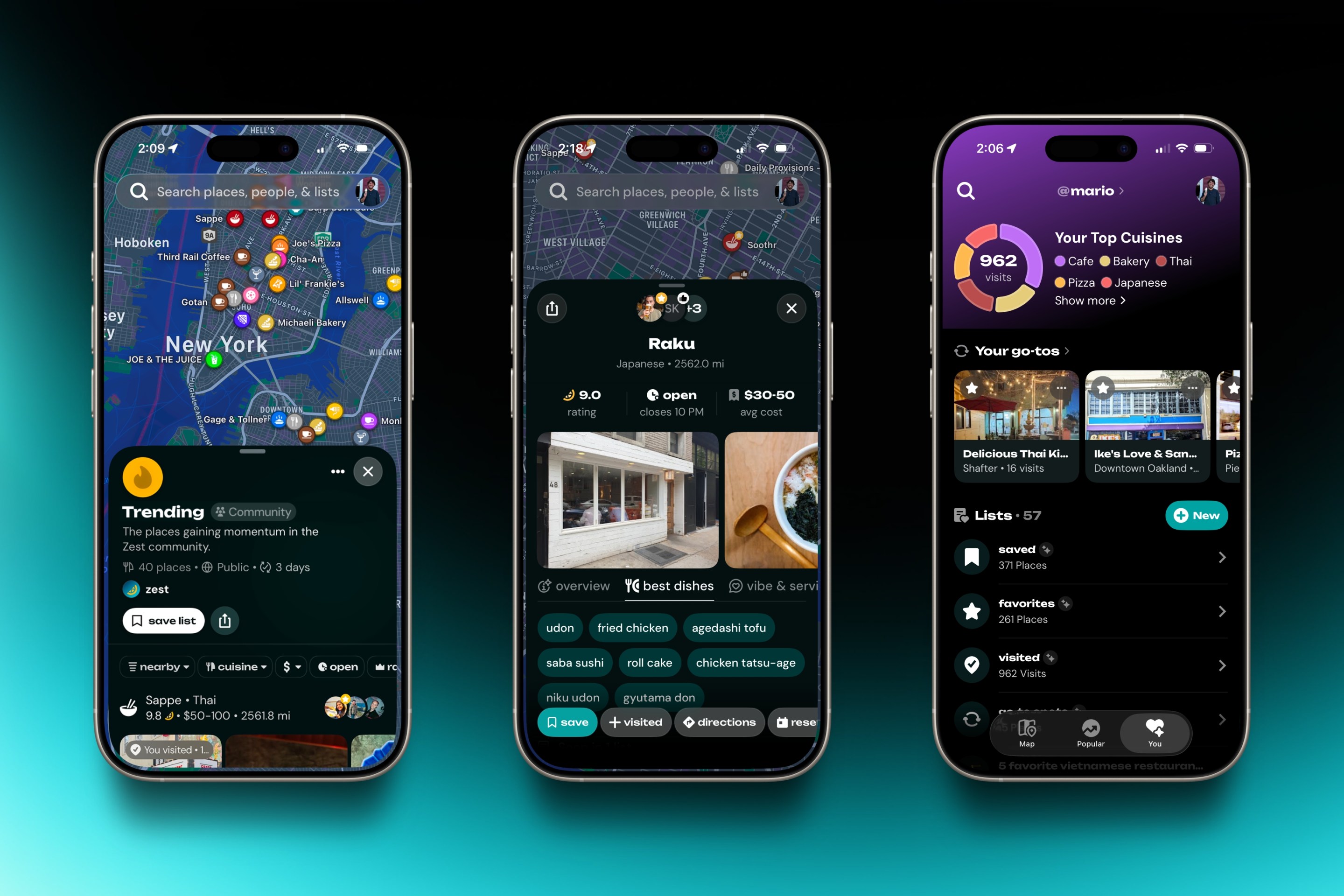
This week, an AI-powered restaurant recommendations platform called Zest Maps went live. The gist? Link your credit card and the app will track your purchasing habits to create a personalized map of places you might like.
My fear? That we’re sucking the magic out of life, 4.9 stars at a time, until we’re completely alone with our phones in our own echo chambers.
Unlike Beli, which has users manually catalog and review meals they’ve had, Zest Maps captures your dining activity automatically with every tap-to-pay transaction. In addition to card activity, Zest taps your friends, social media, Reddit, editorial coverage, and review platforms such as Google to recommend the longest line in your half-mile vicinity. The result is a voyeuristic aggregation of what you’ve already determined you like, displayed for you on yet another app.
Why ask just your friends for recommendations when you can just task AI to monitor you and your friends’ purchase history to spit out a few restaurant names, 86-ing human connection? Perhaps because it’s easier to dull the mind than use it. Or perhaps because needless reliance on nonliving supercomputers undermines human capability, even when approaching issues that belong to the living, such as feeding oneself.
Pattern is not taste. Linking your contacts is not interacting with your friends. Deciding where to eat based on an AI-powered app is not deciding at all; it is surrendering. Surrendering one’s interests, curiosities, tastebuds, budget, and ability to form unique experiences to the computer and, in return, being given a general admission ticket to a growing monopopulation of atrophying brains.
An initial question that arose, and one that I probed Zest’s founder Mario Gomez-Hall with, is this: Where does the potential for serendipity go? Moreso: Has our threshold for failure shrunk to such a point that we would rather cede serendipity than not have our expectations be met a couple times? Is our fear of a “just okay” meal worth forfeiting the fuzzy feelings of stumbling upon something unexpectedly amazing?
“I would say that window shopping, when you walk down the street and peek in and decide to just eat somewhere — I think that happens. It just happens gently now,” he told me. “Now, you’re tapping on pins on an app and looking briefly at the vibe and the dishes and saying, ‘Oh, that looks interesting.’ Like now it’s worth the risk of walking in the door.”
In our own algorithmically curated feeds, we don’t have to risk interacting with an opinion, advertisement, or person that we don’t want to. The only way now to truly discover something beyond your immediate preferences is to hit the pavement. The algorithm may decide that you don’t like a certain cuisine, a certain dish, a certain neighborhood, a certain paint color, but you won’t know until you try.
This isn’t a question about whether to take a recommendation — it’s about who (or what) you’re taking it from. Restaurant recommendations have been a vital part of the industry for decades. Think about Anthony Bourdain or Jonathan Gold, two spectacular faces of food that made a career out of curiosity. They didn’t shy away from strip malls or street food or mom-and-pops with weak online presence and, in doing so, curated bold expressions of culture, life-changing dishes in humble digs, and ultimately, very beautiful lives.
Sure, Bourdain and Gold put us on to some incredible restaurants. But more importantly, they put us onto great stories. We all want our own Bourdain-esque life-affirming hole-in-the-wall tale that you can share again and again, directing more people towards not only a restaurant you love but a hobby that satisfies several of life’s cravings: connection, joy, understanding, and, of course, hunger, to name a few. Gold’s lasting legacy is how he leveraged the simple act of feeding oneself as a vehicle to promote empathy and unite a city.
Hunger and curiosity are near synonyms for a reason, and both are equally innate in us. Why outsource this to a pile of equations that could never understand the concepts of hunger and curiosity beyond their definitions?
AI can detect which food pics amass the most clicks, but it can’t taste it for you. AI can tell you how much the bibimbap costs, but it can’t hear the sound of it sizzling or smell the rice crisping on the dolsot when it’s placed on the table before you. AI can summarize a place as “old-school,” but it can’t see the black-and-white photos on the walls or the precious dynamic of a kitchen staff-turned-family.
Human tastemakers are tastemakers, first and foremost, because they can taste and because they can feel. Where to eat when you’re hungry is only a small part of what we can learn from them; how to live with curiosity is the big one. So please, before you ask Zest or Claude or Gemini where to eat, ask literally anybody.
Editor’s note: This story has been updated to include users’ friends as part of Zest’s recommendation engine.