

As someone who has paid for much of her life with tips, even I felt like a certified chump recently as I kneejerk-tipped 20 percent on a loaf of bread I took from a shelf myself.
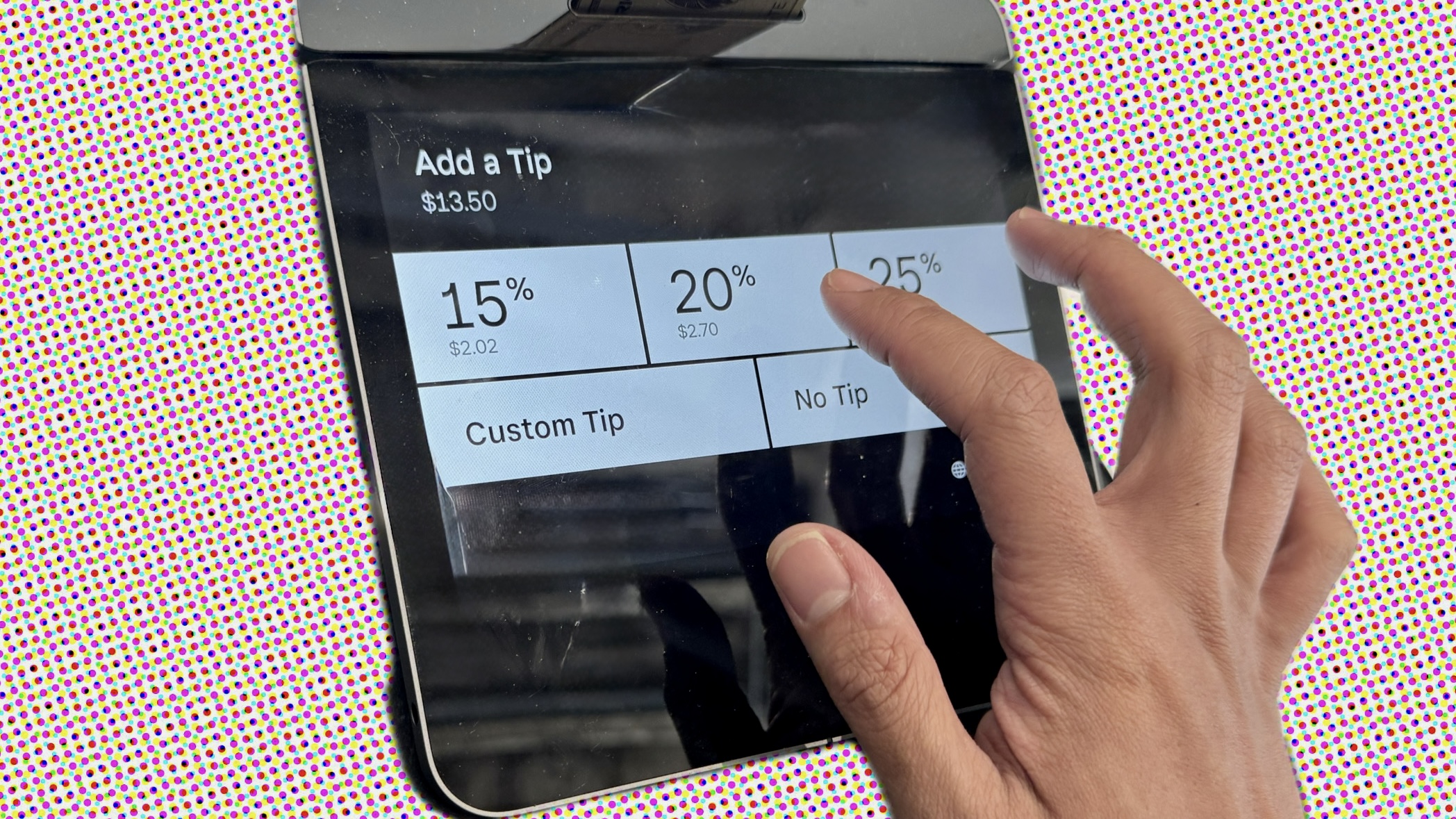
Sure, I could have disregarded the 18-, 20-, or 25-percent options and entered a zero-dollar custom tip. But few of us, even those who’ve worked on the other side of these iPads, are emotionally prepared to skillfully navigate a point-of-sales system with a tired barista staring vacantly at you and an impatient customer breathing down your neck.
Tipping — and tipping anxiety — is unavoidable. Everyone is fed up, uncertain, and in some cases, furious. The touchscreen tablets used by most modern point-of-sale systems have become such emblems of consumer anxiety that there are now online support groups for coping with the social pressure to tap “20%”. Some customers are opting to not tip at all.
Study after study has concluded that the overwhelming majority of the money-spending public feels tipping has gotten ridiculous, and that tips are now expected in more places than they were five years ago. With the costs of living and goods rising, consumers are experiencing “tipflation” fatigue. We’re also more confused than ever about what, when, and why to tip. As a result, people are tipping less. Especially in California.
Consumers resent it. Businesses fear they’ll push customers away with higher prices. And service workers still need to earn a livable wage. Who will cover the cost?
For restaurants, the cost of doing business is high. The minimum hourly wage in San Francisco is $19.18, higher than the state’s $16.90 hourly minimum. In addition to higher-than-average minimum wages, San Francisco mandates healthcare benefits for hourly workers at businesses with more than 20 employees. Tariffs, blockades, and an industry-rattling acquisition have significantly impacted ingredient costs. Locally, rents are climbing, thanks to the AI boom. All the while, people are eating out less.
Gazetteer SF, via our text line and newsletter, recently probed our readers for their take on the matter. One reader’s response summed up the conundrum: “What feels difficult about tipping culture in SF is the income disparity between tech workers and service workers, and the entitlement I’ve witnessed techies exhibit while generally being poor/non-tippers,” they wrote. “[Seeing] a sect of the city making ridiculous money without uplifting their community feels bad! Of course, I would prefer living wages without tips! Tipping is antiquated, but financial need isn’t.”
Nationwide, the poverty rate of tipped workers is twice as high as that of the non-tipped workers. According to a 2025 report from Tipping Point, Mayor Daniel Lurie’s poverty-focused think tank (which he founded pre-City Hall), in the Bay Area, poverty is most prevalent among families with a worker in leisure and hospitality (32.4 percent), a rate higher than statewide (27.3 percent). Meanwhile, the cost of living has outpaced wages. Between 2016 and 2023, incomes rose by 34 percent, but cost of living increased by 46 percent, per the same study. From 2021 to 2023 alone, income grew by 10 percent while the cost of living increased by 18 percent.
“In general, people are reluctant to tip,” one respondent, who works as a barista, wrote to Gazetteer. “The cost of living here is so high that I think most people feel like they have to save as much money as they can, even if they’re already spending for someone else to make food or drinks for them.”
Charlie Lubenow, a server and cook at a restaurant in the Sunset, says, “I automatically tip 20 percent, always. Because I’ve worked so many service jobs, I know what it’s like to have tips be a significant portion of your income. But I was also conditioned by society to do that my whole life. I don’t think twice about it.”
The majority (roughly 90 percent) of respondents to Gazetteer’s survey said they tip 15 to 20 percent or higher, though they’re not necessarily happy about it. “I always tip because I know it is a key part of the compensation of service workers. But with prices of everything so high already it's definitely a bit painful,” one wrote.
The prevalence of tip prompts has discouraged one respondent from tipping: “It’s gotten out of hand… Employers should be compensating their employees enough so they’re no longer ‘living off of tips.’”
One way restaurants are attempting to replace the tipping system is through service charges. This fixed, clearly disclosed fee gets added onto tabs in lieu of a traditional tip. Many businesses in SF already have a fee, typically five to seven percent, to account for the cost of employee health benefits. Service charges, unlike tips, can be shared with back-of-house employees and shrink the discrepancy between floor and kitchen workers.
The Oakland restaurant Burdell was dragged on Reddit earlier this year for having a service charge in lieu of traditional gratuity. Burdell charges a mandatory 20 percent service fee so that employees can expect consistent pay and get 75 percent of their health benefits covered.
“When I started to think about Burdell, before I started thinking about food, decor, fundraising I really wanted to make an equitable and good place to work,” owner Geoff Davis wrote in a February post on Instagram. (Davis declined Gazetteer’s request for comment.)
Other restaurants have adopted similar practices. Decades ago, Chez Panisse replaced its tipping system with a 17 percent service charge. In 2014, Comal enacted a 20 percent service charge as well. Zazie in Cole Valley prices its menu items to be able to pay their employees without a service fee or tip.
“We started seeing some experiments with raising prices when we were opening up. People were trying all-inclusive pricing. It was well-minded and good-intended, but then we saw like, I won't say failures, but a bunch of them walked it back,” said Jay Bordeleau, owner of Mr. Tipple’s Jazz Club in the Mid-Market neighborhood. “It was for various reasons, including customers being shocked by a 20 percent price increase, and staff pushing back for sometimes netting less money,” he said.
Bordeleau charges a service fee — now 21 percent — that is pooled among front- and back-of-house employees since they opened their doors more than a decade ago. They disclose the fee on the menu and again on the receipt, but also provide the option for guests to tip on top of the service charge, which Bordeleau says his customers requested.
The service plus occasional extra tips goes a long way to supporting his team. A good thing since, as Bordeleau put it, “You can't pay rent in high fives and hugs.”
Some restaurants that spearheaded the no-tip movement have since gone back to the old ways. Seven years after Comal enacted its service change, owner John Paluska and former business partner Andrew Hoffman reversed their decision and instated a more traditional tip-pooling system.
Only thirty-three percent of Gazetteer respondents said they would be in favor of a mandatory service charge in lieu of traditional gratuity, mirroring a 2023 national survey by Pew Research Center. Many customers’ qualms about service fees hover around the belief that the money earned as a tip is proportional to the level of service received. A similar attitude applies to those who are weary of what are called “pre-tipping scenarios,” such as at fast-casual restaurants or cafes where the customer frequently pays and tips for the food before it’s served.
“Will a 20% tip on my coffee affect the outcome?” one respondent wrote Gazetteer. For many, tipping is still based on the quality of service or food, while for others, it’s to balance out low wages.
When employee compensation is outsourced to customers, it’s subject to differing cultural norms and be impacted by unconscious bias, racism, and sexism, and other factors. Women comprise roughly 70 percent of all tipped employees in the US. Black, Latina, and Native American women who work for tips are more likely to experience poverty, according to a 2024 National Women’s Law Center report. A 2008 Cornell University School of Hotel Administration study found that Black servers were consistently tipped less than the white servers across the board.
Jamie Himler, a server at a touristy restaurant at Fisherman’s Wharf, said that she’s noticed how tips can vary from server to server, despite comparable experience and friendliness. Himler says she makes some of the highest tips in the restaurant, but, added, “I'm a young white woman, so that probably heavily influences my tips, which is unfortunate for my other coworkers who don't have those privileges and don’t make the same tips that I do, even if they’re also doing literally the best they can.”
One of Himler’s coworkers, a Black man, “is super funny, super nice and just great with his tables. And he makes the lowest tips in the restaurant. It’s so sad. It’s so fucking sad,” she said.
Himler isn’t alone in noticing this. “There's enough research on tipping and hospitality showing that the practice is racist and sexist at best and just completely dehumanizing at worst,” said Bordeleau, the owner of Mr. Tipple’s.
Few people — customers, workers, restaurant owners — seem happy with the current system, but no one has devised an answer for what will replace it. As one respondent, who said that they generally tip higher than 20 percent, lamented, “There needs to be a better way.”