
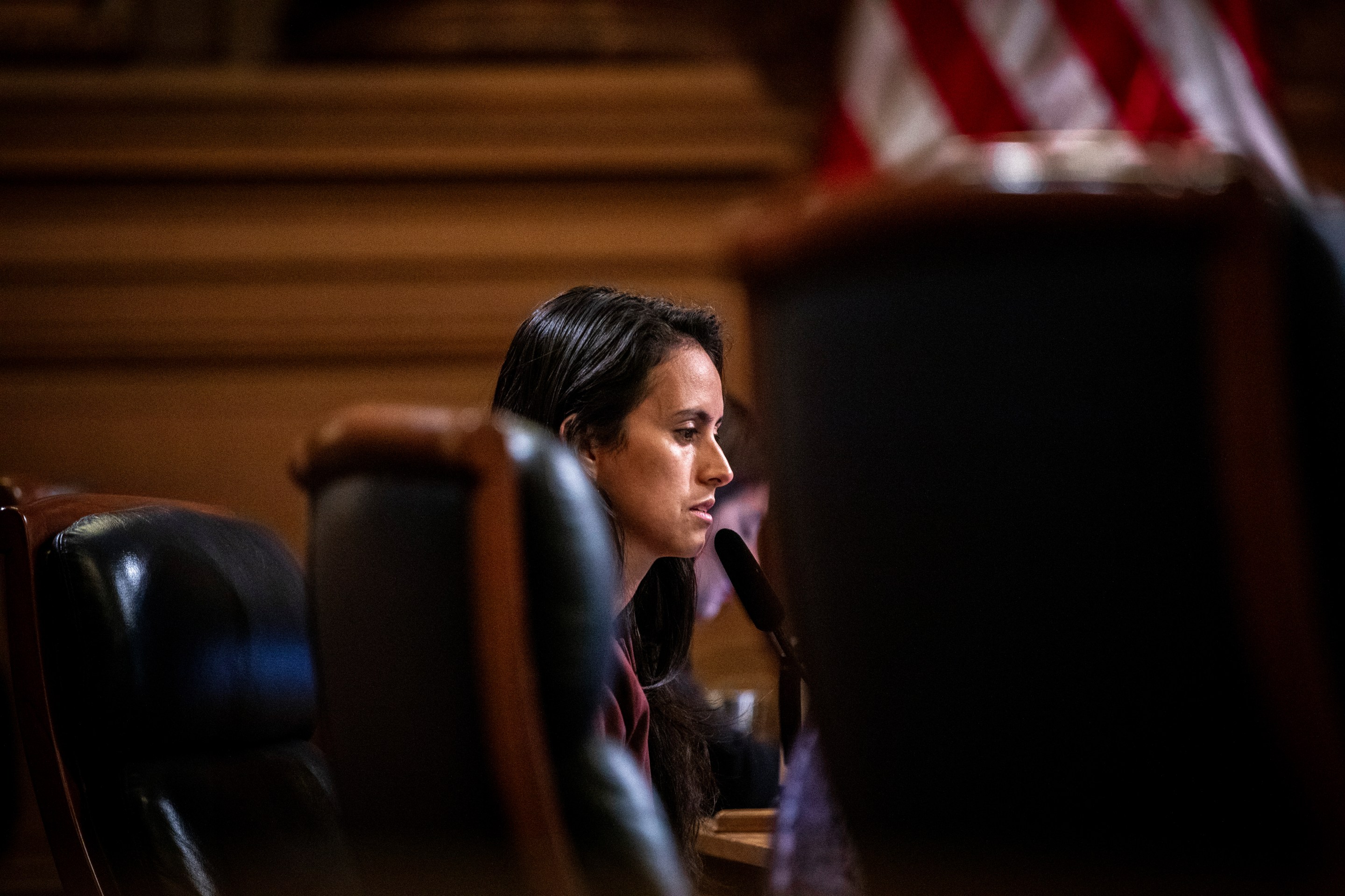

On April 7, Jackie Fielder announced that she was taking a leave of absence from the Board of Supervisors until June 30. The announcement followed weeks during which she requested privacy to recover from an undisclosed mental health issue.
As the most progressive member of the Board of Supervisors, Fielder’s District 9 constituents in the Mission, Bernal Heights, and Portola have missed her sparring with Mayor Daniel Lurie, especially as he molds San Francisco’s budget to meet a fast-approaching deadline. More broadly, San Franciscans are missing her role as a ballast, keeping Lurie — and City Hall — in check.
In a March 29 Instagram post, Fielder’s office said that in her absence, her team will “remain dedicated to meeting the needs of our constituents,” and remains “committed to fulfilling our agenda.” While no one reasonably questions Fielder’s need to take a leave of absence, recent developments highlight the difficulty and reality of addressing her constituents’ most pressing needs without their supervisor in City Hall twisting arms or mounting political opposition.
For Fracisca Oropeza, and San Franciscans relying on an elder care clinic in District 9, the timing of Fielder’s leave couldn’t be worse. Under Lurie’s proposed budget cuts, the South East Mission Geriatrics clinic where Oropeza works as therapist, will be closed. For weeks, Oropeza has been on picket lines and at City Hall, sometimes alongside her patients, fighting to save the clinic before Lurie submits his budget to the Board of Supervisors on June 1.
Fielder’s absence is “a disadvantage for us,” Oropeza told Gazetteer SF. She described former Mayor Gavin Newsom’s attempt to close the clinic in 2009, and how she relied on then-Supervisor David Campos to defeat the effort.
I called her office, and they’re trying to do the best they can, but they’re not her. I don’t know who’s going to make decisions for her.
Francisca Oropeza, South East Mission Geriatrics therapist
“Back when I was fighting the good fight, every time we did that, we had amazing supervisors who would jump on board,” she said, adding that she hopes Fielder may yet step in. “I can’t say for certain, we don’t know. I called her office, and they’re trying to do the best they can, but they’re not her. I don’t know who’s going to make decisions for her.”
Ana Herrera, a legislative aide to Fielder, said in an email that the Supervisor’s office is working “every day” to address constituents’ concerns.
“We have not heard from Ms. Oropeza or the South East Mission Geriatrics Clinic, and look forward to connecting with them and the Mayor’s office, to advocate for protecting this critical city resource in the Mayor’s budget,” Herrera wrote.
Sophia Padilla, a therapist at The Michael Baxter Larkin Street Youth Clinic in the Tenderloin, has had a different experience than Oropeza’s, illustrating the difference the presence of a supervisor, in her case, D5’s Bilal Mahmood, can make.
The Larkin Street Clinic, as it is known, is also targeted for closure as part of the Mayor’s budget cuts. Padilla signed up for a coffee chat with Mahmood and was surprised to learn he knew who she was. The supervisor told her he had spoken to the Department of Public Health and community-based organizations about the clinic’s fate.
“He called himself an ally to us,” Padilla said. While Mahmood made no promises that the clinic would remain open, “he did seem like he was working hard to do so, and having conversations with people and wanting to support us,” she said.
Another example of how Fielder’s absence is being felt: the Lurie administration may get a pass on the $5.9 million contract it steered to OpenGov, the company selected to review the city’s permitting system for new businesses. In October, the San Francisco Standard revealed OpenGov executives had contributed to Lurie’s nonprofit, Tipping Point Community, and that Lurie held an indirect investment in the company.
Less than a week later, on Oct. 21, Fielder, in her role as chair of the Government Audit and Oversight Committee on the Board of Supervisors, called for a hearing to examine Lurie’s procurement process in his selection of OpenGov.
In December, Fielder’s office told Gazetteer SF that the OpenGov hearing would be scheduled for January or February. That never came to pass, and starting in mid-March, Fielder began missing her Board of Supervisor and committee meetings.
Since Fielder’s leave, the Government Audit and Oversight Committee has been reconfigured as a board of two: with D2 Supervisor Stephen Sherrill, a Lurie ally, replacing Fielder as its chair, and Mahmood. If they agree, the two can pass recommendations to the full board. The committee’s third spot remains vacant.
Sophie Marie, a spokesperson for Board President Rafael Mandelman, who makes committee appointments, said Fielder’s request to return to her position as chair of the Government Audit and Oversight Committee will be taken up when Fielder returns.
Sherill, who is running in a special election next month to continue representing District 2, partnered with Lurie on the PermitSF reforms that OpenGov was hired to assist with. Jack Hebb, a spokesman for Sherrill’s office, said the OpenGov hearing won’t be scheduled because it was sponsored by Fielder; the Government Audit and Oversight Committee is waiting for her return before a hearing takes place.
Asked about the OpenGov hearing, Herrera, Fielder’s aide, told Gazetteer SF that Fielder’s office looks “forward to her staunch advocacy, including continuing her government oversight efforts, upon her return.”
In the meantime, her district is missing her.