

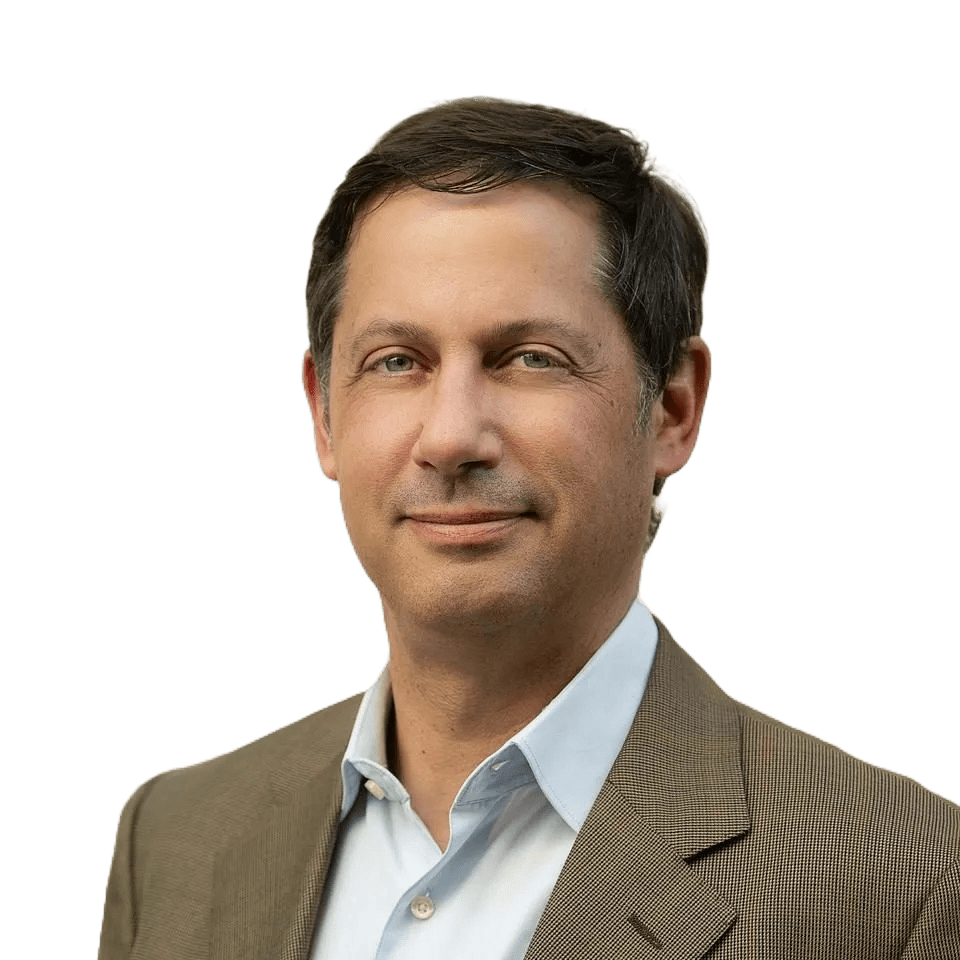
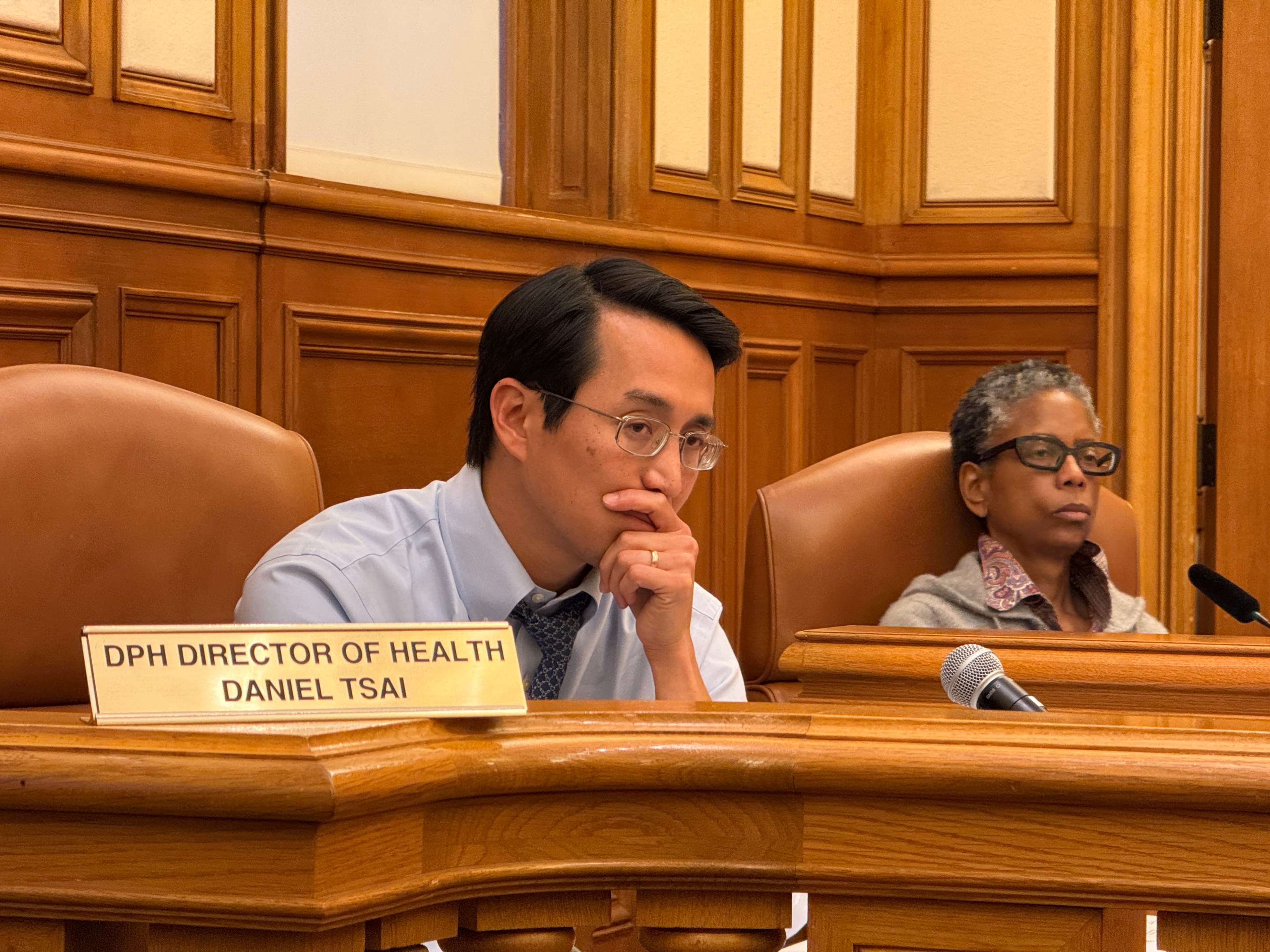

At a hearing Monday at City Hall, Daniel Tsai, the director of San Francisco’s Department of Public Health, found himself playing two roles: ax-swinger and man of the people.
Officially, Tsai was there to explain a proposed DPH budget that meets the cost-cutting demands of Mayor Daniel Lurie’s citywide budget cuts. Tsai’s analysis requires DPH to shear jobs, streamline services, and close clinics. That part came naturally. Unofficially, before the hearing started, Tsai tried the harder piece, by conferring with elderly residents sitting in the front row of the hearing room, whose free clinic, the South East Mission Geriatrics Clinic, DPH is closing.
After listening to their objections, Tsai told the clinic’s patients that his overarching goal is to minimize department layoffs.
As the hearing started, members of SEIU 1021, the union representing over 16,000 city and county employees, filled the room chanting: “No cuts! No layoffs! Protect public services!”
Tsai didn’t strain to be heard over the chants, which persisted in the hallway, behind the hearing room doors. Instead, he calmly proceeded in a professorial presentation about why the cuts at DPH are required, and pointed at a familiar foe: President Donald Trump.
Medicaid cuts in the president’s 2025 P.L. 119-21, commonly known as the “One Big Beautiful Bill Act,” combined with state cuts, including healthcare for California’s undocumented immigrants, resulted in about a $300 million loss of funding to DPH, Tsai explained.
“Those two cuts could collectively lead to unprecedented cuts to the safety net, and Medicaid, all across the country,” Tsai told the assembled crowd. “Especially here in San Francisco, they are incredibly damaging.” For the past seven months, Tsai said, he has been consulting Lurie about what to do.
“Tax the rich,” someone suggested from the crowd.
The interjection came from Jennifer Esteen, a psychiatric nurse at San Francisco General Hospital who, in her role as SEIU’s vice president of organizing, has been one of the union’s most visible and vocal critics of the Lurie administration. A week earlier, Esteen led a union protest against Lurie’s budget cuts at San Francisco General.
Esteen’s unsolicited suggestion was a call to support Measure D, the San Francisco initiative aimed at taxing top executives who earn more than 100 times the median salaries of their employees. The measure’s possible passage in June, SEIU argues, will render Lurie’s budget cuts unnecessary.
Despite the city’s budget cuts, DPH’s budget will grow by $409 million, Tsai said, to $3.8 billion by fiscal year 2027-2028. Paid for by cuts to other city departments, the money will offset the cost of Trump’s and California’s Medicaid cuts. Immigrants in San Francisco who lose state Medicaid coverage, known as Medi-Cal, can continue to enroll in the city’s program, HealthySF, Tsai said.
“We’re not going to let the safety net crater here in San Francisco, and DPH will receive substantially more support,” Tsai told the crowd.
DPH is still left with a $40 million shortfall. In response to Lurie’s demand that Tsai figure out a way to make up the difference, DPH is eliminating 120 positions, seven of them through layoffs. To avoid more layoffs, DPH has left vacancies unfilled, and undertaken a “rebalancing of workload” and an “organizational restructuring,” as the euphemisms would have it, that move some employees to new jobs.
Following his presentation, Tsai listened to more than 100 speakers’ objections to the cuts and closures, including statements from the elderly, teenagers, new mothers, union members, workers at nonprofits, and DPH employees.
Esteen, who was the first to speak, made a rousing case that DPH is failing to prioritize San Francisco’s most vulnerable residents.
In an interview with Gazetteer SF, Esteen said SEIU will continue to protest layoff notices and the clinic closures until Lurie submits his budget to the Board of Supervisors on June 1. The union will continue to be a public presence and push for Measure D, she said.
“Our mayor has the priorities of a billionaire,” Esteen said. “We need him to have the priorities of a regular San Franciscan. So it’s our job to help him change his mind.”
During the presentation, Tsai stuck by the bland term “consolidation” to describe what’s happening to the DPH clinics. In an interview, Tsai confirmed to Gazetteer SF that the South East Mission Geriatrics Clinic, as well as the Baxter Larkin Street Youth Clinic in the Tenderloin, and Cole Street Youth Clinic in Haight Ashbury, will be closed.
Tsai said while he believes the clinics are “wonderful things,” fiscal constraints require DPH to make sure clinicians are seeing as many patients as possible. Patients at the youth and elderly clinics will continue to get treatment at other locations, he said. (Therapists at the hearing told him patients, especially the elderly, are unlikely to go to a different, higher-volume location).
According to DPH, closing the three clinics, which treat 800 patients annually, will save $2 million. To Esteen, it’s an example of DPH trimming a low-cost, critical service that, taken together with other cuts, erodes the historic and life-saving care for HIV-positive patients, the elderly, youth, and immigrants that San Francisco has built over decades. While Tsai and his team are “patting themselves on their backs” for what they’ve preserved, DPH is missing the impacts of their cuts.
“I think he really wants to be liked, I think he’s a hard worker, in some ways I truly believe that he cares about the services we provide,” Esteen said, referring to Tsai. At the same time, she added, “I think Daniel Tsai has been given terrible orders, and I think he is carrying them out efficiently.”