
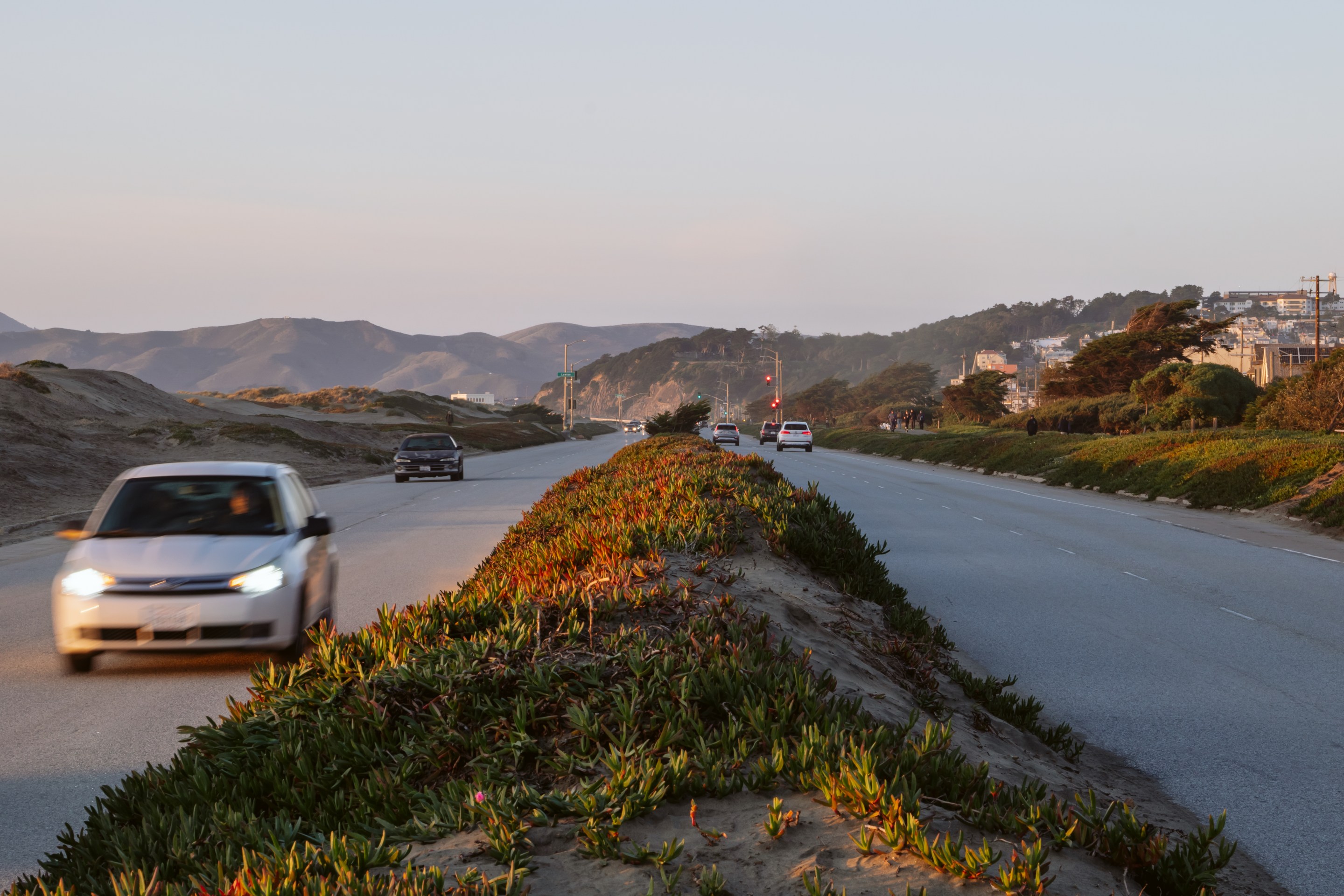
At a press conference on Jan. 8, District 4 Supervisor Alan Wong doubled down on his support of re-opening the Upper Great Highway on weekdays.
Echoing the rhetoric from his loudest pro-UGH constituents, who claim that the closure worsened traffic and endangered drivers and pedestrians, Wong offered numbers comparing the accident rates between April to September 2024 and April to December 2025, showing an increase from 37 to 67 crashes.
“Ultimately, I have to prioritize street safety and the needs of those commuting to work, taking their kids to school or going to the Veterans Affairs hospital over weekday recreation,” Wong told the audience.
A new analysis from data scientist Jacob Zwart, however, goes much deeper than Wong’s year-over-year comparison and suggests that the closure of the Upper Great Highway on weekdays has not had any significant impacts on safety.
Zwart has a PhD in biological sciences and has spent the last decade analyzing data, including environmental research for government agencies. As a resident of the Sunset for the last four years, Zwart followed the fight over the Upper Great Highway and decided that number-crunching could shift the arguments around congestion and safety. In July, the San Francisco Chronicle did an analysis of traffic flow, but that was about all he could find, Zwart told Gazetteer.
“Anecdotes are really powerful and important, but when you’re making policy decisions, you would really hope to have some other data to support it,” Zwart explained.
The problem with Wong’s year-over-year comparison is that it does not account for city-wide trends in vehicular accidents, which can be affected by weather, population shifts, and other elements that have nothing to do with a road closure, Zwart noted.
Zwart dug into the numbers from the city’s database of crashes that led to injury, using a method dubbed “Before-After-Control-Impact” (BACI). BACI is often used in ecological studies to compare the effect of an intervention in one area versus a control area, such as two halves of a lake.
For his analysis, Zwart chose the Sunset as the impacted area. For his control, chose eight SF neighborhoods that are far from the Great Highway: Bernal Heights, Outer Mission, Excelsior, Oceanview/Merced/Ingleside, Portola, West of Twin Peaks, Bayview/Hunters Point, and Pacific Heights.
Using two statistical models, he compared shifts in crash numbers from 2019 to 2024 in the control neighborhoods to Sunset numbers after the full UGH closure last year. The results show “statistically indistinguishable” differences between the Sunset and other neighborhoods, Zwart said. If anything, his number-crunching suggests the Sunset saw slightly fewer crashes than expected in the experiment.
“If you’re looking at a time series of monthly crash data within just the Sunset, and there is an increase right after the highway closure, it’s tempting to interpret it as ‘traffic is being rerouted and it’s increasing crashes,’” Zwart said. “But that’s an interpretation with no reference sites for comparison.”
Zwart says that his analysis does have some weak points, namely the limited amount of Sunset crash data after the UGH shut down, and his subjectivity in picking control neighborhoods (Zwart considered both geographical size and population density, along with their separation from the Upper Great Highway).
He also has some general criticisms of traffic in his neighborhood, noting that he still hits congestion on Crossover Drive, which runs north to south through Golden Gate Park. A bigger issue for Zwart is the lack of four-way stops, which forces drivers to creep dangerously into oncoming traffic when, for example, turning from 30th Avenue onto bustling Lincoln Way.
Nonetheless, Zwart wants Sunset Dunes to remain open all week long. He says he spends at least an hour at the park each day. “It’s the only place in the Sunset that I feel completely safe as a pedestrian,” he continued.
Supervisor Wong did not respond to detailed questions from Gazetteer about his safety concerns, comments from constituents, and key sites of traffic conflict by press time.
Despite his efforts in early January, Wong could not drum up three more votes from the Board of Supervisors by the Jan. 13 deadline to bring the matter back to a citywide vote. The future of the UGH may still be up in play, however. Pro-highway-opening advocates — many of whom were behind the recall of former Supervisor Joel Engardio — are now mulling a signature-gathering campaign to put the matter on the June ballot.