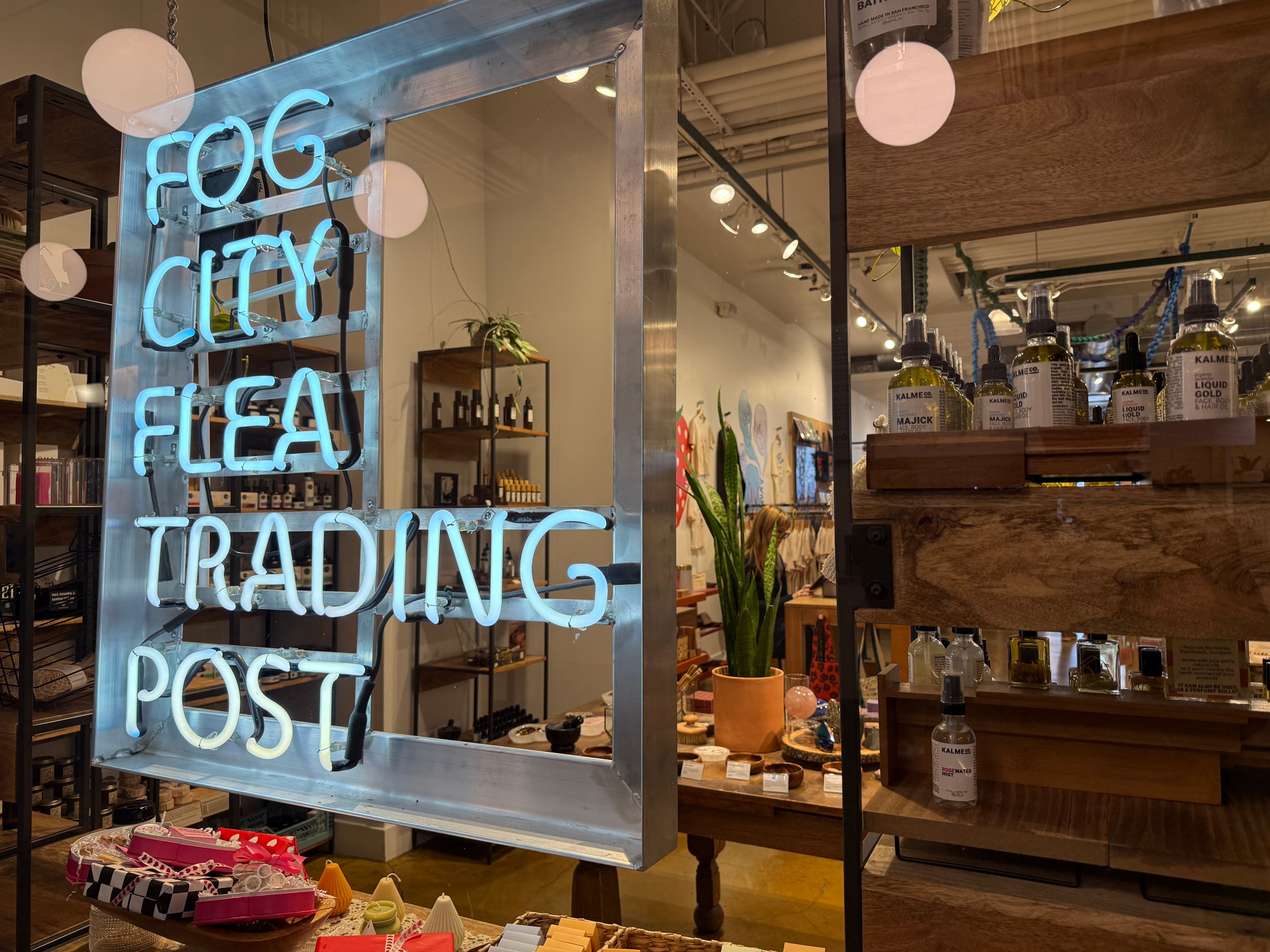

When Deco Denim, a boutique San Francisco denim brand, started selling at Fog City Flea Trading Post in the middle of last year, Sarah Mattes was excited. Fog City Flea was a big success story. It started as a pop-up in 2019 as people gravitated to shopping local and became a fixture of the Ferry Building just as shoppers were committing to supporting small businesses as the pandemic became an extinction level event for many independent retail brands. Local tastemakers like Gravel & Gold were longtime vendors in the shop, nestled in a beautiful, airy part of the Ferry Building overlooking the bay.
For Mattes, who started the company in late 2022, having her clothes in one of the city’s highest-trafficked tourist destinations was a chance to bring her shop to a new audience. Her display at Fog City would also be the first time she’d have creative control over her space, albeit in a mini store-within-a-store format.
Mattes soon realized that her display at Fog City was located at a blind spot for security cameras and employees. In the months after she joined the shop, she found that a handful of her cashmere- and wool-blend beanies had mysteriously disappeared, as did a couple vintage goods. Late last December, after returning to the shop following an extended break to take care of her ailing mother, she learned that more than a thousand dollars’ worth of her merchandise had been stolen from her display. Security guards hired to keep an eye over inventory were abruptly laid off right before the holidays, and Fog City contractually took no responsibility for any thefts that happened inside.
She emailed Fog City’s owner James Morelos in January.
“I value being part of the store and want to make sure selling here continues to be sustainable,” she wrote to Morelos, in an email exchange viewed by Gazetteer. “I’m very open to discussing placement options or other adjustments that would help address this.”
Mattes didn’t expect to hear back from him quickly; Morelos was usually slow to respond, and Mattes often had to follow up to get paid each month.
This time, Morelos responded in thirty minutes. The email was simply an announcement that Fog City would be temporarily closing, and a curt message: “We’ve loved having you in the store and we’re so sad to not be able to accommodate everyone!”
She had three weeks to vacate. She was not invited to open a shop at Fog City’s new Valencia St. location.
According to multiple sources who spoke with Gazetteer SF, Morelos initially gave other businesses two weeks’ notice that he was closing his Ferry Building location; some, like Deco Denim, were not invited back. Employees at the Ferry Building location are also being let go with no guarantees of returning.
In the wake of this abrupt shutdown, current and former business owners who have sold at Fog City describe a culture of fear, delayed payments, and mismanagement all led by owner James Morelos.
“The entire curation of that space is all about fostering small business in San Francisco,” one individual familiar with Fog City’s dealings told Gazetteer. “Yet, this is a business that is actually doing just the opposite. I’m sure James thinks he’s a bit of a hero in this story, but he’s not.”
For small apparel, stationery, art, and decor businesses, Fog City positions itself like an ideal place to land. Fog City Flea began in the city in 2019 as a pop-up extension of the already-successful Mojave Flea Trading Post in Palm Springs. In 2022, it became a permanent part of the Ferry Building, offering wares from dozens of local vendors. Current and former Fog City vendors say that selling there drives a substantial amount of business, and for many first-time entrepreneurs, their first taste of running their own storefront.
Even unhappy small business operators said that selling at Fog City can be a boon. With tons of foot traffic in one of San Francisco’s most tourist-heavy locations, it helped brands reach global consumers. One estimate found that the Ferry Building drew 2.5 million visitors in the first quarter of 2025. “I’m really glad I was in there but it ended up just really being rough,” said one business owner who declined to be identified out of fear of retaliation.
Among the shop owners who spoke with Gazetteer, many recalled that Morelos’ reputation preceded him. Staff at the store, Mattes alleged, warned her not to come in on days when he was around.
Morelos, more than one person said, had final say over the fixtures and the design of businesses’ booths. But Fog City offered no support for businesses, many of whom were doing this for the first time, and made them spend their own money. He also was not present for day-to-day operations.
Morelos, who is based in Palm Springs, did not respond to a list of questions.
When he did come in, Morelos could be cutting. A common gripe from Morelos, sources said, was that racks looked “too Ikea,” or individual shop owners’ decor looked “tacky.” He could also be mercurial, approving a businesses’ design choices after extensive review, then, in a follow-up, decide that he hated it. Even ones that were custom-built for the store — and already approved by him — were subject to impromptu revisions.
He also had final say over what brands could or could not sell in the store. Mattes, for example, recalled wanting to sell vintage home goods at her booth, until Morelos wanted them gone with no explanation.
“As I was taking everything off of my table that was vintage housewares, somebody bought a four set of cups and saucers,” she recalled.
A business owner who currently sells at Fog City told Gazetteer that they were not paid for their sales for three months until his grievances about the business’ displays were resolved. It felt as if Morelos was intentionally withholding pay because of the display issues, they said.
One former business owner found immediate success at Fog City, selling thousands of dollars of merchandise in their first couple of months. Morelos hounded them about their setup, even though sales were strong. For months, the business owner would receive messages from Morelos expressing disdain for the display.
“We were so consistent, making the same amount every month,” the store owner told us. “And then he would come in and just be like, ‘I hate this display. I hate it so much.’”
The business owner tried to find a compromise, but Morelos decided that the shop should just move out. Fog City employees and other business owners were stunned. It didn’t matter that the shop was consistently making rent, or that they were a high-volume seller. The vendor was given 30 days to vacate the premises.
“I’m still sitting on that inventory,” they said. “I just didn’t have to put up with this guy anymore.”
The damage the Ferry Building location’s sudden closure will inflict on Fog City’s panoply of small businesses may be catastrophic.
Some relied on Fog City as their primary selling channel; without this, businesses will have to rely more heavily on e-commerce or take no income for however long it takes to set up their new brick-and-mortar. They also still have excess stock that they have to hold onto. (There was no offer for sellers at the Ferry Building location who will sell at the Valencia St. location, owners told me.)
The shutdown of Fog City’s Ferry Building location has also given Morelos greater leverage. Many businesses continued to work with Fog City, despite his conduct, because they had flexibility over their revenue sharing. Initially, Fog City offered businesses two options: a 50-50 split, which helped newer or more risk-averse businesses, or a traditional agreement where businesses paid Fog City for rent and kept their own sales.
With the closure, Morelos is mandating that all businesses invited to sell enter a 50-50 split, a less than ideal arrangement to many of the businesses who were able to build and expand thanks to Fog City’s previous business model.
“As a company started during COVID, now 5 years in, we are committed to opening more high profile/high traffic locations and want to position ourselves to thrive for the next 20+ years,” Morelos wrote in an email to vendors he wanted to return, which was obtained by Gazetteer.
When Morelos opened up the Valencia St. outpost of Fog City Flea in fall of 2025, he told Mission Local that his business is “truly dedicated to the creatives in the region, women, people of color, queer people.”
Mattes strongly disagreed.
“He comes across like he’s creating a business that is supposed to uplift and empower small businesses,” she said. “But in actuality, he is really a leech.”