

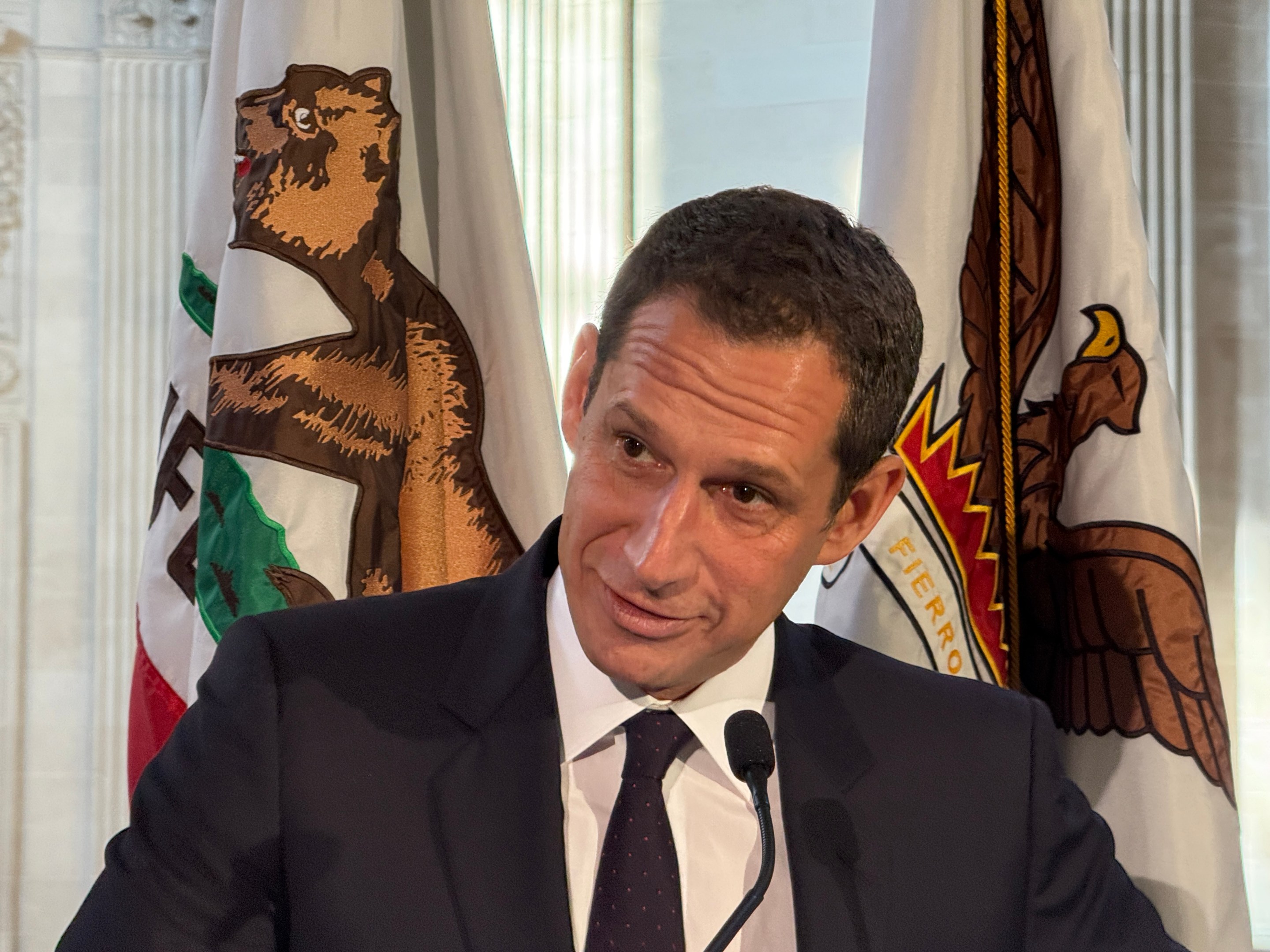

Earlier this month, a data visualization site called Visual Capitalist posted an infographic dedicated to America’s highest-paid mayors. Using numbers from a Business Insider list from June, Visual Capitalist placed San Francisco Mayor Daniel Lurie at the top of the list, which may have surprised some readers who believed that his salary was $1.
Lurie’s updated 2026 salary of $409,391.20 is even higher. It is transparent enough, and fairly well known, thanks to DataSF, the city’s open data portal. It’s also widely understood that given his personal wealth, Lurie continues to draw an actual salary of $1.
What’s not understood, and persists as something of a mystery in the corridors of City Hall, is what happens to the remaining $409,390.20 the mayor doesn’t collect.
Some of the discrepancy in the mayor’s pay comes from the best, local and updated sources of information. While the San Francisco Controller’s office reports the mayor’s 2026 pay at $409,391.20, the city’s Civil Service Commission says he earns $405,548. While the difference went unexplained by the two agencies, it’s narrow, and nonetheless corroborates the fact that the top San Francisco officeholder is likely the best paid mayor in California, and the country. Which further begs the question of where Lurie’s salary ends up.
Charles Lutvak, the mayor’s spokesperson, told Gazetteer SF in an email the oft-repeated explanation that Lurie “donates his salary back to the city.” Under San Francisco’s charter, Lurie is required to take a salary, Lutvak added, “so he has to donate instead of technically forgoing it.”
Lurie’s choice to forego the majority of his salary follows in the footsteps of New York City Mayor Michael Bloomberg, California Governor Arnold Schwarzenegger, and US Presidents John F. Kennedy, Herbert Hoover, and, for at least some part of his first term, self-declared “schmuck” Donald Trump.
Lurie’s salary is his to do with what he wants. But with his campaign promise to donate it, San Francisco voters and taxpayers deserve a good explanation of where the money allocated for the mayor’s salary is diverted. San Francisco’s city government is made up of dozens of departments. Saying it “goes back to the city” doesn’t explain where it is spent.
I pressed Lutvak further on whether Lurie’s salary is directed to a particular department, organization, officeholder, or if it’s returned to the Controller’s office. Does the mayor specify what happens to his paycheck?
“It goes back to the city,” Lutvak repeated in our email exchange. “The budget has a lot of different revenue sources and expenditures — each expenditure does not always correspond with a specific revenue source.”
The San Francisco mayor’s salary, along with compensation for other elected officials, is set by the San Francisco Civil Service Commission. Every five years, the agency conducts a survey of officeholders in five Bay Area counties and averages the salaries to arrive at compensation for San Francisco officials.
2026 to 2027 is the fifth year of the compensation cycle, and based on a 2.7 percent increase in the Consumer Price Index, the San Francisco mayor gets a raise of $10,660 to arrive at a salary of $405,548, according to the Commission. The next highest-paid elected city official is District Attorney Brooke Jenkins, who earns $375,986. The salary for each of the city’s 11 Supervisors, by comparison, is $180,128. The Controller’s Office and Department of Human Resources manage the city’s central payroll system, distributing salaries, overtime, and benefits.
Preeti Grewal, a senior analyst at the Civil Service Commission, couldn’t say what happens to Lurie’s salary. The inquiry is outside the purview of the San Francisco Ethics Commission, which is primarily concerned with officials’ relationships with outside entities, bribery, conflicts of interest, and officeholders receiving money rather than giving it away. Michael Canning, a policy and legislative affairs manager at the Ethics Commission, declined to comment on where Lurie’s forfeited salary ends up.
The best answer, so far, came from Alyssa Sewlal, a spokesperson for the Controller’s office. “The mayor’s salary goes back into the general fund,” Sewlal wrote in an email.
The approximately $6.8 billion fund pays for street cleaning and general maintenance of buildings, streets, and parks. It is fed by property and business taxes — and, apparently, Lurie’s salary.