
Unionized workers of Verve Coffee Roasters today will vote to ratify an agreement with their employer, potentially solidifying the first labor contract since baristas at several locations across San Francisco, Santa Cruz, and Menlo Park voted to unionize last summer.
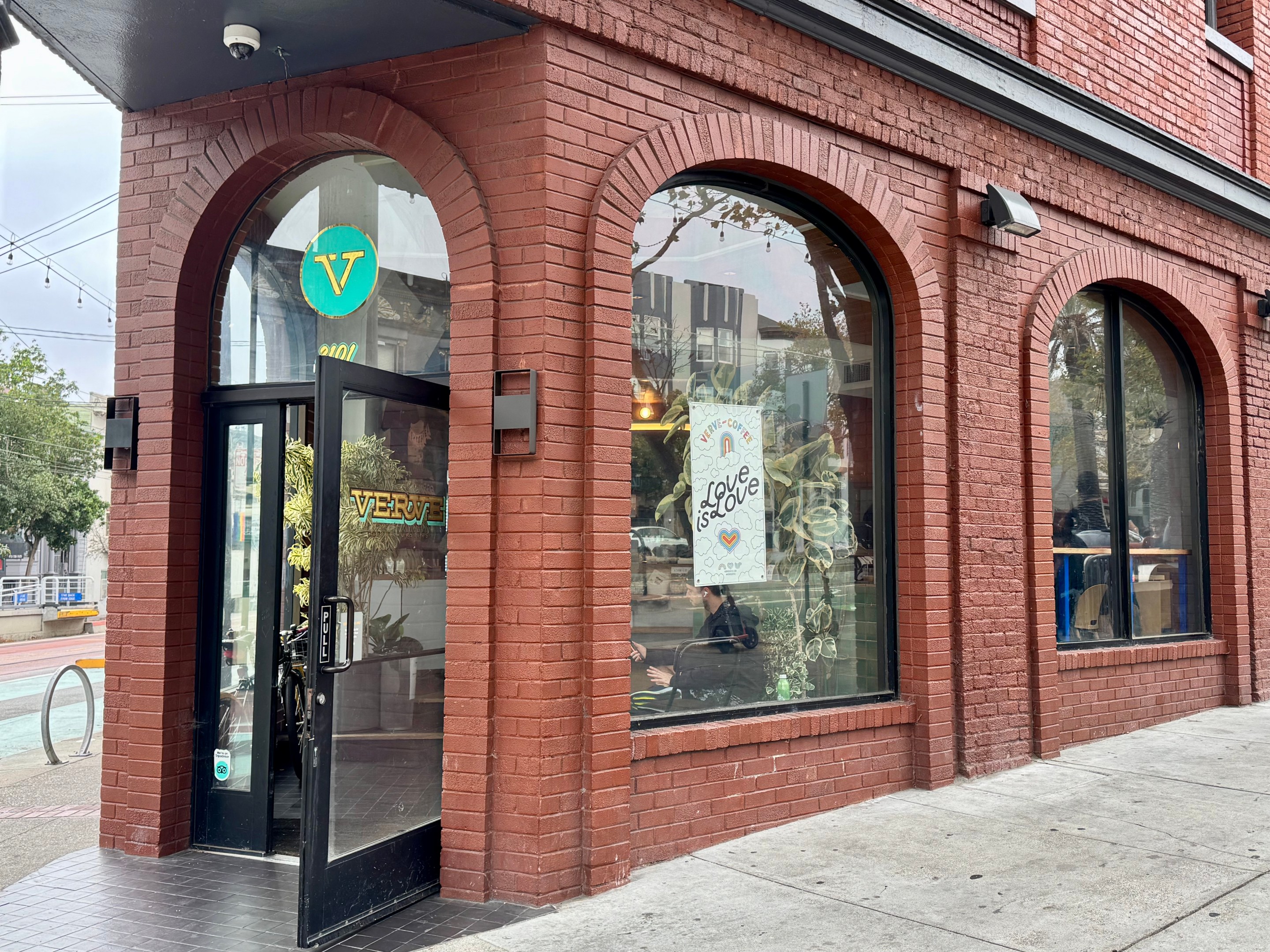
The contract, which is the first to be reached among the slew of recently unionized specialty coffee shops in the Bay Area, clinched protections against AI interference in management decisions, higher paid sick leave premiums, and guaranteed hours for full-time employees. Roughly 60 employees across five stores — one on Market Street and one inside the Levi’s headquarters in San Francisco, two in Santa Cruz, and one at the SLAC National Accelerator Laboratory in Menlo Park — will vote electronically today after 10 months of negotiations.
“The fact that they're actually listening to us now is just so empowering,” said Annika Mikk, an employee at the Market Street location and a member of the Verve Workers United bargaining committee. “If there has been an issue at work, whether it’s something that we ended up negotiating in the contract or a smaller issue, we’re able to bring that up and get things addressed.”
The union’s representative, United Food and Commercial Workers Local 5 (UFCW5), says the AI clause, which states that no managerial decisionmaking can be done by AI, is a historic first in protections against AI’s influence on employees.
The Santa Cruz-founded coffee company had recently introduced Claude-powered evaluations for baristas, causing concern among employees that this software would impact recommendations for promotions or disciplinary actions. Several months ago, shift leads were instructed by Verve to write end-of-day reports and forms that would then generate a summary with AI.
“The AI summary would write things like, ‘This person was really productive today,’ or ‘These are the cafe's best hours,’ and make assessments and judgments,” said Mikk. She said having workers’ performance or details from a shift narrated by AI “had people's alarm bells ringing.”
Employees also noticed that AI was creating similar judgments in their scheduling software, 7shifts. On the desktop version, labels like “most engaged” and “least engaged” were assigned to people based on their activity in the scheduling app. Annika said they were concerned whether the AI labels might be used to unfairly reprimand employees, as sometimes, shift changes were communicated to the manager but not reflected in the scheduling app.
“We were able to get something in the contract that stated people wouldn't be reprimanded solely based off AI — that was the language — which we feel really good about,” said Mikk.
The gradual uptake of AI in the food service industry has posed concerns over the influence of AI on a worker’s employment status and perception of performance, as well as scheduling and inventory. Twenty-six percent of restaurant operators say they are using AI tools at their restaurants, according to the National Restaurant Association’s State of the Restaurant Industry 2026 report released in February.
The most common application was marketing (to many people’s chagrin), followed by administrative tasks. And, as SaaS companies scramble to hop on the bot-wagon, “It’s likely that many of the technological tools that restaurants regularly use (and plan to invest in more) will include increased data and AI integration. This includes point-of-sale systems, human resources tools, customer-facing technologies, and order processing systems, among others,” the report states.
Labor unions nationwide are navigating the explosive rise of AI as workers are increasingly seeking protections for how AI is used in their workplaces.
Nine out of 10 workers favor measures that ensure human oversight in employment decisions, transparency from their employer regarding how AI is used, and strong guardrails against certain applications of AI in the workplace, according to polling data released in May by the AFL-CIO, the largest federation of labor unions in the US.
The survey of nearly 1,600 Americans found that 95 percent want a human to be the final decision maker in matters impacting workers. Additionally, 92 percent said they support strict safeguards for employers deploying AI, though only 7 percent said their employer has disclosed how AI monitors their work. The respondents said they trusted unions, over their own employers or lawmakers, to protect their jobs from AI interference.
Jim Araby, director of strategic campaigns at UFCW5, said they are moving quickly to establish a legal framework and language to address AI with employers.
“We have been through contract negotiations trying to get language that, at a minimum, requires employers to notify the union on the use of such tools, and then demand bargaining over anything that impacts people's working conditions,” Araby said. “Now when it comes to specific language, it’s hard to write anything prescriptive, because these tools are continually developed over time so something that is written as a specific prescriptive language in October, by January, may not work.”
In addition to protections against AI, the Verve contract gained workers significantly higher paid sick leave, receiving an additional $5 per every hour covered by paid sick leave to partially account for lost tip wages. Mikk and Araby said that this is also a historic first in the industry and that more companies should acknowledge that tips are a notable share of the income that service employees rely on.
Verve Workers United and their employer also agreed on guaranteed hours for full-time workers, that schedules be posted 14 days in advance, more direct opportunities for part-time employees to step into full-time roles, a wage progression system, and a small parking stipend.
“Overall, it’s shifting the dynamic so they actually listen to their employees,” said Mikk. “I have seen a difference for sure with how Verve interacts with us and I think it’s great.”