

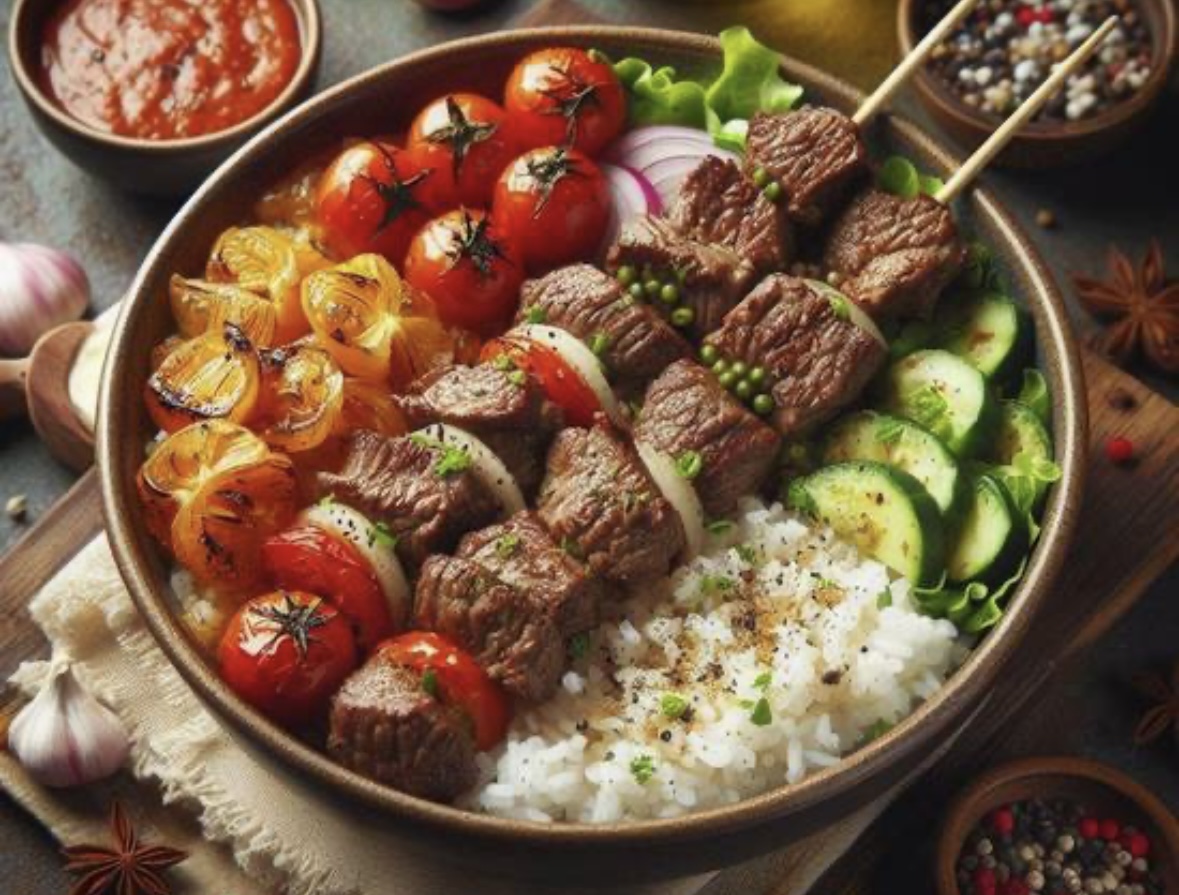
In the window of Simmer & Steamer on at 222 Battery St., there are images of rice bowls cartoonish enough for a Nintendo game. Sesame seeds sit evenly and sparsely atop a perfect white sphere that could, under a certain light, resemble an egg. Seaweed is shredded into orderly, textureless rectangular strips. Fried onion flakes look like tan Play-Doh pushed through an extruder.
Hungry?
Simmer & Steamer isn’t the only restaurant in San Francisco whose menu tumbles into the uncanny valley. AI-generated photos are taking over delivery listings and appearing in printed menus across the city. These days, to scroll delivery apps or peruse IRL menus is to whet your appetite with a barrage of high-gloss gustatory simulacra. As these images spread, it raises the same question that accompanies almost every new application of AI: Who wants this?
Unrealistic perfection has always been a part of food advertising, but AI-generated images may be the new frontier of deception.
“I think the dining public accepts some degree of dissonance between what they see in a photo and what they're going to get on their plate, you know?” said San Francisco food photographer Eric Wolfinger. “That's why I have a career, because I make food look really delicious.”
But AI-generated images of food can also contain uncanny flaws: absent texture, blurring, illogical shadows and lighting, or simply nonexistent ingredients.
Portraying every dish on a menu in itself is a fairly new phenomenon. Menu photos were once typically common at fast food or fast-casual restaurants; now, even upscale restaurants require images to market on delivery apps such as DoorDash, Grubhub and Uber Eats, which are (heartbreakingly) overtaking in-person dining among Gen Z and millennials.
Photos are essential on these apps. A DoorDash study from 2024 found that some 38 percent of delivery app customers are influenced by menu photos in deciding which restaurant to order from, and businesses whose menus use photos saw an increase of up to 44 percent in monthly sales.
So if restaurants need photos, why outsource them to AI?
Leah Clapper, a marketing lead at AI “agent” startup Rox, thinks AI can produce higher quality photos on tight timelines. During Tech Week this past September, she was in charge of a smoothie and waffle truck pop-up Rox hosted on Market Street. The chef contracted to make the smoothies took photos for Rox to plaster on the side of the food truck, but Clapper felt they were subpar.
“They were not straight-angle, the lighting was bad, the background was bad,” Clapper told Gazetteer. “I was like, AI can make this look better.”
What looks “better” is subjective, but certainly, they looked like AI: Textureless, cartoonish, too-perfect. The images of the different smoothie flavors were identical, except for the color. The image of the waffle was flawlessly round and looked more like a pocked hockey puck than a warm Belgian waffle.
AI also helps restaurants skirt photographer fees. Given the tiny margins for most food businesses, saving money could mean the difference between operating and failing. A few services, including DoorDash, offer complimentary photoshoots for vendors. Others, such as Uber Eats, charge $125 for a quick shoot.
While delivery apps offer free or less-spendy photoshoots for menu items, “what they expect and what they offer to pay photographers to shoot food is offensive,” said Wolfinger, the photographer. This can lead to disappointing results, unprofessional experiences, and, still, a lot of effort for a restaurant. “So if there's anyone to blame for this race to the bottom of food photography, it's the apps.”
These platforms strive for easy scrolling and consistent experiences; visual homogeneity serves this purpose. “There is a sort of plug-and-play element to DoorDash-style photography anyway, whether it's AI-generated or generated by a human,” said Nicola Parisi, a San Francisco-based food photographer whose clients include Flour + Water, Mister Jiu’s, and Loló. “The whole point of that platform is to have it feel standardized.”
Representatives from DoorDash, Uber Eats, and Grubhub all claim their platforms do not allow entirely artificial images. However, they were sure to distinguish between AI image generation and AI image enhancement, a feature that DoorDash and Uber Eats both offer its vendors for free.
Industry stalwart Grubhub does not offer any AI-powered services for its vendors and doesn’t encourage the use of generative AI for menu photos, a spokesperson for the company told Gazetteer over email.
Given that Grubhub only accounts for 8 percent of delivery app orders, while DoorDash, which rolled out even more AI photo enhancement features this year, dominates the market, one could make the case that AI menus are good for business. But if you’re hungry for actual food rather than enterprise profits, they’re not always appetizing.
The stomachs of customers and restaurateurs have been turned for years by sneaky AI images. In 2023, one Uber Eats customer shared the grotesque result of AI confusing the pizza “pie” terminology for a dessert pie across one New York pizzeria’s entire menu. (Note the presence of “Lelnach,” everyone’s favorite and obviously real brand of ranch.) Earlier this month, vendors on Forkable, a catering delivery app, were similarly puzzled when their photos were quietly replaced with otherworldly, unappetizing versions of their restaurant photos.
Scrolling through Uber Eats, AI-generated images are sprinkled among photos of real food — sometimes, even varying among businesses’ individual pages — making it more and more confusing to discern between them. The more we scrolled Uber Eats sniffing for imposters, these reporters felt their AI-detection faculties disintegrating in real time. Are limes really that green? Why is the beef in this burrito so shiny? Every white plate and marble countertop, tell-tale signs of the apps’ “enhancement” tools, became red flags.
When the jury (Gazetteer staff) was hung, photos were uploaded to the judge (wasitai.com) for a verdict: In almost every case, our slop suspicions were confirmed. Then the ultimate question became: Are we still hungry?
Perhaps these defects are what have kept photographers Wolfinger and Parisi safe from Mr. Steal Your Job.
“The phone continues to ring from people who have a very clear vision and who care about their food,” Wolfinger said. “Every restaurant, every chef, even every corporation has their signature style of doing something. And I'm not sure AI is capturing that for these restaurants.”
“I think you can really tell when a human who loves what they do is producing something versus, you know, just looking at an AI-generated image,” said Parisi. “It's a lot more than just food on a plate at the end of the day.”