

As Saikat Chakrabarti looked out upon the crowd of supporters, volunteers, and staff at the Chapel in the Mission on the night of June 2, the outcome was clear: He had lost his shot.
“I was honestly sad about letting people down,” he recalled. “A lot of people put their hopes into this.”
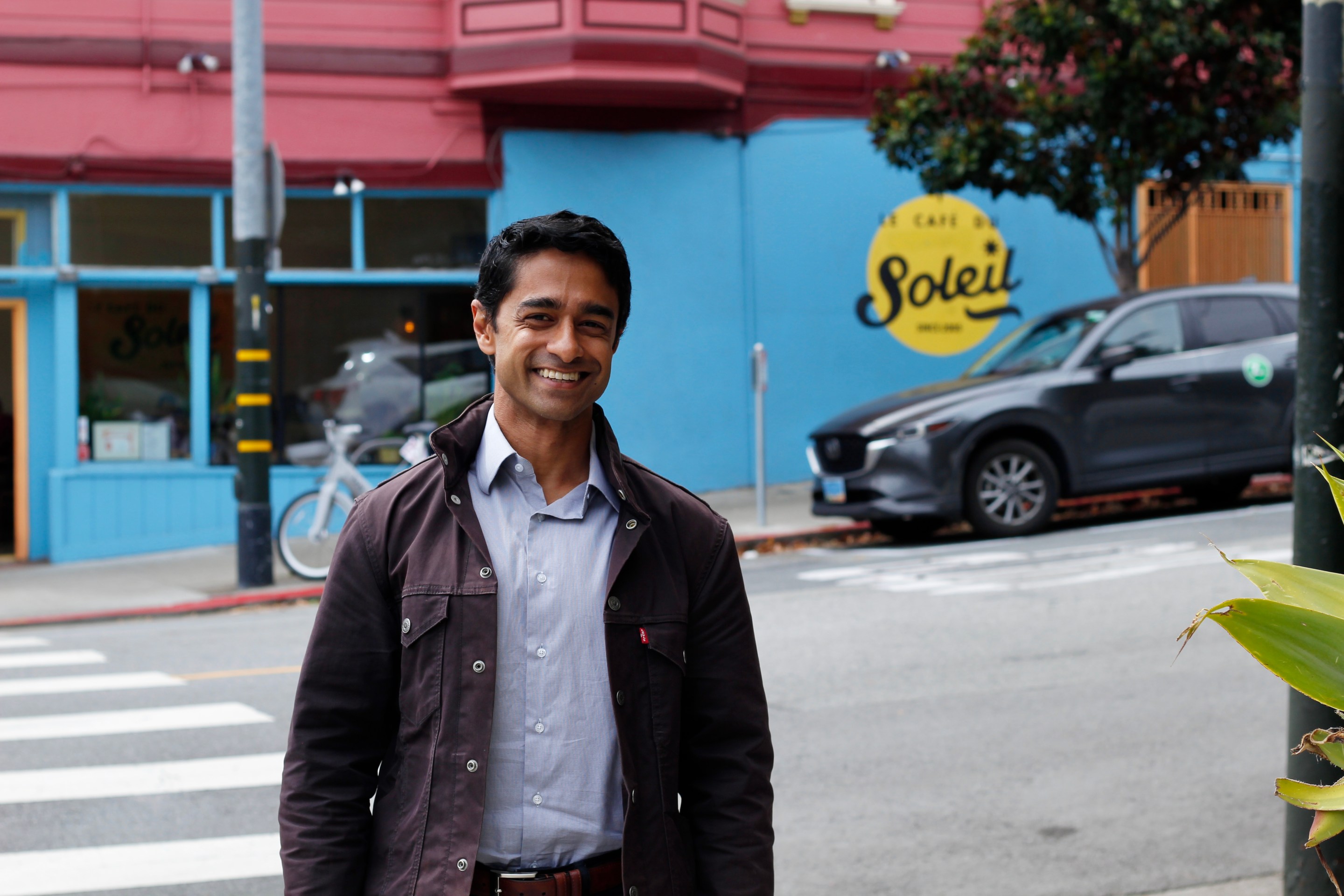
Chakrabarti’s face creased into a frown as he mulled the memory at Duboce Park Cafe on June 26, less than a month after his campaign ended. “But I don’t ever want anyone to pin their hopes on one campaign, anyway. The stuff we want to do still needs doing.”
He swirled a glass of green juice as he contemplated how he’d spent time talking with progressive candidates in other parts of the country even during his campaign.
“It was bittersweet. I didn’t do well. But Angela Gonzalez-Torres did well in Los Angeles. Randy Villegas did well in the Central Valley,” Chakrabarti, 40, said.
Although Chakrabarti only garnered 18 percent of San Francisco votes in the race to replace Nancy Pelosi in Congress, the June primary was a generational moment in local politics. Pelosi, after all, represented the San Francisco area in the House of Representatives for decades; November’s general election will be both a farewell for Pelosi and a coronation of, potentially, San Francisco’s next dominant congressperson.
Over the last month, Chakrabarti formed the Solidarity PAC to fund canvassing and phone-banking to support Connie Chan against Scott Wiener, and has leveraged his existing field campaign workers to convert Chakrabarti’s supporters into Chan voters come November.
Chakrabarti didn’t plan to back Chan with his resources after the primary, but he told me that the returns are positive: Some 80 percent of his supporters are converting to Chan, he said.
What comes next? Chakrabarti pledges that he’ll stay involved in local politics, and if he does, there will be plenty of hard-learned lessons to unpack from the 2026 cycle.
This interview has been edited and condensed for clarity.
What do you consider your biggest strategic success?
The message of radical change, the policy ideas, the decision to go as straight to people as possible, tons of town halls. I think that helped me build up the sort of volunteer army that we got. It brought in a lot of new people into politics here, especially a lot of young people who are pretty fed up with the status quo.
We weren’t always good at field campaigning at all. It’s just when we saw a bunch of volunteers show up at our office opening party back in July that we decided to do that. You need people who are excited and motivated to do the work. You could just go and hire people off Craigslist, but that’s a crappy field campaign.
I have a theory that, if you had a few years of any type of political organizing in San Francisco, you would’ve gained a lot more votes.
It’s hard to know because if I had done that, then I wouldn’t have done the work that led me to run for Congress, right? You know, either I would’ve worked in federal policy and Congress and learned how to make change there. Or I would’ve worked locally, and then I wouldn’t be qualified to run for Congress. What would I be offering? What difference would I bring?
To be fair, you could say that about Connie Chan, that she has no experience outside of SF.
That’s the thing, that was my difference (Laughs). But I’m backing her because she’s better on policy. But it’s interesting, in a lot of races, people run as complete outsiders and they win. I mean, [Alexandra Ocasio-Cortez] didn’t have any political experience before she ran.
I think something I noticed in San Francisco is that, somehow, all my national political experience was completely discounted, both in the press and locally. People just didn’t accept that. It might be something unique to SF politics. Like, people are really used to candidates coming up through the establishment.
My theory on this is that, in a lot of other cities, progressives are the insurgents. In those cities, there is no progressive establishment. There are fewer progressive institutions. So people don’t expect progressives to necessarily run on a bunch of political experience. Whereas in SF, we have strong progressive institutions. That’s a good thing, but I’d say the flip side is, I think that also makes a progressive movement here sometimes get a little staid in [its approach.]
Was a hypothetical endorsement by AOC the biggest factor in the result?
It was more the non-endorsement and then a month of news about it and attacks. I think that because literally, as that moment happened, we started seeing everything go down. We dropped in the polls, and we started seeing our field numbers go down.
Have you been able to talk to AOC after all the controversy?
Uh, no, not since the election.
It is what it is?
It is what it is.
Are you going to keep trying?
Look, for me… nothing in this is ever personal. I don’t hold grudges. I just want change to happen. AOC is a major figure in the progressive movement. I don’t know what she’s going to do next, but if she chooses to run for Senate, if she chooses to run for president, and there’s a moment to make real change, I’m going to do whatever I can to support that.
The June election, based on the defeat of Prop D and Lurie’s appointees winning in supervisor races, was a sort of referendum on the mayor. What do you make of that tension?
I think that a lot of what people in the city think about the San Francisco government is that it's very dysfunctional. They feel it’s just two tribes of people that go at each other. I think Lurie won largely on the message of, “I’m not a part of any of this. I’m not corrupt, either.” I don’t think a lot of voters [in 2024] put him in a bucket of “progressive” or “moderate.” They put him in the bucket of “outsider who will try to solve the culture of politics.”
On that front, I’d say… well, even when I talk to progressives who work in City Hall, and when I talk to Connie, the [takeaway] is that he’s better culturally, right? He and Connie seem to have a good relationship even though they’ll fight about policy. They can still talk. Whereas that didn’t happen as much with London Breed.
And, I mean, this is Connie’s strength, too. It’s something I’ve admired about her.
To your point, she’s been head of the city’s budget for the Board of Supervisors under two very different board presidents: Aaron Peskin and Rafael Mandelman.
Well, Connie tells you what she thinks and she’ll be upfront about it. She will deal with anybody. I mean, she’s a progressive in a district that doesn’t always have her politics. But she’s won trust there. That’s a great skill for a politician.
But to go back to Lurie, if you look at what people like about him, he tends to be solid on things like cleaning up City Hall, but he’s not getting great results on homelessness and housing.
He made a lot of big promises.
Yeah, but I think people are still in the phase of, “Well, we gave you the mandate, let’s see what he can do.”
I think now, people aren’t voting so much on “disorder.” I think public safety is no longer the No. 1 concern. It really is affordability and the cost of living. We need a brand of progressivism that can explain what our solution is, not what we’re opposing. I think Zohran [Mamdani] has done a great job of this in New York City.
How do you reconcile your criticism of Super PACs with the fact that you’ve, well, created a Super PAC to support Connie?
I was clear in the campaign that I don’t take corporate PAC money, or lobbyist money. My view has always been, who is influencing you when you go to DC? It’s not just corporate PACs but all the CEOs and execs that these politicians have to call all day and beg for money who shapes their worldview.
But the way politics works today, everybody has to deal with outside spending that supports them or opposes them. It’s just the way you have to win races right now. Do I like it? No. I would like to have no money in politics.
Publicly financed elections?
Completely public, yeah. In the case of the Solidarity PAC [in support of Chan], there’s no dark money involved. All the donor info — well, the donor is me, but our donors will be published in public filings. I think the idea here is, hey, we have a field campaign. We need a mechanism by which to use my field campaign to support Connie. And this is the legal way to do it.
Are you and Connie planning to coordinate on PAC spending? That used to be illegal, but we’ve reported on Scott Wiener operating in the legal gray area for canvassing funding.
The PAC is only doing canvassing and phone banking, but we’re not coordinating with Connie anyway because it’s kind of a risky rule. It’s just a weird rule to allow it. I don’t like these gray areas, honestly.
What do your wife and daughter think about the end of your campaign?
It’s bittersweet because, obviously, they love you and want you to do well, but they’re excited for me to spend more time with them. My daughter, especially, because she was sad for me. Like, she saw me work really hard and not succeed. She’s six, so really starting to understand life.
I think it was kind of a good thing for her to see, right? You can try really hard at something and not succeed, but it’s still worth the effort.