
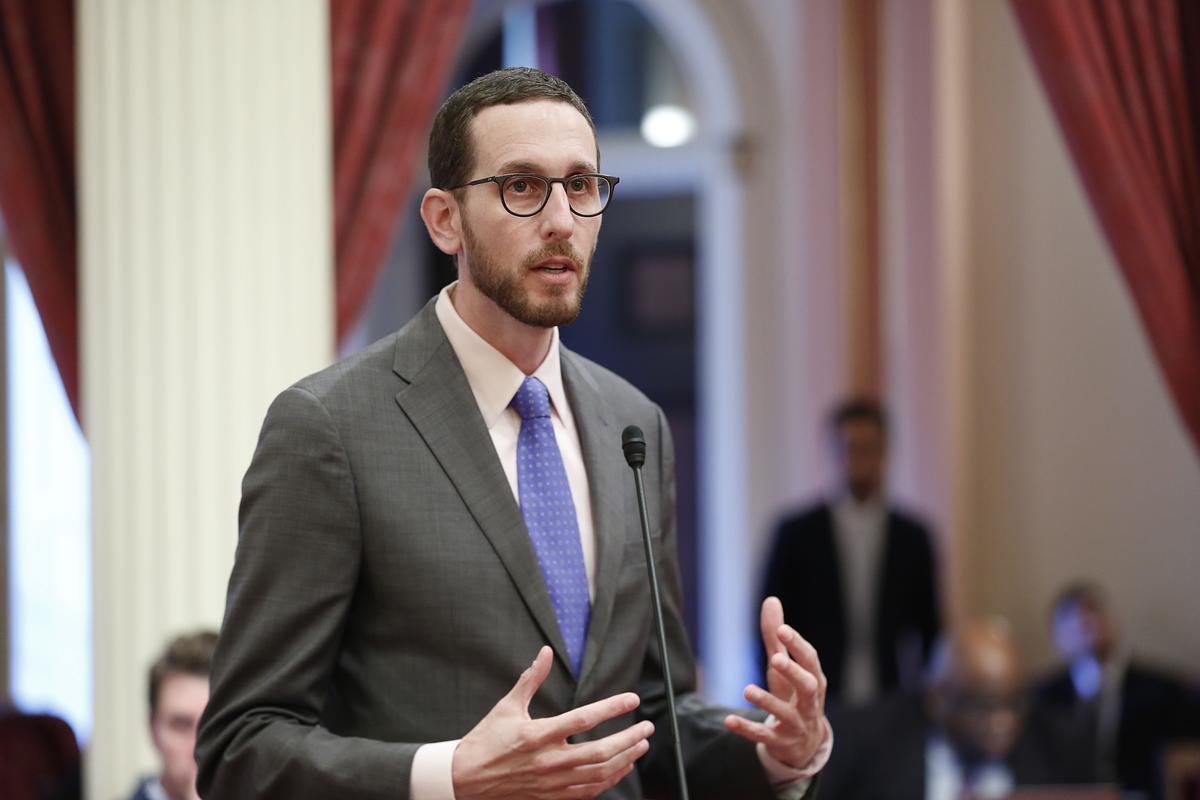

State Sen. Scott Wiener has raised the most outside funding in the race to succeed Nancy Pelosi in California’s 11th Congressional District, with individual donors filling his coffers with more than $3.5 million and multiple super PACs boosting his war chest.
One super PAC, Families for an Affordable SF, has raised more than half a million dollars and poured more than $260,000 into supporting Wiener through the end of March, per FEC filings. The PAC and the campaign are paying some of the same people to work for both entities, and actively coordinating to strategize the ground game and pay for canvassing.
This would have been illegal before 2024, but this new normal has campaign finance legal experts raising red flags.
“This is the first election cycle we’re seeing campaigns coordinating with super PACs in such an open way,” said Shanna Ports, senior counsel for the Campaign Legal Center’s campaign finance team. “It’s contrary to a strong electoral system that ensures candidates are accountable to their constituents rather than big money and special interests.”
In 2024, the Federal Election Commission put forward a transformative rule change on how super PACs, which are able to take in unlimited amounts of money from outside sources, can work with campaigns on canvassing strategy and pay for canvassing without restriction.
It’s a major blow to transparency that allows undisclosed “dark money” to flow from special interests to candidates, with less oversight than ever before.
The change prompted the Campaign Legal Center to file a lawsuit last week challenging the 2024 advisory opinion, which it has deemed a “legally indefensible loophole” that breaches Congress’ directive on the definition of a campaign contribution and regulations on spending. The lawsuit was filed in conjunction with the nonprofit Citizens for Responsibility and Ethics in Washington.
Before the 2024 advisory opinion, the FEC had an explicit ban on a candidate’s campaign and a super PAC sharing information and funds for canvassing, Ports said. In addition, a super PAC’s “independent expenditures,” or public communications (typically ads) delivered through a third party like a radio station, TV network, or postal service, had to be created without any input from the candidate’s campaign.
“The quintessential coordination violation is when a candidate calls up the super PAC and says, ‘I need an ad focusing on law and order in so-and-so neighborhood.’ And then the PAC funds that ad on the radio or TV,” explained Ian Vandewalker, senior counsel and manager of the Brennan Center for Justice’s elections and government program.
Coordination on independent expenditures remains subject to FEC rules. However, the FEC’s 2024 ruling determined canvassing, canvassing materials, and scripts used by canvassers did not count as “public communications.” The change in policy opened the floodgates for campaigns and super PACs to coordinate directly with each other without triggering federal PAC contribution limits.
“They took out the ‘independent’ part in the definition of independent expenditures when it comes to canvassing,” Ports said.
The Campaign Legal Center states the advisory opinion allows federal candidates to “outsource and conceal millions in dollars” spent by super PACs. In practice, the rule change allows campaigns to save money on independent expenditures like mailers and, instead, have a super PAC foot the bill for an army of canvassers with those flyers in hand.
The rule change also supercharges the ability for campaigns and super PACs to mingle employees; Ports noted that many super PACs are run by a candidate’s former staff or political partners with direct knowledge of the candidate’s strategy and funding needs. That is in direct opposition to the spirit of federal campaign laws intended to create a firewall between the two entities, Ports said.
Wiener’s campaign has multiple examples of shared staff with Families for an Affordable SF.
The Families for an Affordable SF super PAC was set up by Todd David, who was Wiener’s political director for his 2016 state Senate campaign. David is currently political director of the congressional campaign, as well as the active treasurer of the Families PAC. He has been paid $32,500 from December through March for “canvassing consulting,” as well as $2,500 from the Wiener campaign in November for consulting, per FEC filings.
Chloe Young, a senior organizer for the Wiener campaign, is now also senior organizer for the PAC’s “Team Wiener,” and was paid by the campaign ($9,880) and the PAC ($15,750) in that same period, per FEC filings. Noah Ventosa, the digital organizing director for the campaign and digital organizing manager for Team Wiener, was paid $6,200 from the campaign and $16,282 from the PAC through March. Jupiter Peraza, who worked as a finance associate for the Wiener campaign between November and March, was paid by both the campaign ($6,000) and the super PAC (about $12,692) in the same period.
While sharing employees who coordinate on canvassing is no longer illegal, it represents a breach of one of the longest-standing rules to prevent super PACs from influencing federal campaigns. It could also set the tone — and operating budget — for future campaigns.
The Wiener campaign, through spokesperson Joe Arellano, declined to comment for this story.
Sam Singer, spokesperson for the Families for an Affordable SF super PAC, stated that any coordination between the PAC and the campaign is legal canvassing activity and that all printed election materials are given out as canvassing literature, rather than distributed through a third party as an independent expenditure.
The scale of the Wiener campaign’s coordination with the Families PAC is unique, but other candidates have also leveraged the 2024 rule change. Julie Edwards, a spokesperson for Connie Chan’s campaign, pointed to public filings that show the super PAC Working Families for San Francisco has spent $72,000 on canvassing; Chan’s overall funding trails far behind Wiener’s $3.5 million, with less than $500,000 raised through April. Saikat Chakrabarti, a centimillionaire, has spent nearly $5 million of his own money for his campaign and does not have a super PAC supporting him.
“Having unlimited outside money in the campaign finance system is dangerous in terms of the wealthy influence on both elections and policymaking after elections,” Vandewalker, from the Brennan Center, said. “And the closer that unlimited money gets to campaigns, the more this danger of undue influence.”
Editor’s Note: This story has been updated to reflect the fact that numbers from Working Families for San Francisco were found in FEC filings.