

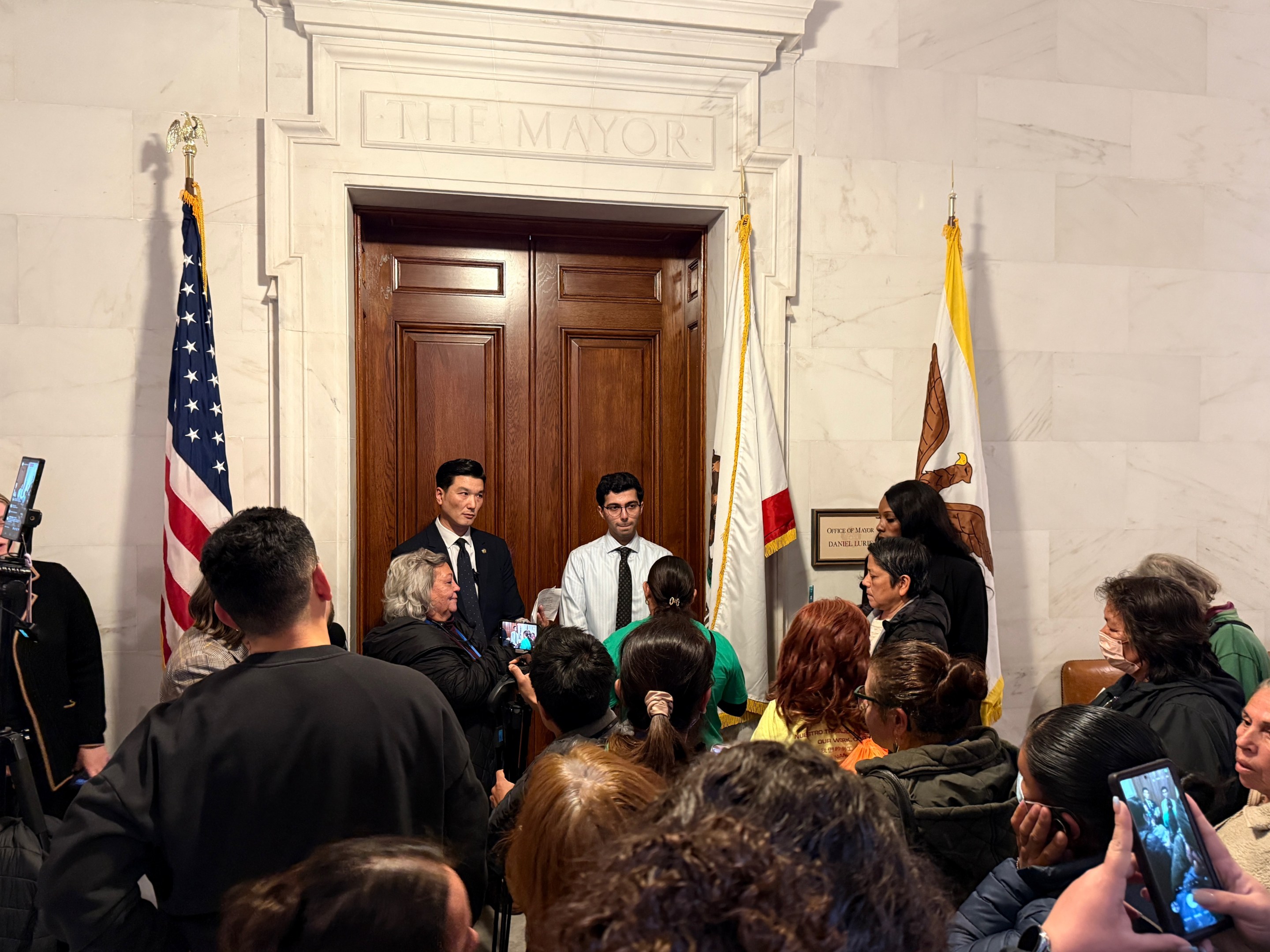

On Tuesday, a protest against Mayor Daniel Lurie’s budget cuts took over the second floor of San Francisco City Hall, with a crowd of about 250 chanting a familiar slogan: “What does democracy look like? This is what democracy looks like!”
Mayor Lurie, who was in his office at Room 200, could surely hear them. Outside his door, an office assistant took notes and collected postcards addressed to the mayor, about 1,700.
Anya Worley-Ziegmann, the coalition coordinator at the San Francisco People’s Budget Coalition, an organization of nonprofits, unions, and community groups, said City Hall had been chosen for the action because the mayor would be in his office for his monthly appearance before the Board of Supervisors later in the afternoon. The plan was to “sing him” into the board meeting.
Worley-Ziegmann said she hopes the mayor’s team reads every single postcard and experiences even “a fraction of the heartbreak” that went into writing them. Lurie’s cuts target the same people as Trump’s cuts, she said: queer communities, immigrants, seniors, and economically precarious youth. Some of the postcards express support for Lurie, she said. “They want to make sure that they can stay in the city to see the good work that he’s been doing, but they might not be able to stay here if he makes these cuts,” Worley-Ziegmann said.
Protests against cuts and layoffs of public health professionals, and the closure of clinics for troubled youth and the elderly are ramping up as a June 1 budget deadline approaches.
The mayor has already announced 127 layoffs of city workers as part of his demand that departments cut $400 million. As many as 300 more layoff announcements are anticipated. Tuesday’s protest was a “last opportunity,” Worley-Ziegmann said, because Lurie will realistically finalize his budget by the end of this week.
The protest died down before Lurie left his office around 2 p.m. for the Board of Supervisors meeting. Worley-Ziegmann had mistimed the mayor’s meeting, thinking it was earlier. Most of the protesters stayed longer than they had anticipated and left. At the meeting afterwards, the mayor said nothing about the budget or the protests outside his office door. Instead, Lurie touted a decline in homelessness, and the recently opened RESET sobriety center.
I asked Worley-Ziegmann if she thought there was any chance the mayor would back down and meet her group’s demands. “He has a chance to join us,” she said, “before things get harder.”