

By the mid-19th century, San Francisco was a boomtown that was fast becoming the west’s financial and logistical hub. Flush with gold and transportation fortunes, early philanthropists set about creating a cosmopolitan city to rival New York, Philadelphia, and European capitals.
In 1854, the Mechanics’ Institute was established with $300 and four books to foster learning in the new city, with a library and chess and games room to give wayward working men somewhere to go besides saloons, brothels, or opium dens. Its original building burned down following the 1906 earthquake and fire. In 1920, Albert Pissis, the architect behind the Flood Building and the domed Hibernia Bank building, built a replacement at 57 Post St. featuring a cast-iron staircase that spirals nine stories.
The Mechanics’ Institute continues to draw members paying $150 a year ($80 for students) who come for the collection, the reading environment, and to play chess. For their membership, 2,400 patrons get to have librarians who know their names and their tastes, and a faster track to titles than the San Francisco Public Library hold list allows.
This fall, the Institute will begin a $5 million renovation to update furnishings and fixtures, expand compliance with the Americans with Disabilities Act, and install modern study areas around the library.
“Since our inception, we’ve worked to create a sense of community. That is what we’re about: a cultural hub, a place where people can gather who can think, socialize, work and play together,” CEO Katherine Bella recently told Gazetteer SF.
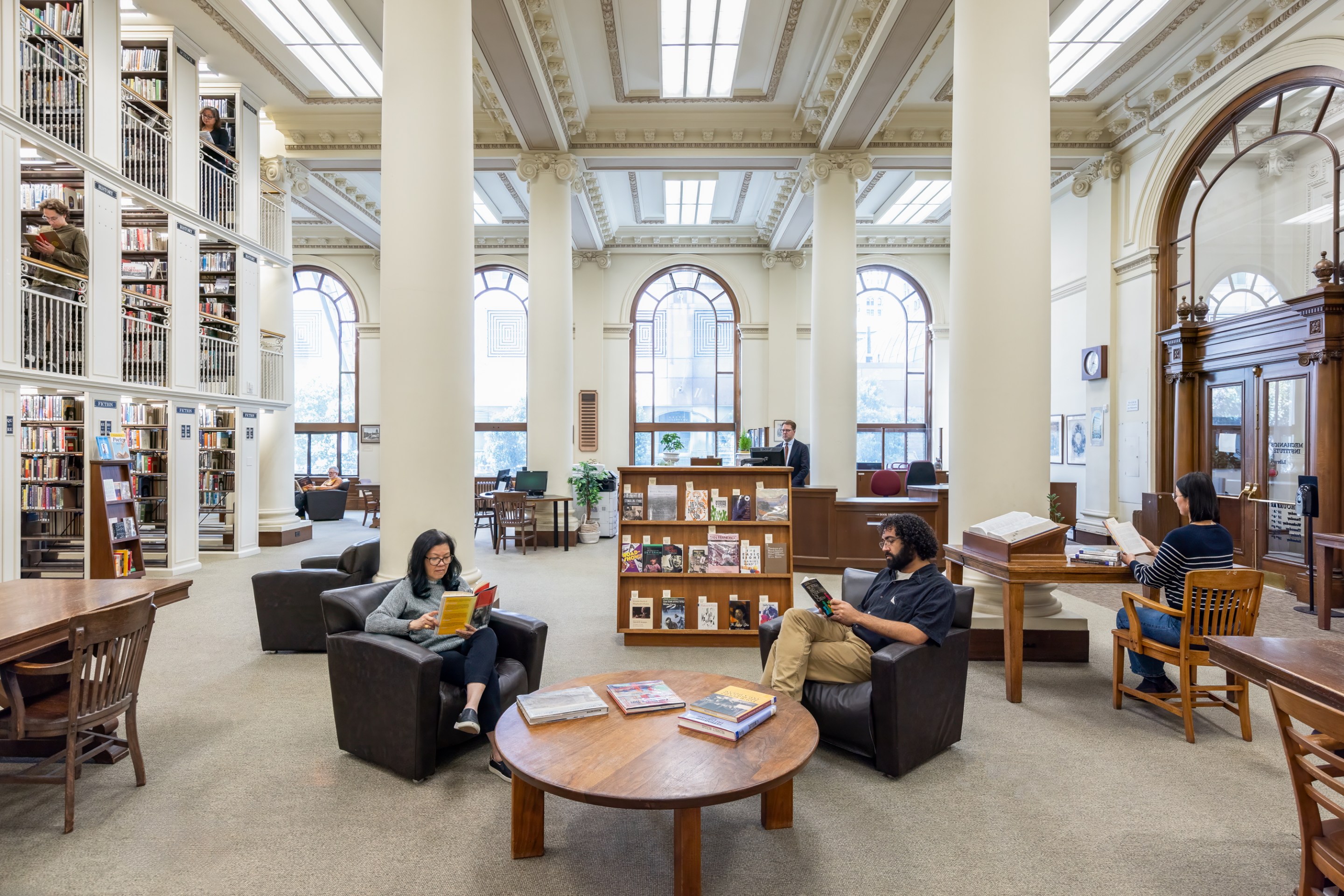
The library’s reading area opens to three levels of stacks, the entire space flooded with light from enormous windows. Bella said the building on Post Street “is of the time and of the place,” e.g., San Francisco in 1910. The game room features rows of tables topped with black-and-white checkered boards, the walls cluttered with artifacts of decades of chess history that took place there.
During a recent visit, the library was sparse. Head of circulation Jenny Huynh, who has worked at the Mechanics' Institute since the late 1990s, said the library became far less busy after the Covid pandemic but that traffic is picking up again: "Sometimes the morning’s busy; sometimes at lunchtime."
The game room on the fourth floor buzzed with children taking part in the Institute’s chess camp. Since the pandemic, chess has experienced one of its periodic popularity booms, this one thanks to the release of Netflix’s The Queen’s Gambit in 2020.
“It’s such an interesting thing to see other people who really love logic and creative thinking learn and grow," said a 14-year-old chess camp participant named Blouin who lives in the Inner Sunset. (Gazetteer is choosing not to print the last name of a minor.) “Over the computer, you don’t see anyone who you’re playing. You just see their username, and that doesn’t feel as special as actually meeting your opponent, building up a relationship with them and then seeing how they play, because everyone has a different playing style.”
The Institute’s chess club runs after-school programming at public and private schools across the city, summer camps at its headquarters, and weekly “Chess in the Community” events. Chess revenue for the Institute has grown around $300,000 since 2019, reaching more than $400,000 in 2025.
“It’s just grown and grown,” Bella said. “Our job is to just keep up with demand.”
Because the institute owns 57 Post St outright, it earns rental income from tenants including the literary journal ZYZZYVA and the archives of the International Wizard of Oz Club. It also rests on a healthy endowment, built over generations and fed from three directions: membership dues, program fees, and, most substantially, bequests from members who write the library into their wills, a cultivated part of its fundraising.
Linda McBain, 79, is one such member considering supporting the Institute in her will. She began going to the Institute as a Lone Mountain College (now University of San Francisco) student in 1969 and said that she appreciates the associative thinking the open stacks spur. “It’s like hitting for gold,” she said of the nuggets hidden within the Institute’s stacks. “Those are things that you’re going to learn that won’t pop up on your phone.”
“It is the quintessential library, historically, for San Francisco,” McBain said. “The whole world is in that library.”