

As I found my seat to see Bob Dylan at the Greek Theatre at UC Berkeley Sunday evening, I was surprised by how good my view was. I was off to the side, about eight rows from the stage, and much closer than it looked on Ticketmaster’s website. After absorbing my good fortune, my first thought was what a good photograph I’d be able to get of the Nobel Prize-winning legend. I pulled out my phone to text my wife that I’d arrived, and to share a shot of the stage with her.
I had texted no more than three words before I was accosted by a concert staff person who firmly warned me to put my phone away for the remainder of the show. I complied, and quickly saw that had I been even a little bit slower to grab my device I would’ve noticed the concise signage posted all around the theater: “NO RECORDING OR FILMING USING ANY DEVICE.”
As I reconciled myself to not capturing a photo of Dylan, and what that might mean, I realized it was an opportunity to do what I’m always demanding of my own kids: look up from my screen, see and feel the world around me, and preserve any worthwhile images in my own mind.
The restriction was immediately liberating, and not only because I was able to fully release the impulse to look at my phone. Everyone else was, too. It was like having a few thousand accountability buddies as a kind of digital-free unity took hold of the crowd.
Banning phones at concerts is hardly a new idea, especially for Dylan. In 2019, Rolling Stone reported his rebuke of fans in Vienna, a nearly unprecedented direct interaction with his audience, over their phones aimed at him.
Before the show, I pulled out a small notepad and pencil and began jotting down thoughts. As I started writing, the same staffer who admonished me repeated her demand of the concertgoer sitting next to me.
He was a big guy, with a leathered, creased face, blue eyes, grey moustache, and faded tattoos on his arms. He tried to finish his text, which he later told me was to his daughter, who was somewhere in the stadium. He wanted to meet up with her. “The phone can’t come out — at all,” the staffer told him. The man looked at me, and nodded a reluctant acceptance of his phoneless fate. The forfeiture prompted a conversation about how it was his first time seeing Dylan, the realization of a dream 20 years in the making.
The stage looked like a dark European street with lights that resembled glowing street lamps. Eventually Dylan drifted onstage dressed in a black robe, with a big hood over his head. He looked like an apparition, or a reaper.
Dylan probably thought of himself as “an old king from some vanished country,” as he described being over 80 in a New York Times opinion piece that had come out just that morning.
He floated centerstage to his keyboards, facing the audience but with his face cloaked, prompting the big man next to me to ask where Dylan was. “I want to see that motherfucker!” the man said.
One fan I met speculated that the person on stage wasn’t Dylan at all, and that the phone policy was enforced to eliminate any evidence of the ruse. “Bob doesn’t want you to take a picture of not-Bob,” he told me.
Dylanologists, known for the insane lengths they go to ferret out information about the artist including sifting through his trash, have been spinning bizarre theories about him in the half century since his July 1966 motorcycle accident in Woodstock.
For his second number, Dylan — or whoever it was under the hood — sang “Man in the Long Black Coat,” a haunting number from his 1989 album Oh Mercy.
As he sang, his vocals raspy but his elocution clear, I sensed Dylan had become the man he sang about, the one with “a face like a mask.”
“He sounds good,” the big man next to me concluded. “Fucking badass.”
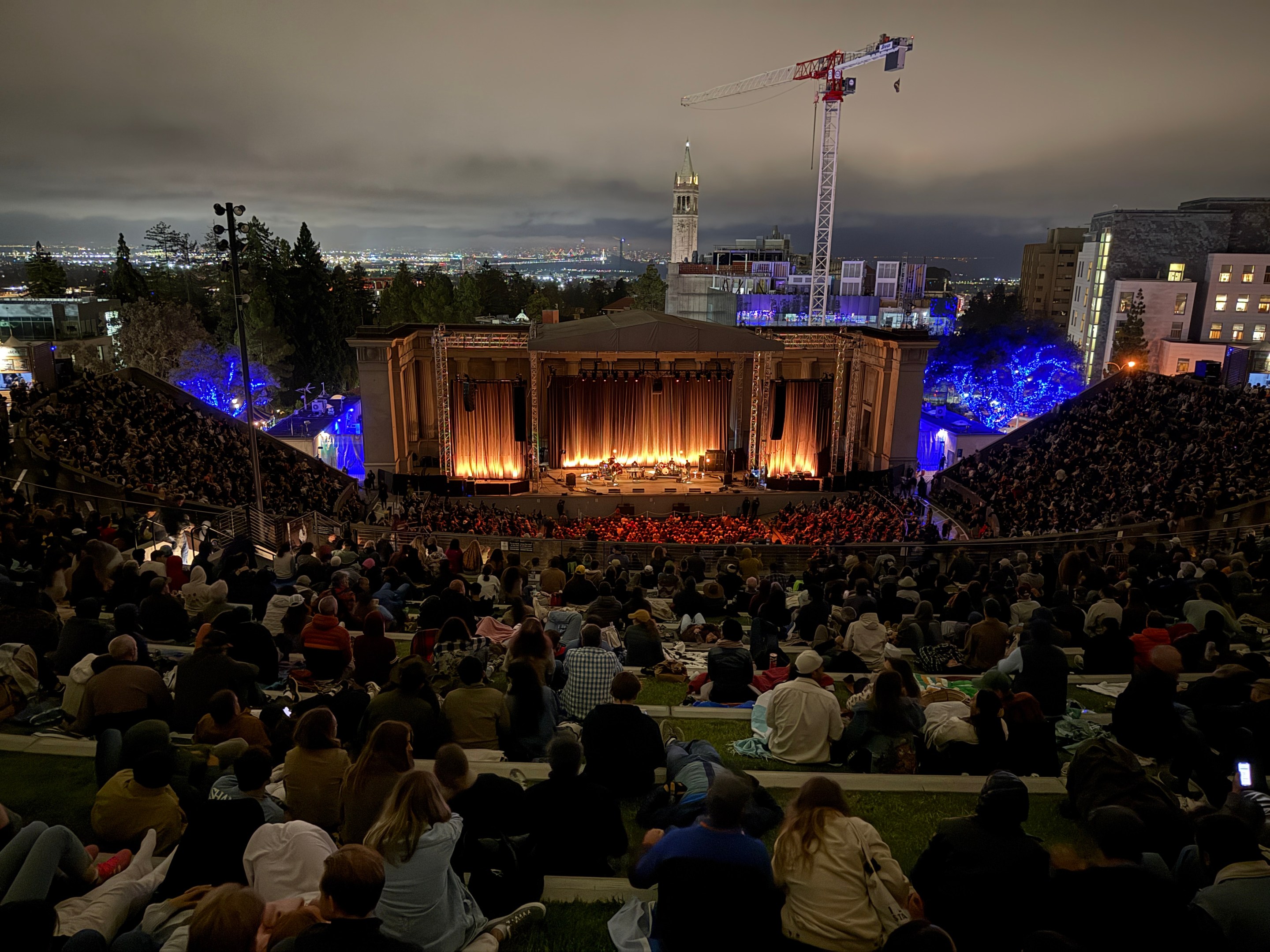
Before the end of the show, I went to the top of the theater where the phone ban was less policed. I snapped a photo of the entire scene from afar. The hooded figure onstage resembled a high priest who’d captivated his flock, most of whom seemed content to let go of their need to record it.
At the end of his performance, Dylan walked around his keyboards and looked into the audience with his face still hooded but visible. He took repeated full bows to a standing ovation, the reaper unmasked as king.
Dylan’s so-called Never Ending Tour rolls into Santa Barbara tomorrow, followed closely by more California shows in Highland, Palm Desert, and San Diego before heading to Arizona, New Mexico, and Texas.
It turns out that the best evangelist for breaking our phone addictions may be an 85-year-old songwriter who seems hellbent on keeping us apart from our devices and together in real life — at least while he’s on stage.