
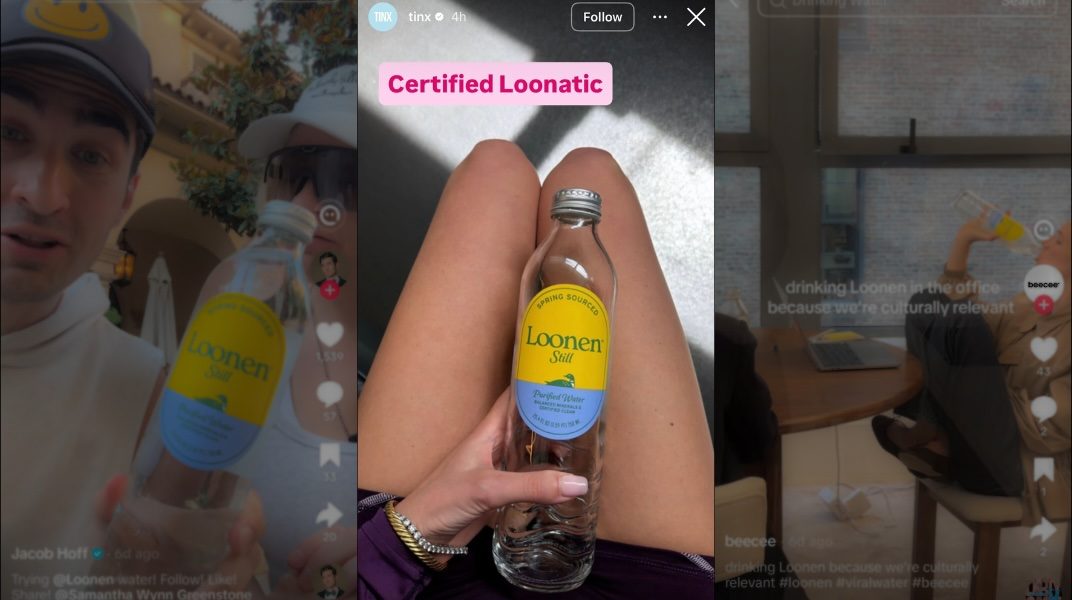
This summer’s must-have accessory is a bottle of Loonen, a suddenly and baffling viral water from a six-month-old Berkeley-based company.
Everywhere you look, social channels are being flooded with Loonen’s signature yellow-labeled bottles by influencers, reality stars, and people you know but have no idea why quaffing the stuff like their lives depend on it. (That may be true: It is water.) There it is sitting in front of Dua Lipa as she works out. It’s being glugged by Jacob Hoff in front of his 4.2 million TikTok followers. It’s a video prop for reality TV stars. It’s in the lemonade at Matchaful. Tinx is a self-proclaimed “Loonatic.” Comedian Esther Povitsky calls it the “it-girl water.” Influencer and writer Marisa Menist is “obsessed.” Recipe creator Joslyn Kramer is using it in her “water cocktails.” It has joined the ranks of Lola blankets.
Loonen was launched in December 2025 by Clara Sieg, an Oakland-based former VC. Sieg said she got the idea while pregnant with her first child. She found it simple to eliminate toxins and plastics in her cookware and only purchase organic foods, but water was more complicated. She wondered whether she could source (and sell) spring water that had never interacted with plastic.
“That period for me felt really out of control, like I had very little agency,” recalled Sieg. Eliminating plastics and toxins “felt like one piece of our life that I could actually impact meaningfully and make changes. And so, I did make those changes across our household. And then the last thing was water, the thing we interact the most with.”
“Water is the foundation of any wellness routine, right?,” she asked. “If you strip it all back, health is just the food we eat, the water we drink, and the air that we breathe.”
Sieg isn’t alone in worrying about microplastics. A 2021 study found that humans ingest some five grams of plastic per week; researchers are finding it in women’s ovaries and uterine lining. It’s an issue across the board, though particularly for women, as plastics contain endocrine-disrupting chemicals such as phthalates, bisphenols, and PFAS that can interfere with women’s hormone function and fertility, and, according to a recent study, increase the risk of preterm birth.
To achieve its goal, Loonen currently sources natural spring water from Palomar Mountain, about 50 miles inland from Carlsbad. Sieg said their water source is subject to change based on environmental factors that could affect the quality of the water, much like the loon, a species of bird known to return to one lake every breeding season until the water quality declines.
The company says that the water is only transported in stainless steel and never touches municipal infrastructure. After it’s filtered through stainless steel membranes, minerals are added to the water to “rebalance” it. The batch is then tested for microplastics, so-called forever chemicals, and trace contaminants; results of these tests can be viewed by a QR code displayed on the glass bottle it’s sold in. It goes for $5 at Bi-Rite, but some videos online cite prices as high as $7.
Sampling a bottle of Loonen purchased at Oudel Market at the Ferry Building for $6, I found it to be overwhelmingly normal. It tastes like nice water — neither here nor there.
Loonen hit the market in December 2025 and has steadily gained real estate on high-brow shelves. New York’s Meadow Lane, Los Angeles’ Erewhon chain, and San Diego’s Frazier Farms are all stockists. Mister Jiu’s, Penny Roma, Flour + Water, and Causwell’s all pour Loonen. It’s sold around the city, including at all the classic high-end grocers such as Gus’s, Bi-Rite, Mollie Stone’s, and Rainbow (which knows a thing or two about pricey water trends), as well as at coffee shops, yoga studios, and even Bernal Cutlery.
As of this week, Loonen is being sold at nearly 500 Sprouts locations. In a matter of months, the glass bottle has become a way to signal that you’re health conscious and affluent enough to spend $35 on a pack of water. Subliminally MAHA, supraliminally top one-percent, and egregiously extra, it seems to be only gaining momentum as the days get longer and warmer. One Substacker referred to its sudden rise as the “‘wait, I’m seeing this everywhere’ effect.”
Loonen’s hyper-condensed timeline from stealth to status symbol feels a bit inorganic, but the company denies any paid influencer marketing. While the company has sent out cases to influencers, Sieg said that the company has not paid for any sponsored content.
Interestingly, while Sieg’s mission has everything to do with eliminating toxins from our diet, the wall-to-wall viral buzz about Loonen hasn’t so much as mentioned its health benefits. Videos are more likely to praise the water for its crisp taste or merely flaunt the bottle as an accessory (one video says “drinking loonen in the office because we’re culturally relevant”). Meanwhile, in my conversation with Sieg, she hardly touted the water’s taste: It seemed like an afterthought at best.
While the company has flooded the feeds of East Coasters, it hasn’t made such a splash in its hometown despite being everywhere online. Perhaps while NYC and LA have moved onto status water, SF is still in its status-water-bottle timeline, content to chug Hetch Hetchy and keep riding that Owala craze.
RIP Postscript. You would have loved Loonen.