

A member of the anti-AI group Stop AI was ordered to appear in San Francisco Superior Court this morning, where she will stand trial for blockading OpenAI’s headquarters last February.
Wynd Kaufmyn, one of the lead organizers of the East Bay-based activist group, is facing misdemeanor charges from the District Attorney’s office, including trespassing, unlawful assembly, and obstructing business operations. Since 2024, several Stop AI members have been arrested for non-violent protest. Kaufmyn is the first member to stand trial in San Francisco.
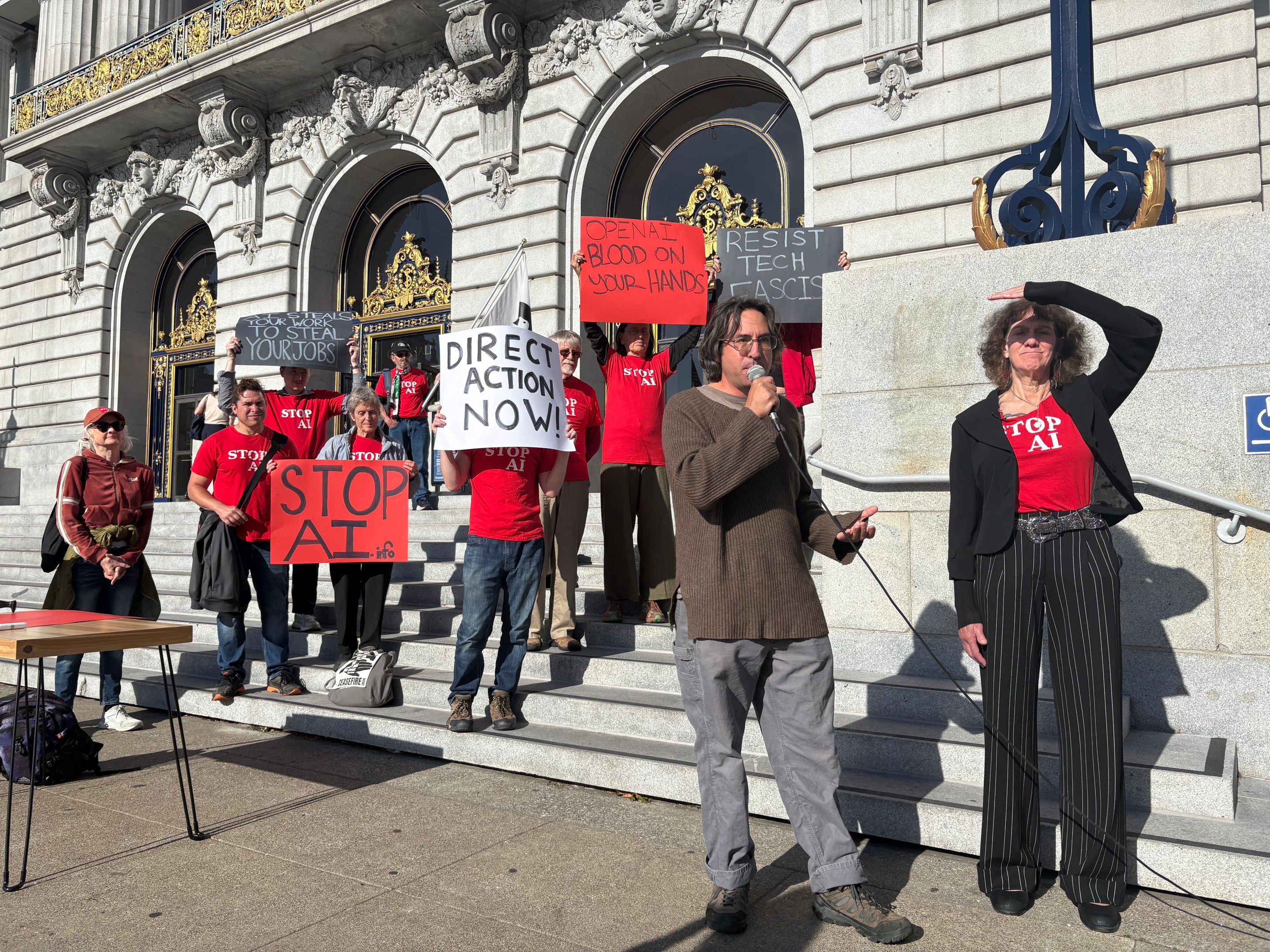
An hour before she was scheduled to appear in court, Kaufmyn, along with about 20 Stop AI members, most dressed in red, held a press conference on the steps of City Hall to explain the nature of the trial and more generally call for a full stop to the development of artificial general intelligence and artificial superintelligence at companies like OpenAI and Anthropic.
Kaufmyn spoke briefly about her reasons for blocking the gates to OpenAI’s headquarters on February 22, 2025, including OpenAI chief Sam Altman’s statements that the worst-case scenario of AI development is “lights out for all of us.”
David Krueger, an AI researcher and the founder of Evitable, an AI safety nonprofit that Stop AI press coordinator Valerie Sizemore said is loosely affiliated with Stop AI, urged people to take direct, non-violent action against AI immediately. “Essentially, these companies have put a gun to all of our heads and we’re being told that we simply have to lie down and take it,” he said.
Despite widespread criticism and a smattering of protests against AI-fueled job displacement and data center construction, Stop AI has struggled to gain traction for its campaign in San Francisco. The group has a meager online presence, and its organizers can be hard to reach. Like most Stop AI events, this morning’s press conference was poorly attended. (Gazetteer SF was the only news outlet that showed up after receiving a press release via email.) Kaufmyn noted “a lot of people” were probably watching the livestream of the event but also blamed the fact that she had only been ordered to appear in court last Thursday, which left the group little time to drum up attention around the trial.
Last December, Stop AI made national news when one of its members, 27-year-old Sam Kirchner, vanished after the San Francisco Police Department warned he was a potentially violent threat to OpenAI. No one in Stop AI has seen him since.
When Gazetteer SF asked about Kirchner during the press conference, Kaufmyn turned to speak directly into the livestream camera, pleading, “Sam, if you’re watching this, please reach out to us. We’re worried about you and we really care about you, and we feel like we can all learn from our past mistakes and go forward in unity and fight this together.”
Outside City Hall this morning, Guido Reichstadter — arguably the most radical and well-known activist currently affiliated with Stop AI — reiterated boilerplate statements about the need to ban AI development immediately, at times speaking into the mic on the verge of tears. Last year, Reichstadter made headlines when he began a hunger strike outside of Anthropic headquarters at 500 Howard St., demanding CEO Dario Amodei meet with him, acknowledge the existential risks posed by AI, and call for an end to the technology’s development. After 30 days and no response from Amodei, Reichstadter ended the strike, as his “body was beginning to shut down,” he said.
During her hearing today, Kaufmyn said her attorney, Rose Mishaan, will argue in court for what’s known as the necessity defense, which excuses illegal conduct if it was done to prevent some more serious harm.
Kaufmyn also said that her attorney had subpoenaed Sam Altman to provide evidence — ostensibly something that would demonstrate the existential risks of AI — to help make the case for the necessity defense. The subpoena was quashed in December, but Kaufmyn said she and her legal team “do hope to reissue the subpoena.”
“If we get the necessity defense, it is more than appropriate” to have Altman take the stand, Kaufmyn said.
If the necessity defense is granted, Kaufmyn speculated the trial “will probably take ten days.” If not, the trial will likely be shorter. If she is found guilty, Kaufmyn could face up to a year in jail.
“I think that probably won’t be what they sentence me to,” Kaufmyn said, before noting she assumed her sentence would probably be something more like 30 days. “I don’t know, but I’m not worried at all. I’m willing to accept the consequences, and really, I’m just focused on getting the message out.”