
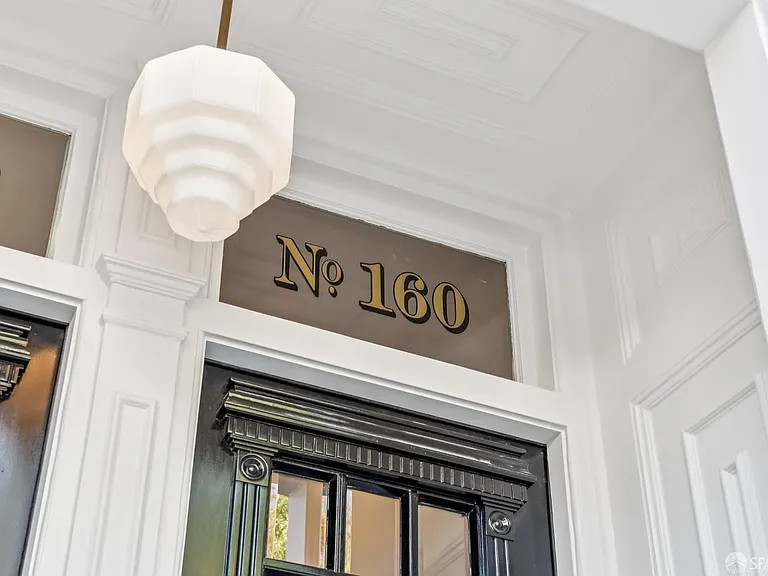

A three-bedroom, two-bathroom residence near Duboce Triangle hit the market for just under $3 million yesterday, and its seller says they will consider OpenAI or Anthropic stock as payment.
The luxurious two-story apartment, listed for $2,995,000 and located at 160 Noe St. just off Market, is the latest example of a burgeoning Bay Area real estate trend, with homeowners using the AI-driven real estate bonanza to get their hands on shares of private companies as they race to go public.
Real estate agents are skeptical, however, that prospective buyers can use pre-IPO stock to buy a house.
“You can’t just say, I’ll sell my house for a thousand almonds, or, in this case, a thousand shares of OpenAI or Anthropic,” said Robert Collett, a San Francisco-based real estate agent. “If this is a $3 million dollar house, what is $3 million dollars worth in those stocks?”
Legally, all home sales must be reported to the city assessor’s office, which then calculates the transfer and property taxes based on a percentage of the sale price. Shares of private stock, however, are not publicly quantified with dollar amounts.
The city assessor’s office did not respond to Gazetteer SF’s request for comment in time for publication.
Collett noted other lingering questions, like how a buyer might go about sending stock to a neutral escrow company. But he did concede the sale process could be figured out in some cases, if all parties were willing to find and exploit a number of financial and legal loopholes.
More likely, he said, the offer is a marketing tactic to attract the most competitive buyers; these days, that’s almost always AI employees.
Real estate agents used similar gimmicks during the cryptocurrency craze of the late 2010s. “I never actually encountered an agent or buyer or seller who did it,” Collett said of using crypto to buy a home. “So I don’t necessarily buy it, pun intended, but it’s always a catchy headline.”
The generative AI boom has sent local real estate prices steadily skywards since 2023, but impending IPOs have provoked even fiercer competition among buyers so far this year. Since February, the median home sale price in San Francisco has jumped from $1.4 million to more than $1.6 million, a five-year high according to new data from Redfin.
Anthropic, which just last year was AI’s second-fiddle, announced a $65 billion funding round yesterday, putting its value at a dizzying $900 billion and officially surpassing OpenAI as the industry’s most valuable player. OpenAI’s last valuation was $730 billion. Elon Musk’s SpaceX recently announced it’s targeting an IPO value of $1.8 trillion.
For the brief period before they go public, shares in Anthropic, OpenAI, and SpaceX are arguably the most coveted resource in the city today. Hungry investors are rushing into the shadowy “secondary equity market,” entering into sketchy and questionably legitimate deals to get, in some cases, just fractions of shares in top AI firms. However, after a self-described venture capitalist posted to X about brokering one of these deals, Anthropic updated its policies on unauthorized stock sales to specify “if someone purports to sell Anthropic shares without proper board approval, that transaction is invalid.”
These restrictions also apply to the stock-for-property schemes. “A homeowner accepting an employee’s shares could end up holding nothing the company recognizes,” said Wilson Leung, a real estate agent who leads a team in San Mateo. “Unless the employee has some sort of influence” on the board of these companies, these transactions “would be close to impossible.”
“It’s definitely a marketing ploy,” Leung said.
Earlier this month, Storm Duncan, the founder of San Francisco-based investment bank Ignatious, listed his sprawling $8 million property in Mill Valley, asking for Anthropic shares as payment. This week Duncan told Bloomberg that the offer has potential buyers lining up, including some asking if he’d be open to accepting shares of SpaceX instead. The listing has since been removed. Duncan declined to comment on the situation to the media.
The owners of the Noe Street home, which was listed by the Noe Valley-based real estate team the Swann Group, appear to be the first in San Francisco to make this sort of offer. The Zillow listing went viral online almost immediately. The response has been largely similar to Collett and Leung’s assessment, fueling skepticism about how exactly buying a house with private shares would work.
Kelly Bennett, a realtor at the Swann Group, confirmed that the offer at 160 Noe St. was legitimate. Bennett told Gazetteer SF that Rachel Swann, who directs the Swann Group’s luxury division, facilitated the offer herself.
Swann, whom Bennett said is currently on vacation in Bali, could not be reached for comment in time for publication.