
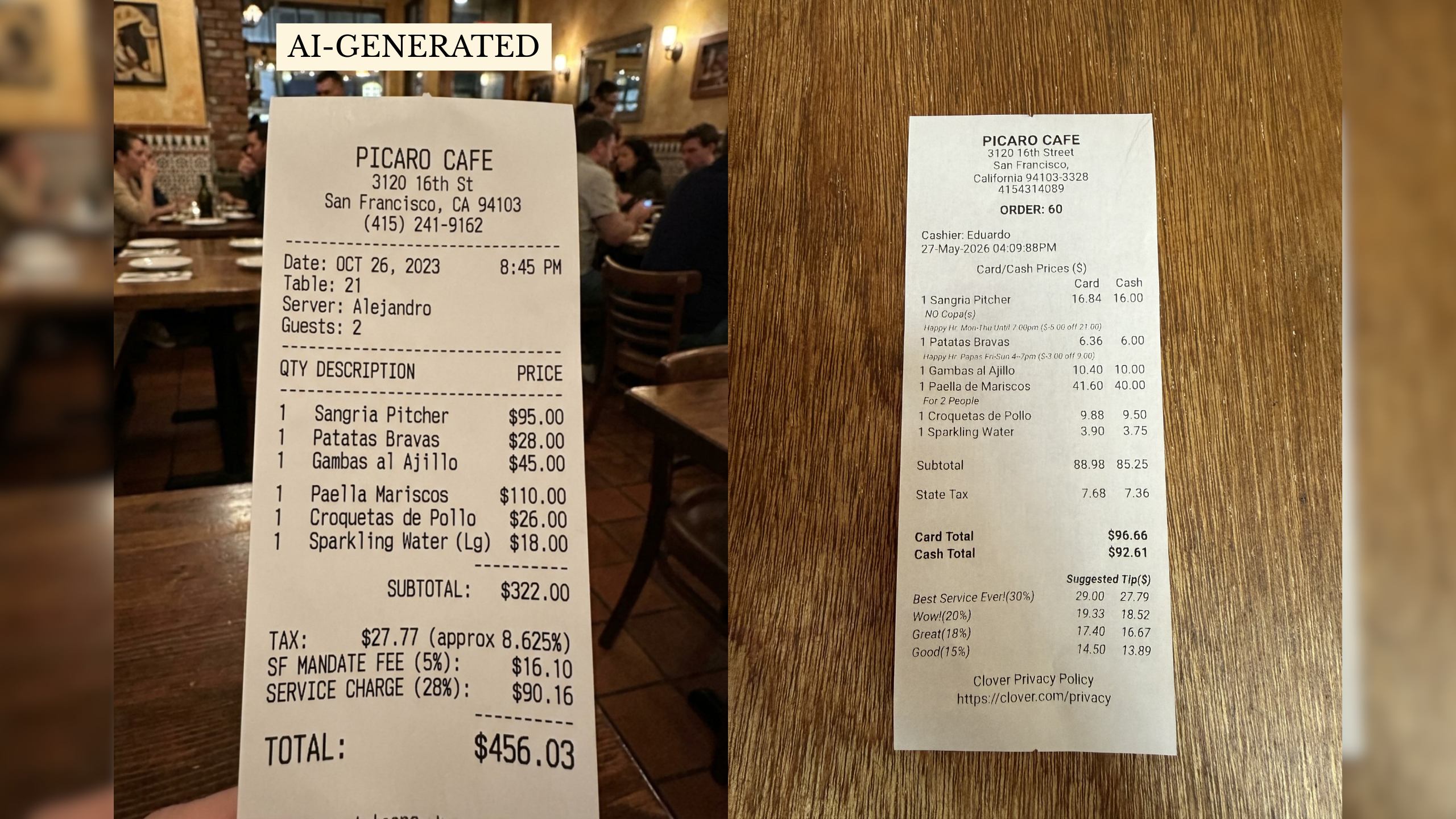
“San Francisco restaurant fees are getting so out of control that you basically need an accountant to decode the final bill now,” reads a Facebook post shared Tuesday morning by the user Dariy Jessica.
The post features a picture purportedly of a receipt from Picaro, a tapas spot on 16th Street in the Mission. Jessica complains about items that “already weren’t cheap”: sangria, shrimp paella, gambas al ajillo. Then, mirroring commonly heard gripes about dining out in San Francisco, the post goes on to bemoan the various fees tacked on at the end of a meal: tax, the “SF mandate fee,” and an additional service charge.
The total bill? $456 for a party of two. Yikes. Even scarier, though: it’s a fake.
That hasn’t stopped it from amassing a few thousand views, and more than 150 comments and reactions apiece.
Somehow the uncanny-valley account of the poster,the ludicrously suspicious 28 percent service charge, and the 2023 date on the receipt didn’t tip off many of those commenters who commiserated about the high cost of everything these days.
To set the record straight, during a recent visit to Picaro by Gazetteer SF, general manager Eduardo Hernandez did us the courtesy of printing an authentic receipt: A sangria pitcher costs $21 ($16 during happy hour), not $95; patatas bravas costs $9 ($6 during happy hour), not $28; gambas al ajillo $10, not $45; shrimp paella $40, not $110; croquetas de pollo $9.50, not $26. In total, the meal would cost less than $100 — far less than the $322 listed in the fake receipt, before potential fees. (More on that later.)
Even as prices for ingredients and transportation continue to rise, Hernandez said that Picaro wants to keep prices as low as possible to draw in as many customers as they can.
He told Gazetteer SF that he was first tipped off to the fake receipt when users on Yelp and Google shared them on those platforms. He’s not sure whether the Yelp and Google posts were also made by the same user from Facebook, but the impact is all the same. (Hernandez flagged the now-deleted posts to Yelp and Google, but Hernandez provided screenshots showing posts on both platforms featuring the fake receipts.)
“It’s frustrating ‘cause what can you do? If you engage, you're giving them the attention that they want,” he said. “There were some people that took the time to go to the web page and there were comments like, ‘Oh, I went to the website and I saw that those are not the prices.’ But not everybody does that.”
For every commenter who double-checked and confirmed the inauthenticity of the post, there were at least two more who took the post at face value. Some lamented just how expensive dining out had gotten; others complained about the forced service fees.
“Go to restaurants that don’t charge all these ridiculous prices,” wrote one Facebook user. “Establishments you’re familiar with.”
What makes this more frustrating, Hernandez said, is that Picaro doesn’t tack on a mandate fee or service charge in the first place. The only fee the restaurant charges is a 4 percent credit card processing fee that gets waived for customers paying cash.
There's an economy of Facebook engagement bait that preys on people’s frustrations about dining out.
But this is the first instance I’ve seen of a San Francisco restaurant being identified by name.
Right now, the material consequences of this fake post are slim, save for a couple of credulous Facebook users who plan on not going to Picaro anymore. But as AI-generated slop improves (and can remember that it’s 2026), the possibilities of how this can be exploited to harm restaurants are huge: Imagine fake insults scrawled on checks by staff, real-looking service charges to dissuade people from going to certain restaurants, and, of course, the possibility that people may fictionalize a bad experience at a restaurant with AI generated images of rats, roaches, or rotten food.
Hernandez never imagined that this kind of thing would be a concern in his nearly two decades of working at Picaro. But he’s on the lookout if — and when — this happens again.
“We'll prepare for the next time, but hopefully there's not a next time.”