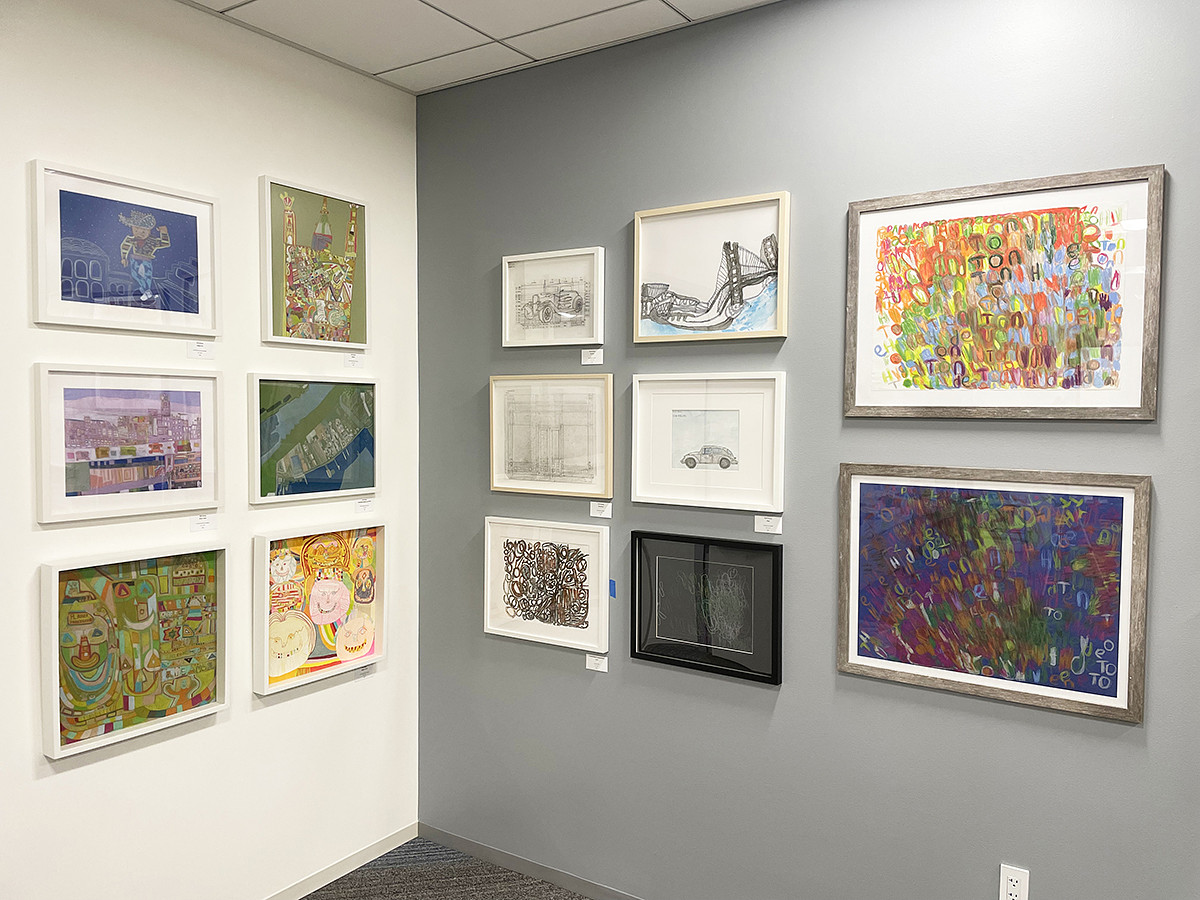

Starting Friday, Creativity Explored x Open Invitational, an art exhibition devoted to artists with disabilities, will be presented at an East Cut pop-up at 215 Fremont St. as part of SF Art Week, the weeklong celebration of the region’s visual art scene that coincides with FOG Design+Art. While FOG can be a chance to see blue-chip galleries from around the world, the price of artworks can run in the six-figures and even if you just want to look, tickets alone cost the same as museum entry. Open Invitational, by contrast, is all about inclusivity and accessibility, both for visitors and the artists whose work is on display: San Francisco’s Creativity Explored, Oakland’s Creative Growth, Richmond’s NIAD Art Center, and other galleries and art centers across the country that work with artists with disabilities will be featured.
Open Invitational was co-founded by David Fierman, who operates his eponymous gallery in New York City, and Miami-based collector Ross McCalla. The fair aims to support and showcase the work of progressive art studios, a term that refers to nonprofit art centers that help “adults with mental health and developmental disabilities to build and maintain careers in contemporary art,” according to the Progressive Art Studio Alliance.
Creative Growth, founded in Oakland in 1974 by Florence and Elias Katz, was the first progressive studio in the country. The pair went on to found Creativity Explored and NIAD Art Center. In 2024, SFMOMA made a massive acquisition of Creative Growth artists’ works, including pieces by Judith Scott, Dan Miller (both of whom were shown at Venice Biennale in 2017), and SF-born William Scott.
“I’ve always been interested in blurring the distinctions between what is outsider art and what is contemporary art,” Fierman said. “That takes various forms, from queer art to Native American art and beyond. And I’ve always been personally and academically interested in artists with disabilities.”
This interest was further catalyzed by an encounter with Living Museum, an art studio inside the Creedmoor Psychiatric Center in Queens, New York. Fierman worked with the studio to help establish their presence in the art world, a partnership that ballooned into the idea of creating an art fair focused specifically on progressive studios, positioning them not as “outsider” but also as their own vital way of artmaking in the contemporary context. So far, there have been two annual Open Invitationals in Miami, during the city’s 2024 and 2025 Art Weeks, and an inaugural edition in New York City during the Armory Show art fair in 2025.
The San Francisco edition will be the largest Open Invitational yet, featuring 22 studios and two retailers, almost double the fair’s previous roster. That’s in large part thanks to Open Invitational’s partnership with Creativity Explored, who leveraged local private and city initiatives to make the fair a reality.
In July, Creativity Explored secured a $100,000 grant from Culture Forward, the philanthropic initiative of the Svane Family Foundation aimed at supporting arts and culture in downtown San Francisco. The East Cut location where the fair will be held, a 1,400-square-foot former Charles Schwab office, was donated by the property owner Clarion Partners. The fair was also given free MUNI ads by the Office of Economic and Workforce Development.
While the Culture Forward grant will cover this year’s fair budget, Creativity Explored is hoping to find a more sustainable model to make the fair an annual event, according to Harriet Salmon, Creativity Explored’s director of art partnerships.
In addition to showing the work of artists from progressive studios, Open Invitational is a chance for the directors and staff of art centers to forge connections and develop community. “There’s a really palpable sense of solidarity that exists among progressive art studios at Open Invitational,” said Kathleen Henderson, co-founder and executive director of Studio Route 29 in Frenchtown, New Jersey. “We all share contacts and collectors and strategies and spot each other for lunch and coffee.”
That sense of solidarity extends to the collaborative effort of producing the fair. In the past, some studios that didn’t have the budget to send staff were able to send artwork to be presented on their behalf.
Henderson said the first edition of the Open Invitational, which Studio Route 29 participated in, “was game changing for our artists and studio. We weren’t getting too much traction. It changed some of our artists’ trajectories. It’s a free foot in the door.”
Henderson is no stranger to the Bay Area. She worked at Creative Growth for a decade before helping to open the new studio in New Jersey. Now in its fourth year, Studio Route 29 offers programming for teens with disabilities, currently supporting around 40 artists in diverse media, including a video program, publishing, and their own record label. (A disclosure: Several years ago, Henderson created The Creative Growth Magazine in collaboration with Gazetteer SF’s editor-in-chief.)
“Every community deserves to have one of these studios,” Henderson said. “People like to say that everybody is an artist and that if you give them time and space and love they can make anything. And it’s actually true. There’s not a lot of cultural literacy here. People here don’t seem to have any art history in school. To see people come to the studio and, within a year, make sophisticated, heartbreaking paintings and sculptures has felt so successful.”
The last few years have seen major advances for artists with disabilities. In addition to the SFMOMA acquisition, the Museum of Modern Art in New York is currently exhibiting a solo show of NIAD artist Marlon Mullen. In December, Nnena Kalu was the first artist with a disability to win the Turner Prize, Britain’s most prestigious art award.
“These artists are poised for more recognition than they’ve been given in the past,” Fierman said. “Also, the general culture is more cognizant of developmental disabilities. Sure, our current government is a last-gasp pushback against trying to meet people where they’re at, but I think there’s a broader general acceptance of people with different life conditions. I think there’s also a hunger in the art world for authenticity — which this work has in spades. This is peoples’ real, direct self-expression.”
The art fair market has been bogged down by a trend of zombie formalism in recent decades. In response to a struggling market, many galleries have doubled down on what has worked in the past, rather than seeking the new and the next. With authenticity in seemingly short supply, the unfiltered expression of artists not beholden to art history or the current art market is an exciting development for critics, buyers, and admirers.
“Art fairs are an incredible way to see a lot of work in one place but they are also steeped in commerce,” Creativity Explored’s Salmon said. “It’s not a terribly generous overview of contemporary art. When sales aren’t the only measure of success, that leaves a little more room for good feeling and less competition.”
Still, “Open Invitational is not an alternative to doing major fairs,” she said. Creativity Explored even participated in FOG last year. “This is a celebration for our community. There’s a lot of infrastructure around the contemporary art world that can be really intimidating. This fair doesn’t make you feel like you aren’t welcome in a rarified space.”
As Fierman sees it, shows like Open Invitational are a chance to bring artists with disabilities into the commercial art world. “We want to be at the forefront of building this movement in the broader art world by getting artists with disabilities seen at the same level as other artists,” he said. “The amount of life changing you can do when you help folks who society has deemed unworthy of attention is really incredible.”