

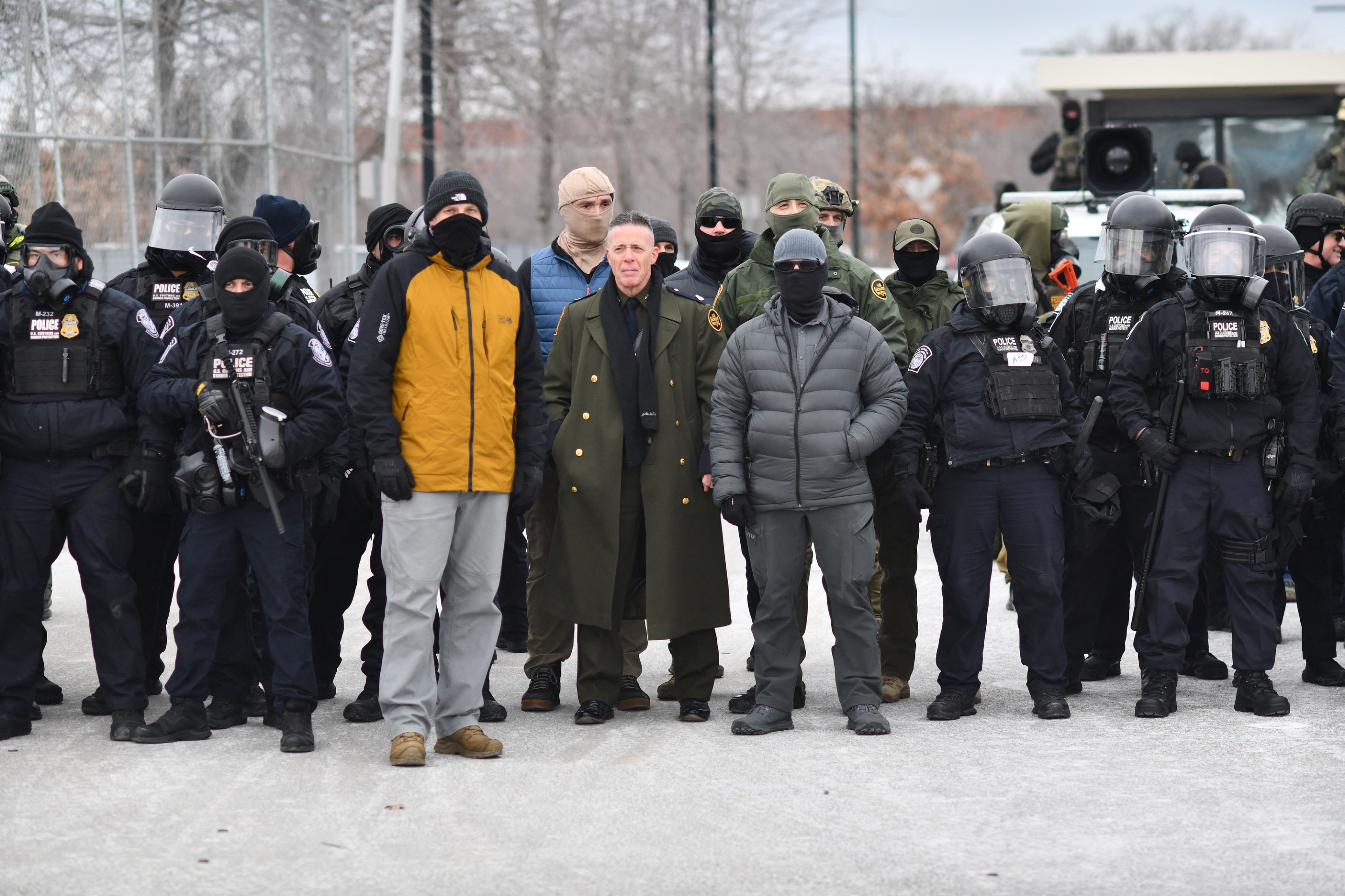
It’s been a minute since we’ve seen the likes of one Greg Bovino. The now-reassigned commander-at-large of the US Border Patrol catwalked into public awareness thanks to his personal style while overseeing ICE and Border Patrol agents on the streets of Minneapolis earlier this year.
Sporting an eye-catching olive green greatcoat that was just a little too close to Nazi chic for comfort, Bovino volunteered to serve as latest poster-/whipping-boy for the Trump administration’s ongoing playlist of throwback hits that also includes Elon Musk’s now classic “Roman salute.”
Bovino’s long military trench coat flapping in the Minneapolis breeze fueled all the predictable hysteria one expects from the liberal media during our era of theatrical #Resistance. Social media feeds were ablaze for a couple of days about yet another supposed recrudescence of fascism — even Germany got into the mix with their Der Spiegel hyperbolically accessorizing Bovino’s fit with “Nazi” gloss.
You probably heard this story told with a different emphasis than the one I’m giving here: Since 2015, the Year of the Golden Escalator, liberal pundits, podcasters, and posters have holstered the words “fascism” and “Nazi” more accessibly than an itchy-fingered gunslinger in a spaghetti Western.
In this climate, Bovino’s crypto-fascist turn as a supermodel sporting Nazi chic (never mind that the greatcoat in question dates back to the early 19th century and was widely deployed across the European continent, fascist and otherwise) is supposedly only the latest on-the-nose indicator that literal fascism is again on the rise, a specter haunting bottomless mimosa brunches from Cape Cod to Marin County.
If there is one common denominator across the political spectrum, it’s that everyone is awake to theater now. Nothing that hits our screens, not even the slaughter of our fellow Americans, hasn’t been framed for maximum visual flair and shareability.
But does the hypocrisy of the Chardonnay #Resistance really matter at the end of the day? After all, it would be a hard sell indeed to impute plausible deniability to Bovino’s frisson of authoritarian drag.
I won’t even try to make a case that our fashionable commander-at-large was blissfully ignorant that his brass-festooned greatcoat (to say nothing of the 1930s heritage haircut) wasn't communicating anything.
It’s obvious to anyone who’s been paying attention to the right’s provocations these past ten years that Bovino didn’t just accidentally put on a militaristic show with that coat. Yet, it’s also obvious that he not only knew precisely what he was doing, but why. If there is one common denominator across the political spectrum, it’s that everyone is awake to theater now. Nothing that hits our screens, not even the slaughter of our fellow Americans, hasn’t been framed for maximum visual flair and shareability.
My personal experience with the question of ‘to Nazi or not to Nazi’ gives me a more informed take than most on the Great Greatcoat Affair.
During the early days of my tenure with the alternative rock band Interpol in the 2000s, I myself dabbled — more than dabbled — in the “rich” rock tradition of Nazi drag. Unlike Keith Moon, who donned an entire SS uniform or Siouxie Sioux who accessorized her perfect punk look with an actual swastika armband, my own carefully crafted attempt at Nazi chic was more suggestive — though, admittedly, with the ensemble featuring polished combat boots, a sleek, black leather holster, a plain armband, and a striking Hitlerjugend coiffure, the “suggestion” was communicated through a megaphone.
It would stretch credulity if I insisted that I had no idea that my onstage costume wasn’t curated with the highest degree of attention to communicate something. The references I was making with this turn on that virtual catwalk were obvious. I even showcased much greater verisimilitude than Bovino.
As with Moon, facetiousness was meant as a clear sign that I and everyone else at the time knew what was really going on. I remember visiting my bespoke tailor one time and laughing after I’d come out of the dressing room decked out in one of his latest creations. “May I see your papers?” he inquired with a German accent delivered through a shit-eating grin.
Though our backgrounds, our politics and our job description are worlds apart, Bovino and I nonetheless have something in common: We both partook of the captivating allure of midcentury military chic knowing full well that a bunch of cameras were around the corner waiting to capture it all for posterity.
Of course, both of our fashion choices were already shopworn by the time we donned them, as “Fascinating Fascism,” Susan Sontag’s classic 1974 essay in The New York Review of Books reveals.
Yet, whereas Sontag’s analysis of the appeal of fascism emphasized its shared visual vernacular with sexual sadomasochism (something my stage attire was intended to theatricalize), Bovino’s seems less preoccupied with titillation than with provocation.
While it’s easy to imagine Bovino — like so many of his fellow MAGA mascots — is an actual Nazi-admiring fascist, the truth is probably less terrifying or even interesting. As with so many other politically motivated public figures (and, honestly, so many of us), he knows that spectacle, not actual politics, drives clicks. Those clicks are pre-political; and, sadly, they dominate our lives at the moment.
In our latter-day Debordian Society of the Spectacle, everyone is competing with everyone else for attention. Bovino’s display of muscular militarism can not be taken at face value. It should be seen for what it is (and was for Moon, Sioux, and me): a gimmick and a gambit.
In Subculture: the Meaning of Style, the English sociologist Dick Hebdige wrote about mods, rockers, Teddy Boys, Rastas, and other British music scenes of the 1970s. Hebdige’s exegesis of London punks has stuck with me the most, particularly his analysis of their deployment of the swastika. At one point, Hebdige quotes a “punk on the street” speaking with the kind of terse, uncomplicated logic one expects from a disaffected working class Brit: “Punks just like to be hated.”
I look back to my dalliance with Nazi chic as being of a very specific time and place, a context far removed from the present. It’d be in bad taste, and probably insensitive, for me to do today what I did back then.
The 2000s were a different time: no omnipresent cameras, no social media, no hashtags. In the intervening two decades, consciousness has been raised among the liberal class; similarly, the impulse to create a capital-S Spectacle has risen among the illiberal one.
Would that the consciousness of so-called progressives continued to higher spheres, we might be spared their obnoxious sermons; would that people like Bovino not bait them so expertly, we might be able to think about other things for a change.
A version of this commentary first ran in print in Gazetteer San Francisco Issue 2.