


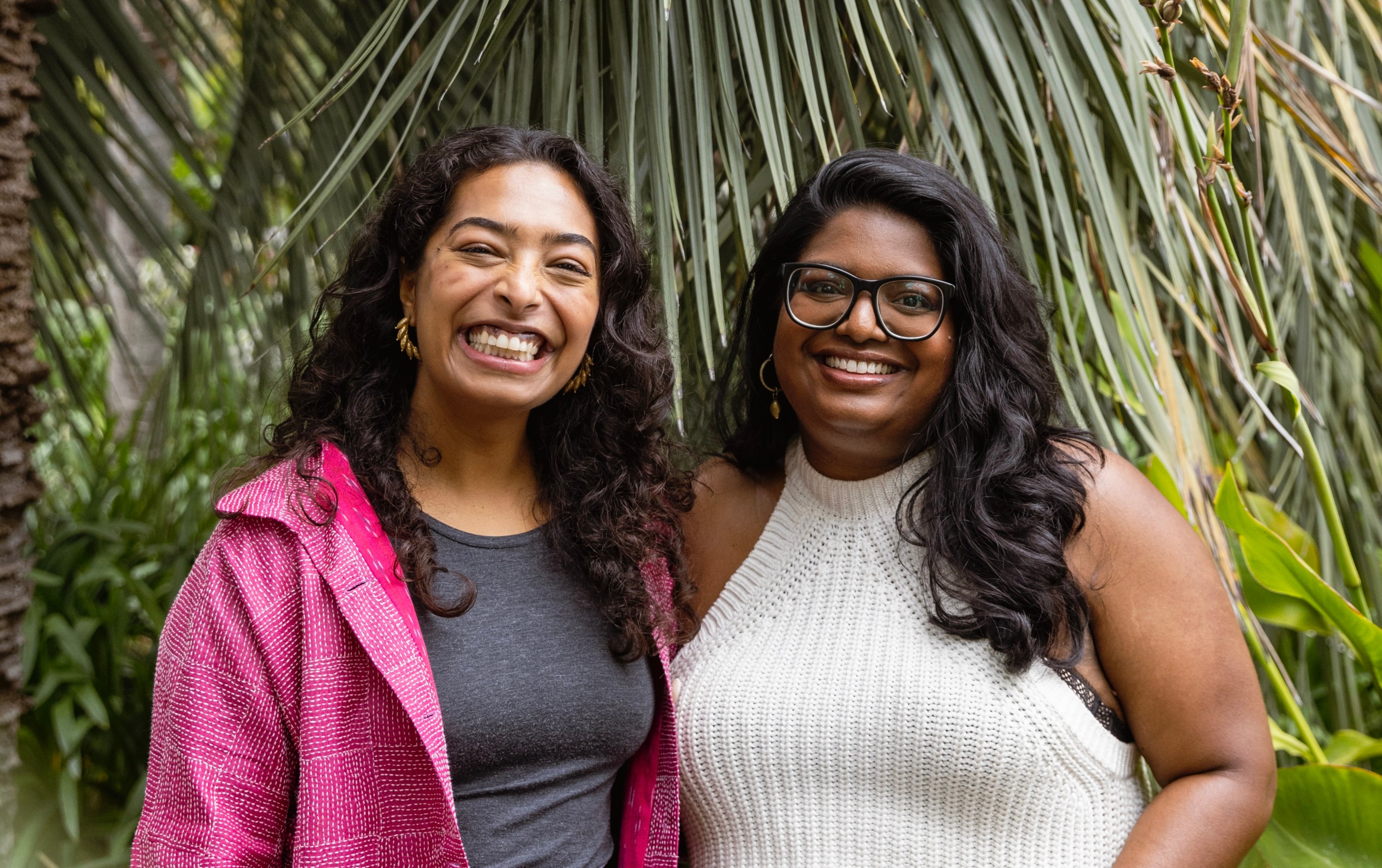
Sana Javeri Kadri, co-author with Asha Loupy of The Diaspora Spice Co. Cookbook, spends a quarter of every year in India meeting with the farmers who supply her Oakland-based heirloom spice company Diaspora Spice Co. So when the time came to travel the entire country researching what they say are never-before chronicled recipes for her and Loupy’s book, Kadri was prepared.
To create the cookbook, Kadri, Loupy, and photographer Melati Citrawireja spent four months travelling to farms in India and Sri Lanka, reaping inspiration and family recipes. As befits a company that sees spice farmers as partners, every entry in the cookbook credits both the region and the person from whom they learned the recipe.
Now in its ninth year, Diaspora pays its partner farms a premium roughly six times the commodity price.
Kadri hatched the idea for the spice company while working at Bi-Rite in San Francisco, and realizing that, while lots of attention was paid to the origins of coffee and chocolate, spices were still given the bulk commodity treatment. She booked a one-way ticket to Mumbai and began several months of market research and farm meetings. Eventually, from the basement of the queer Oakland co-op she inhabited at the time, Kadri founded Diaspora with one offering: Pragati turmeric. Diaspora now sells 30 spices grown by small, multi-generational farmers who use regenerative practices and are single-origin.
Kadri and Loupy will be appearing Thursday night at Omnivore Books on Food at 3885A Cesar Chavez St. in Noe Valley.
This interview has been edited for length and clarity.
How did the cookbook idea come about?
SJK: Most of the Diaspora super-fans here in the Bay know the names of our farmers. They know which festivals they celebrate, they know what they like to eat for breakfast. And this book in a way is an extension of that.
I wanted people to know how a third-generation pepper farmer cooks with pepper and how beautiful that can be. I wanted people to know how, like, in the wild cardamom forest of Kerala, you can make the most delicate fish curry using two or three spices. And that, like, spices in South Asian food are often seen as intimidating, but when you’re making fresh seasonal food, it doesn’t have to be. And that’s where Asha came in.
AL: I’ve always loved cooking since I was little and I knew that I wanted to be in food, but being in a restaurant kitchen was not at all something I was interested in. So, I worked in specialty food first. I worked at Market Hall Foods in Oakland for 12 years and ended up as one of their grocery buyers.
During that time I heard someone say, “Hey, there’s a woman and she’s bringing in turmeric.” When I tasted it, I really felt like I have not tasted turmeric like this before. Like, there was actual taste. There were citrus notes, there were earthy notes. It was bright and flavorful. And so I started cooking with the turmeric, and then also just tagging Diaspora and Sana [on social media], and we built our relationship that way. And then when Sana knew that she wanted to expand the catalog, recipes would become a huge part of that. So I joined in February of 2020 doing one recipe a month, and then later that year, joined in a recipe editor capacity and that led to the cookbook.
What was the recipe development process like for this book, taking dishes from across the world and localizing them for a Bay Area audience?
AL: When we were all traveling, I made a huge list of vegetables — like, all the vegetables that I could think of that you could buy in the United States — and we used that as a basis of what we wanted to learn with some of the farmers. What dishes might suit them best.
So we wanted to learn okra with our cumin farmers and then cabbage with another farmer, so we did have that thought process during our travels. What was a little bit surprising to me is there weren't that many substitutions we had to make when we were developing the recipes.
There were things like bottle gourd, which is just harder to find here, so we substituted cucumber in one dish and zucchini in another dish. But when we were in Manipur, which is in the northeast near the Burma border, there were fava beans at their farmers market! I was really excited because that’s my favorite vegetable — I’m always really excited when I see them at the Ferry Building, so seeing them on the other side of the world and that I would be able to make a recipe using them was very thrilling to me. But there wasn’t that much that we had to change in regards to what vegetables we were using because all of those vegetables are on the farms in India, too.
SJK: And people would never know that! They’re often like, “Oh like Indian food means heavy, greasy, chicken tikka masala and naan.”
AL: Exactly. And I feel like when developing the recipes, where we changed things was much more of a technical and technique-driven challenge because when we were on the farms, we were learning on open fire. Or it was like a pot that was buried in cow patties. And obviously, I’m not going to ask American cooks to go outside and make a fire and put a pot on it.
Also, none of the kitchens we went to had ovens, whereas in American kitchens, an oven is a staple. With one of Sana and my favorite dishes, which is a Kashmiri squash dip, they prepared the squash by pressure cooking it and then hung overnight so that all of the liquid would drain off. For us, we can just roast it.
What was your path through India? Like was it a big loop?
Kadri and Loupy began scribbling in the air with their fingers, laughing.
SJK: We were dealing with harvest seasons and when the best time would be to visit. I wish that we could have just started north and gone clockwise. But nay. And we were also dealing with about 40 different collaborators, who are all women with their own personal lives and work lives and farming-intense periods and chill periods where they could give us time.
We started in October in Kashmir and in Maharashtra. Then we took a break for a couple months over the holidays and then in January, we started in Gujarat, which is the center of India and then, boop! all the way down to a new country, Sri Lanka.
AL: Then Kerala.
SJK: Right, so then we went a little bit back up—
AL: I lose the plot after that.
SJK: On one travel day, we went from the bottom of the country, our pepper farm in Kerala, all very top of the country, to our garlic farm in the Himalayas. I think we had a 13-hour travel day. It’s very similar to like, starting in Brazil and ending in Alaska. That's how different we’re talking. It’s not like going from California to Colorado.
I remember eating dinner with this woman and being like, “Oh shit, we’re still on the clock.”
AL: I mean, that was a very comforting dinner. But I remember us taking a selfie and then later looking at it and being like, “Wow, we look tired.”
What are some of your favorite recipes?
AL: It's really hard to choose a favorite, but one I love and the one that I make a lot is this dish from Andhra Pradesh. What was really revolutionary to me was, they were taking the tomatoes and salting them and putting a little turmeric on them to pull out some of the juices. And then the tomatoes would be sun-dried for a little bit, but the juices that were left over were used to rehydrate the tamarind that was going to be part of the dish later. And so you were really getting every part of the tomato essence. And what is left is this really sunshiny, tangy, spicy, crunchy, jammy condiment.
As a tomato lover, I’m going to beeline to that recipe.
SJK: We’re tomato lovers. This book has a lot of tomato lover recipes. I think we came to a point where we said that we had to stop putting in burst tomatoes. We couldn’t do that anymore. That couldn’t be our crutch.
How has touring and promoting the book been?
SJK: We’ve spent almost six years on this project, so it still feels very surreal to see the book out in the wild and have my friends take pictures in bookstores and that it’s in people's hands. We spent so much time and effort on this book and went through so many phases of our lives during it.
I started on this book when I lived in Oakland with my ex-girlfriend and my dog of seven years. By the middle of this book, I was living out of a suitcase between India and my grandparents’ house in Berkeley. And the book has come out when I have a fiance and two stepdaughters in Menlo Park. I think Asha has the same complete change of life during this effort.
And, it was really hard. We’re building an archive of recipes that have never been archived before. So when we were trying to find an example of a recipe, has anybody else written this down before? There was nothing to look at. You know? You start to feel crazy — I was like, was that cabbage salad like 3 feet tall or are we just crazy?
Has this inspired you to do another book?
AL: My manuscript is due on April 30th.
Oh my god!
AL: So I just added another layer by being on this book tour while working on finishing the manuscript. It's called Dinner Season and will be out in June 2027.
SJK: I will not be working on another book for a long time!