


Since 2007, an ordinance has mandated that take-out foodware in San Francisco must be either compostable, recyclable, or reusable.
20 years later, most to-go orders that move throughout the city are packed in what appears to be compostable foodware. Even things that resemble plastic, like forks, cold drink cups, and bags, are labeled “compostable” or “biodegradable” and often disposed of in green waste bins. But many supposedly compostable foodware packages are sorted out down the line and wind up in landfills. The reasons for this are complicated.
For starters, bio-plastics such as plastic-like utensils and clear drink cups (even those labeled as compostable), should actually be directed to the landfill, according to Recology, the company that manages all of SF’s waste. Per Recology’s guidance, only paper, wood, and natural fiber-based foodware materials such as chopsticks, paper plates, and bamboo utensils should go in the green waste bins. That leaves out your “green” iced coffee cup and bio-plastic fork.
In California, all compostable plastic and plastic-coated packaging must demonstrate 90 percent biodegradation within 60 days. “While we try to compost all the items labeled as ‘compostable’ that we receive, not all of them fully break down,” explained Robert Reed, a public relations manager at Recology. Bio-plastic utensils, if they make it to the composting facility, are typically distorted by the heat generated within the composting process and then get sorted out.
Not only do the bio-plastics perform inherently differently than organic matter during the composting process, but if the compost is intended to be used to grow food and improve soil health, farmers and scientists say it would not be safe to include bio-plastics. The life cycles of bio-plastics are fundamentally different than organic material such as food scraps and natural paper fibers.
There’s a small exception like polylactic acid (PLA), a plant-based biodegradable plastic that is made from renewable sources such as corn starch or sugarcane. Recology accepts this into its compost feedstock, as it degrades into lactic acid, a naturally occurring substance.
For consumers looking for answers on what to put where, the messaging can be confusing.
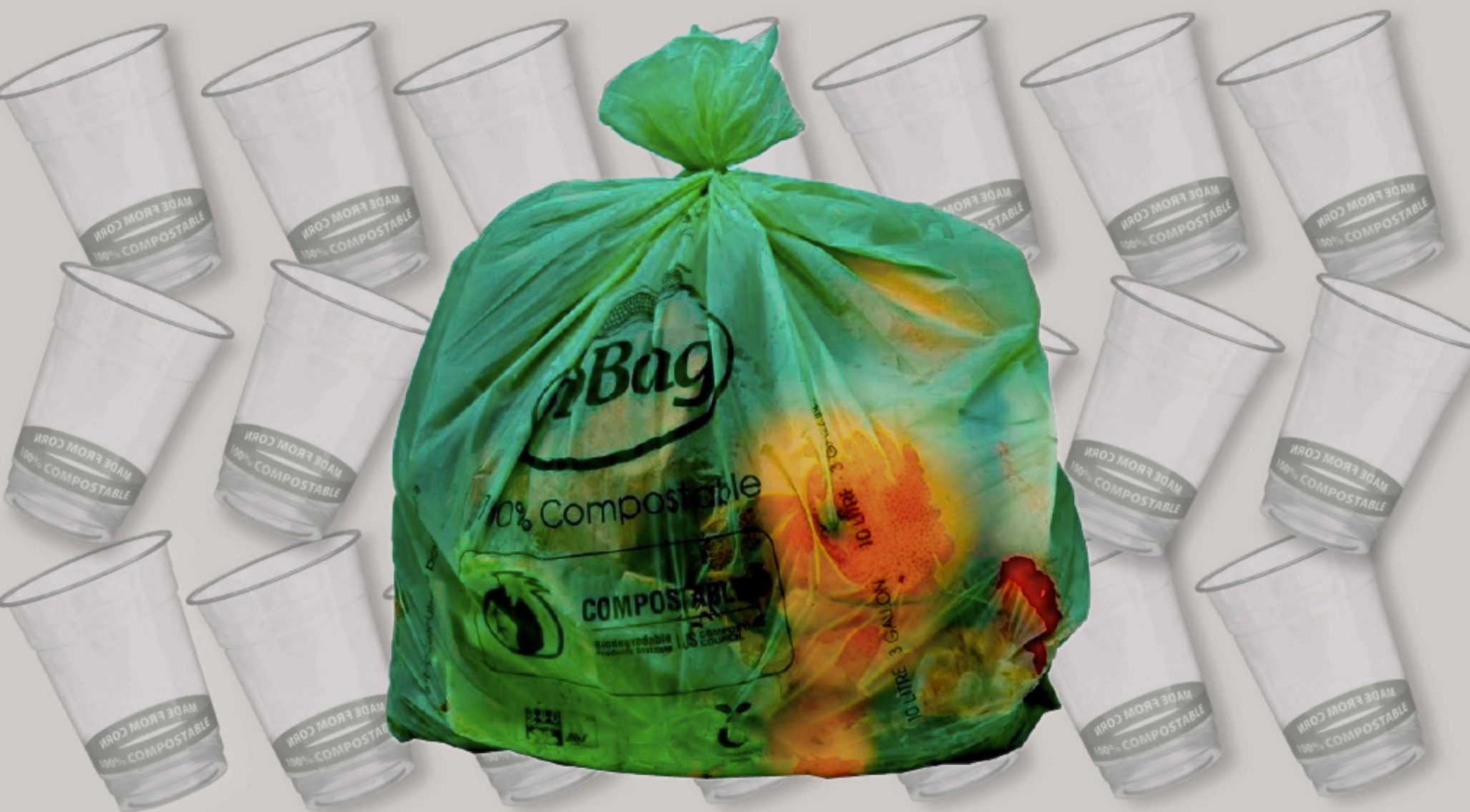
Recology clearly states that any plastics labeled as “biodegradable” should go to the landfill bin, though the SF Environment Department (SFED) advises residents to include containers like bags, cups, plates, bowls, and utensils labeled as “compostable” in the green waste bin, even showing an image of the clear bio-plastic cup that Recology says belongs in the landfill.
SFED was not clear on why they advise that bioplastics be put in the green bin if Recology does not compost them.
Adding to the confusion is the prevalence of greenwashed packaging materials distributed to SF businesses, which undermines the city’s zero waste goals.
Many green waste bags, for example, are not actually compostable. Recently, a small grocer in the city was reported to the SFED for selling green “organic” bags that were actually just plastic.
One of SFED’s objectives is to ensure that businesses are purchasing correctly classified packaging and foodware and refer to products certified by the Biodegradable Products Institute (BPI). When it comes to compliance, SFED cannot take punitive action, but they can attempt to steer businesses and distributors away from greenwashed products.
The same goes for cups, clamshells, and utensils; with hundreds of different brands and products on the market, food businesses buying the takeaway foodware and the consumers taking them home can find themselves duped into thinking something is greener than it is.
“They say ‘We’re earth friendly,’ but what does that even mean?” asked Hilary Near, SFED’s senior zero waste coordinator. Near speculates that Californians are an easy target for this sort of deceptive packaging: “I think we're a little bit more susceptible to that because we are early adopters. As it becomes more and more expensive to comply, more and more products will try to get around that.”
A 2024 study from the Closed Loop Partners Composting Consortium found that 85 percent of contamination at US composting facilities is from conventional plastic. Widespread contamination of plastics, glass, and other materials in green waste bins has prompted more intense screening processes, causing many materials to be sorted out of the compost stream and redirected to the landfill.
Any materials resembling plastic are often redirected during a pre-sorting process at West Wing Organics, at 501 Tunnel Road, before the green waste makes its journey to the Blossom Valley Organics composting facility in Vernalis.
“In order to be able to return [the finished compost] to farms and residents, we have to try and get those contaminants out,” said Near. “A lot of times, if it acts like plastic, it’s not going to the composter. It's not unique to our program.”
At West Wing, a large screen called a trommel sorts out anything larger than 4 inches. Near says organic material like food scraps and yard trimming often break down in transit and make it through the screen, as do bamboo utensils, paper products, and green bags. Larger objects, including anything from plastic containers to tennis shoes, are caught by the trommel.
Green waste bags, despite being such a large culprit of contamination, are still encouraged by SFED with support from Recology because they worry a messier, less convenient process could lead to even less participation in the mandatory municipal green waste program.
“We saw the potential to move more tonnage. That's the whole point: We want to make it easy for people to not contaminate the green bins and reduce ‘ick’ factor to create more ease. People are used to convenience culture. So, we included these with whole participation from Recology,” said Near.
The goal right now is to encourage residents and businesses to sort their waste as accurately as possible. If the green bags (even slightly un-green ones) help, they’ll allow it and deal with it downstream.
Lauren Turk, an Oakland resident and the founder of CompoSTARS, a compost impact tracking and education platform, says the messaging may appear muddled to the consumer, but municipal and large-scale composting is still in an early phase.
“There's the adage of like, don't let perfect get in the way of good,” she said.
When it comes to diverting food scraps, yard trimmings, and natural fiber-based materials from the landfill, something is better than nothing; in fact, composting these items alone has a massive impact on SF’s waste reduction. In the US, food is the single most common material sent to landfills, comprising roughly a quarter (24.1%) of all municipal solid waste, according to the Environmental Protection Agency. With yard trimmings, wood, and paper/paperboard added to the food waste, these organic materials alone comprise 51.4 percent of municipal solid waste in landfills.
State law AB 1201, passed in 2021, mandates that products labeled “compostable” and sold in the state of California must be in compliance with the US Department of Agriculture’s National Organics Program. That program prohibits bio-plastics, even certified compostable ones such as PLA, from compost inputs. After a petition from BPI to reconsider the rules, USDA’s National Organic Standards Board in January voted unanimously against including bio-plastics within compost feedstocks.
Last year CalRecycle, the state agency charged with implementing State law AB 1201, extended its implementation deadline to June 30, 2027. Until then, Recology will continue accepting PLAs and consumers will keep throwing them in the green bin.
“Inputs are outputs. I think this is a life philosophy, but it's especially true when it comes to composting,” said Turk.