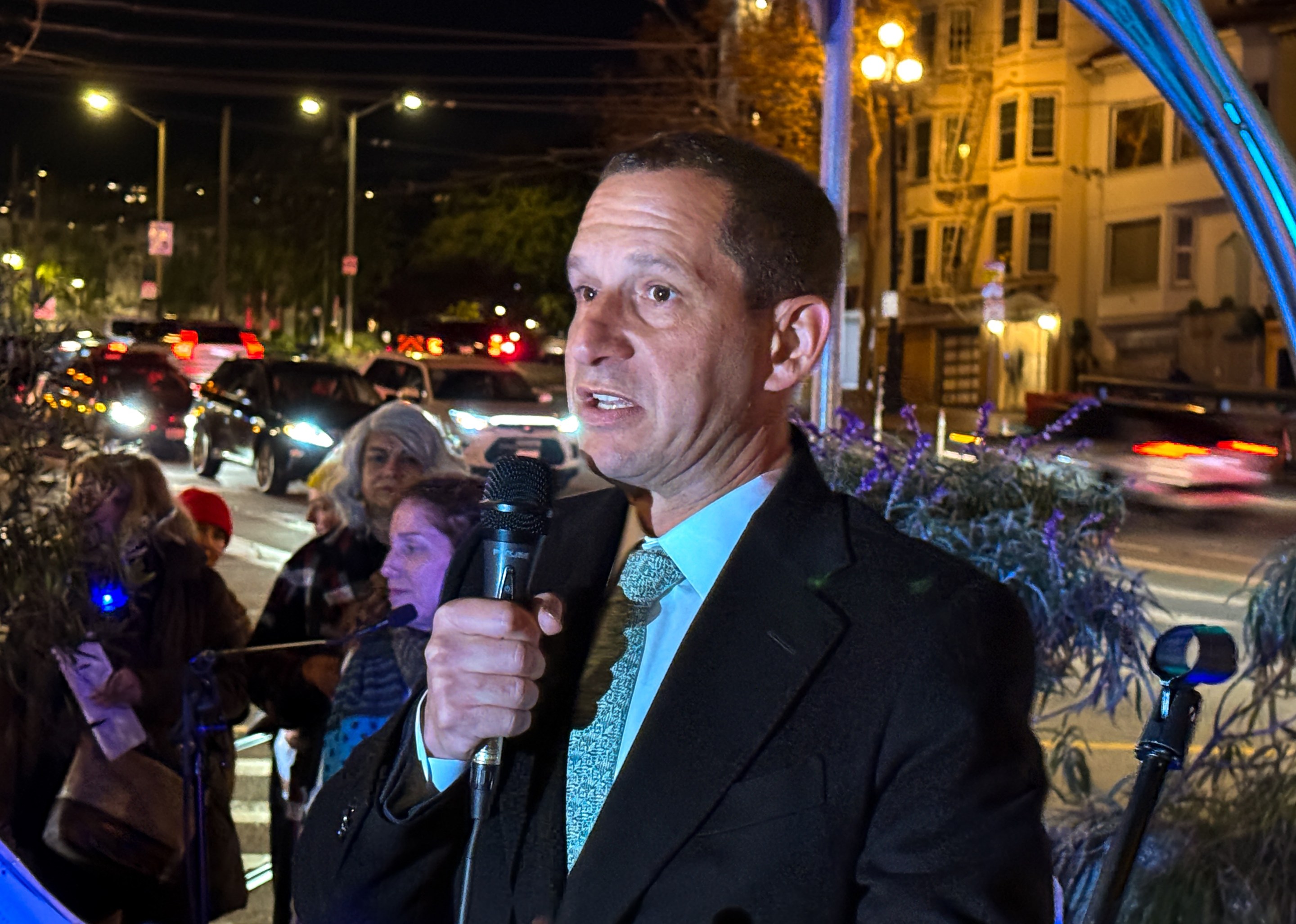

Rabbi Mychal Copeland was on the corner of 17th and Market Streets Monday evening to welcome about 200 people, including San Francisco Mayor Daniel Lurie, to a menorah lighting ceremony in the Castro. Of the people and groups she thanked for being there, officers from the San Francisco Police Department were near the top of the list.
“You’re everywhere around the perimeter, and we are so grateful to each and every one of you for coming out here with us tonight,” Copeland said to more than a dozen cops.
The SFPD added more officers to the event after a mass shooting at a Jewish celebration of the first day of Hanukkah in Sydney, Australia, killed 15 people the day before. SFPD Captain Amy Hurwitz, who was at the Castro celebration, confirmed to Gazetteer that the shooting in Sydney was the reason for the increased police presence. “We’re very cognizant of the threat to the Jewish people, and we’re paying attention,” she told me.
Copeland, who serves as rabbi at Congregation Sha’ar Zahav, told the crowd that she wanted to “be in a space of pure joy,” and for the gathering to be a Hanukkah sameach, Hebrew for joyful. At the same time, the rabbi acknowledged, “we are holding a lot of pain right now.” In addition to the mass shooting in Sydney, she mentioned the shooting at Brown University.
Copeland said she understands some Jews are “are feeling a little reticent” about displaying their lighted menorahs in the window but struck a defiant tone toward the festive. “We are here in public tonight, and we are loud. So be loud! Can we be loud?”
The crowd responded with a modest cheer.
According to Copeland, Jewish people are commanded to demonstrate Hanukkah joy. A big point of the holiday, she told the crowd, is to “advertise the miracle of us being here.” Unlike on the Sabbath, when Jews draw the light and warmth from burning candles privately, on Hanukkah they should “push the light out.”
“Because the street needs it,” Copeland told the crowd. “Our world needs it. We bring that out to the world in every way we possibly can. So in any way that you can this season, I encourage you to do that.”
Jewish San Franciscans, like anyone, have different ideas about how loudly they should advertise their faith or identity. Near to one extreme, closer to Copeland’s exuberance, would be the young Adam Sandler’s performance of his “Hanukkah Song” on Saturday Night Live in 1994. On the other end of the spectrum are the 42 percent of American Jews who, according to an October Washington Post survey, said they avoid displaying anything that identifies them as Jewish because of their fear of antisemitism. Israel’s siege of Gaza has only complicated the self-examination. A survey by the Pew Research Center from April 2024 showed that nine in ten American Jews think antisemitism has risen in the US after the Israeli invasion of Gaza that followed Hamas’s October 7, 2023 attack on Israel.
The speakers in the Castro were, at least publicly, showing their pride. “Not everyone here is LGBTQ, but I do love being around a bunch of queer Jews!” state Senator Scott Wiener told the crowd. “With everything happening in the world, I have never been prouder to be a Jew than I am right now.”
District 8 Supervisor Rafael Mandelman relished the opportunity to introduce Lurie. “I love our Jewish mayor!” he announced. “Daniel Lurie is such a mensch!”
Lurie was more solemn. He lit the candle on the menorah, which really meant screwing in a small lightbulb. He said he was heartbroken and devastated by what happened in Sydney and Providence. The night before, his father Brian Lurie, a rabbi, pointed out that in Sydney it was Ahmed el Ahmed, a Muslim, who stopped one of the shooters.
“It was a non-Jew that saved a lot of Jews,” Lurie said. “And we have to, as a community here in San Francisco, and around the world, we have to take care of each other, whatever your religion, whatever your background.”
After Lurie finished, Copeland, wearing a rainbow yarmulke, spun a giant dreidel that came up to her waist as a traditional song played. “Everybody should get a chance with the giant dreidel!” she said. As the songs continued, Lurie joined with a moderate amount of enthusiasm.
During a brief conversation, Lurie told me he credits his father for instilling a deep sense of Jewishness in him. His dad, a former assistant rabbi at Temple Emanu-El, and longtime executive director of the Jewish Community Federation, imparted “strong Jewish values, not as much religion, but values,” Lurie said. Does he remember and observe those lessons, and Judaism, today? “Always,” he said.
I asked about what Copeland said of earlier, the reticence about expressing joy and one’s Jewishness loudly. Did he understand the desire to lay low and not celebrate too loudly out of fear?
“Absolutely,” Lurie said. “I’ve never had that attitude, I know others have it. There’s no judgement. But when your dad is a rabbi, you don’t think ‘I’ll be quiet about my Judaism today,’” Lurie said.
“I’ve been proud of my religion, always, and proud of the values of my religion to take care of people, of everybody. I was raised to believe if you take care of one person, you take care of the world. That’s a Jewish value, but it’s a human value, so I’ve never run from it.”
I asked the mayor if he thinks of San Francisco as a Jewish town. I told him I don’t, having lived in places like New York and Los Angeles that have more defined Jewish communities and neighborhoods.
“I know what you’re getting at,” Lurie said, adding that he grew up here and attended Sunday school at Temple Emanu-El. The city and Jewishness are “just part of me,” Lurie said. “So maybe I have a different experience growing up here.”
Our interview over, the mayor disappeared behind a group of police officers and police trucks. Captain Hurwitz stood surveying the lingering crowd.
Supervisor Mandelman had referred to Hurwitz in his speech as the “Jewish godmother in the San Francisco Police Department — she looks after the Jews.” As Hurwitz explained it to me, she serves as the police chief’s liaison to the Jewish community. The SFPD has officer liaisons for the city’s other groups, including Muslim, African American, and Asian communities. “You name it, we’ve got it,” she said.
Talking with her, Hurwitz agreed emphatically with me that San Francisco does not feel like a traditionally Jewish town. “I was told it’s because the Jews here have been here for a really, really long time, and they’ve just assimilated,” Hurwitz told me. One example that immediately came to my mind, of course, was Levi Strauss, whose family the mayor joined when his mother, Mimi Haas, married Peter E. Haas, a Levi’s heir.
“You know, I’m a New Yorker,” she said. “It’s a different kind of Jew, I guess. Maybe we’re louder, more obnoxious, I’m not sure. Or maybe that’s just me,” she added, laughing.
I asked her if she took pride in the fact that San Francisco has a Jewish mayor. “You know, it means more to me that he’s a really good mayor,” Hurwitz said. “That is the thing that is most striking about him, and the Jewish part, is secondary. I’m just psyched that he’s our mayor.”